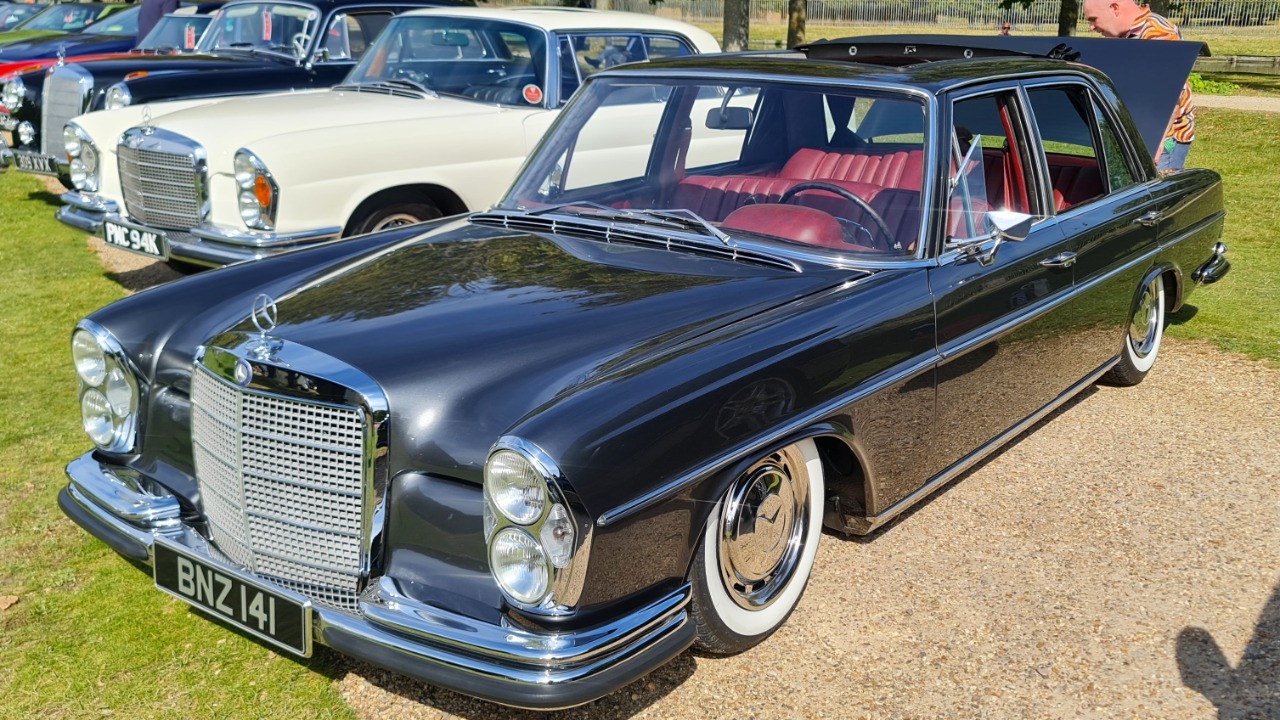
The 1972 Mercedes-Benz 450SEL did not arrive as a plaything for enthusiasts. It was engineered as a rolling statement of power, a car meant to glide up to embassies, ministries, and boardrooms and silently announce who was in charge. From its proportions to its technology, it was built to project authority on behalf of the people sitting in the back as much as the one holding the wheel.
When I look at the 450SEL and its later 6.9 variant, I see a company using engineering to codify status. The car’s size, its hushed speed, and its almost obsessive focus on comfort were not accidents, they were tools. In an era of political tension and economic shocks, Mercedes and Benz turned their flagship into a kind of mobile office for those who needed to look unflappable in public.
The W116 as a new language of power
By the early 1970s, Mercedes and Benz wanted a flagship that did more than replace the old SEL sedans, they wanted a car that would define what top-tier motoring looked like for governments and executives. The W116 platform, which arrived as the new S-Class, was conceived as a formal, almost architectural shape, with a long wheelbase, upright glass, and a stance that made even a casual observer understand this was the senior car in any parking lot. The 450 designation at the top of the range signaled that this was the serious one, the car for people whose decisions affected other people’s lives.
That sense of hierarchy is clear in how the W116 line was positioned as the “mighty” S-Class from Stuttgart, with the 450 SEL sitting as an expensive, range-topping saloon that crowned the series and set the tone for everything below it in the Mercedes portfolio. Contemporary accounts describe the W116 as the respected Stuttgart flagship, and the long-wheelbase 450 SEL as the car that fully expressed that ambition, a machine that made its owners look as if they belonged in the first row of any motorcade, not the second or third, which is exactly how a car focused on authority is supposed to behave. You can see that intent in the way the Mercedes W116 S-Class was introduced as a mighty, expensive range-topping saloon from Stuttgart.
From 450SEL to 6.9, authority gets muscle

When the 450SEL first appeared, its mission was to be the calm, confident top of the tree, but Mercedes and Benz quickly realized that some customers wanted their authority expressed with more force. That is where the 450 SEL 6.9 came in, taking the already imposing long-wheelbase shell and pairing it with a massive V8 that turned the car into a high-speed executive express. The numbers themselves, 450 and 6.9, became shorthand in certain circles for a very specific kind of power, the kind that could cross a continent in a day while the person in the back reviewed briefing papers.
Everything about the 450 SEL 6.9 was calibrated to reinforce that impression. It was described as Powerful, extremely comfortable, and prestigious, a high-end power saloon that impressed with comfort and performance in equal measure, which is exactly what a senior official or chief executive needed from a car that might spend as much time idling outside a summit as it did storming down an autobahn. The way the 450 SEL 6.9 was introduced, with its 450 badge and its 6.9 engine capacity, underlined that this was not just another luxury sedan but a deliberate evolution of the SEL idea into something that could dominate the fast lane as confidently as it dominated the valet line, a point underscored in period descriptions of the Powerful 450 SEL 6.9.
Comfort as a tool of control
Authority is not only about speed or size, it is also about composure, and the 450SEL treated comfort as a strategic asset. The long-wheelbase SEL shell gave rear passengers generous legroom, turning the back seat into a working space where a minister or CEO could read, dictate, or negotiate without feeling the road. In the 6.9, the hydropneumatic suspension went further, isolating occupants from rough surfaces so completely that the outside world felt slightly distant, which is exactly how many power brokers prefer it.
That obsession with comfort shows up in how the 450 SEL 6.9 was praised for delivering the same level of refinement as its lesser siblings while adding far more performance, a combination that made it especially appealing to people who wanted to arrive fresh after long drives. Enthusiasts later noted that what added to the appeal of the 6.9 was the way it exerted all of this performance while still delivering the same comfort, a trait that helped keep surviving examples in pristine condition as they moved from official fleets into private collections, a pattern reflected in owners discussing What made the 6.9 so appealing.
Technology that quietly served the driver
For a car aimed at people who valued control, the 450SEL’s technology was designed to make the driver’s job easier without drawing attention to itself. One of the most telling examples was the original cruise control system, which used an electro-mechanical actuator around the throttle managed by a control unit that compared the set speed with the actual speed and adjusted the throttle accordingly. This was not sold as a gadget, it was framed as a way to maintain steady progress on long journeys, reducing fatigue for the chauffeur and keeping the person in the back undisturbed.
The way that system worked, with its focus on smoothness rather than drama, fit perfectly with the car’s broader mission of effortless authority. It turned the 450SEL into a car that could hold a precise pace on the autobahn or a long A-road, letting the driver concentrate on traffic and security rather than constantly modulating the throttle, which is exactly the kind of quiet assistance that powerful clients expect from their tools. That philosophy is captured in technical descriptions of how the electro-mechanical cruise control compared set and actual speed and adjusted the throttle as a luxury convenience.
Authority in an age of crisis
The 450SEL’s focus on authority becomes even clearer when you place it against the backdrop of the 1970s energy shocks. When OPEC member states limited crude oil production and the price of petrol and diesel soared, many carmakers scrambled to downsize and economize. Mercedes and Benz did improve efficiency, but they also pressed ahead with the 450 SEL 6.9, a car that openly prioritized performance and comfort over frugality, signaling that there would always be a market for a true automotive top class even in lean times.
That decision was not reckless, it was calculated. By continuing to offer a large, powerful SEL at the top of the range, Mercedes and Benz reassured their most influential clients that their needs would still be met, even as the rest of the world adjusted to higher fuel prices. The company framed the 450 SEL 6.9 as part of the automotive top class, a car that justified its appetite with its capabilities and its role as a tool of state and corporate power, a stance that is evident in period commentary on how OPEC’s production limits and fuel prices shaped the market while the SEL held its place in the automotive top class.
How it felt from behind the wheel
Authority cars are often judged from the back seat, but the 450SEL also had to convince the person driving it, whether that was a professional chauffeur or an owner-driver. Accounts from racers and journalists who later sampled the 6.9 describe an imposing machine that could be hustled with surprising ease, a car that combined its mass with a sense of control that inspired confidence. One such driver, THE RACER VIEW JOHN BOWE, spoke of the 6.9 as an imposing machine and compared it favorably with its lesser siblings, noting that if he were to own one, it would be the 6.9, which tells you how compelling the package felt even to someone used to competition machinery.
On fast roads, that character translated into a kind of discreet pace that suited the car’s image perfectly. Reports from wide open A-roads around Goodwood describe how Yet on those stretches, the 6.9 could maintain startling speed with only the tiniest adjustment of the throttle, its hydropneumatic suspension and long gearing allowing it to cover ground quickly without ever feeling rushed or unruly. That blend of composure and speed is exactly what you want in a car that might need to move a cabinet minister or a CEO swiftly and safely, a point that comes through clearly in reflections on how Yet on the wide open A-roads around Goodwood the 6.9 maintained discreet but startling pace.
The 450SEL’s lasting status signal
Half a century on, the 450SEL and especially the 6.9 still carry a particular charge when they appear at auctions or in collections. Enthusiasts talk about them not just as classic luxury cars but as artifacts of a time when engineering and status were tightly intertwined, when a long-wheelbase sedan with a big V8 and a subtle badge could say more about its owner than any press release. The fact that the 6.9 is still described as one of the world’s greatest cars, with its 6.9 figure called out explicitly, shows how deeply that reputation has stuck in the enthusiast imagination, as seen in features that frame the 450SEL 6.9 as one of the world’s greatest cars.
Even standard 450 SEL models from later in the decade are still treated as something special, with sellers emphasizing that the W116 Design was the Flagship sedan for Mercedes Benz starting in 1972 and that the initial designation was 450, details that underline how the car’s identity was built around its role at the top of the range. When I see a 1978 Mercedes Benz 450 SEL offered today, I do not just see a vintage sedan, I see a carefully engineered symbol of calm, confident power, a car that was always meant to glide at the front of the convoy, as reflected in listings that describe the 1978 Mercedes Benz 450 SEL Flagship Design and its 450 designation as the flagship sedan for Mercedes Benz starting in 1972.
Why the 450SEL still feels authoritative today
When I try to explain why the 1972 450SEL feels so steeped in authority, I keep coming back to how deliberately Mercedes and Benz aligned its engineering, styling, and positioning. The long wheelbase, the restrained design, the focus on rear-seat comfort, and the quiet but advanced technology all served the same goal, to create a car that made its occupants look and feel in control, even when the world outside was volatile. In that sense, the 450SEL was less a product of its time and more a tool for managing it, a way for leaders to move through an unsettled decade without showing strain.
That is why the car’s legacy has outlasted the specific politics and economics of the 1970s. The idea that a vehicle can project calm strength through engineering and design is still very much alive in modern S-Class models, but the 450SEL and its 6.9 sibling captured that idea in a particularly pure form. They were built for people who needed to look unflappable, and even today, when one glides past, it still carries that same quiet message: someone important is on board, and everything is under control. The way enthusiasts and historians look back at the 450 SEL 6.9, noting that Everything about the Mercedes Benz 450 SEL 6.9 screamed legend and linking it to earlier cars like the SEL 6.3 with 250 horsepower, shows how clearly that intent comes through decades later, as seen in retrospectives that emphasize how Everything about the Mercedes Benz 450 SEL 6.9 screamed legend from the start.