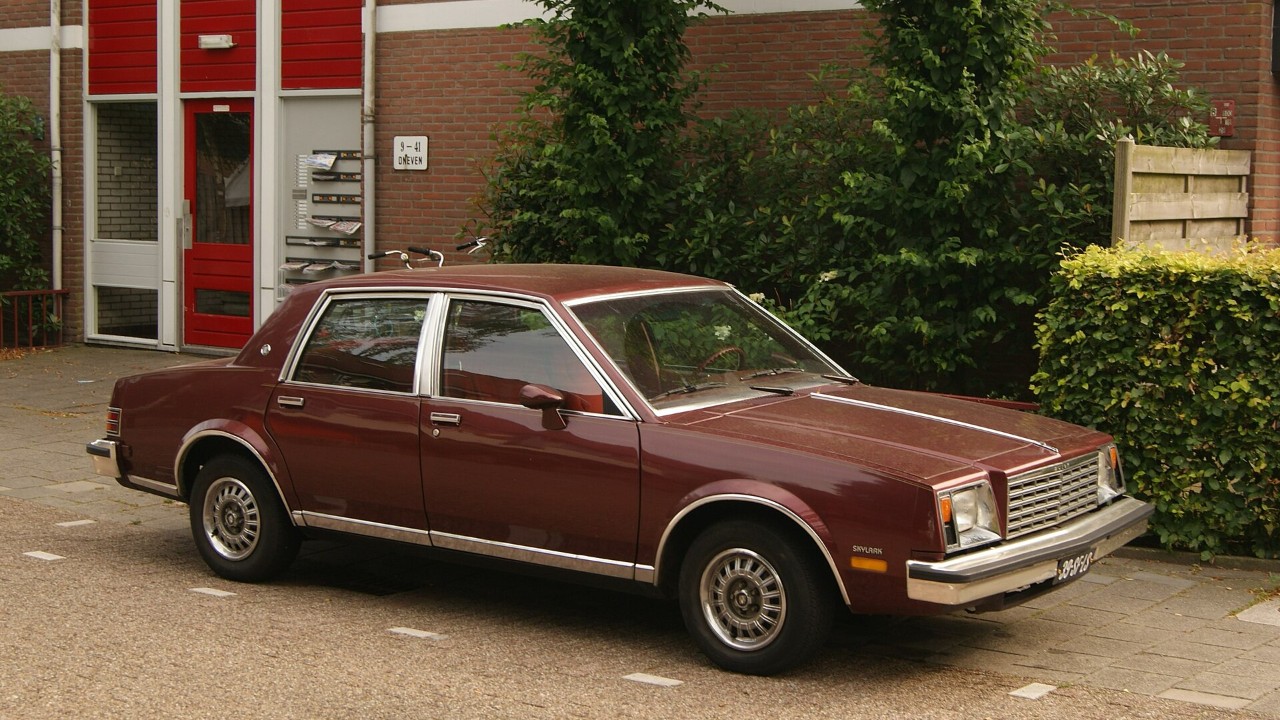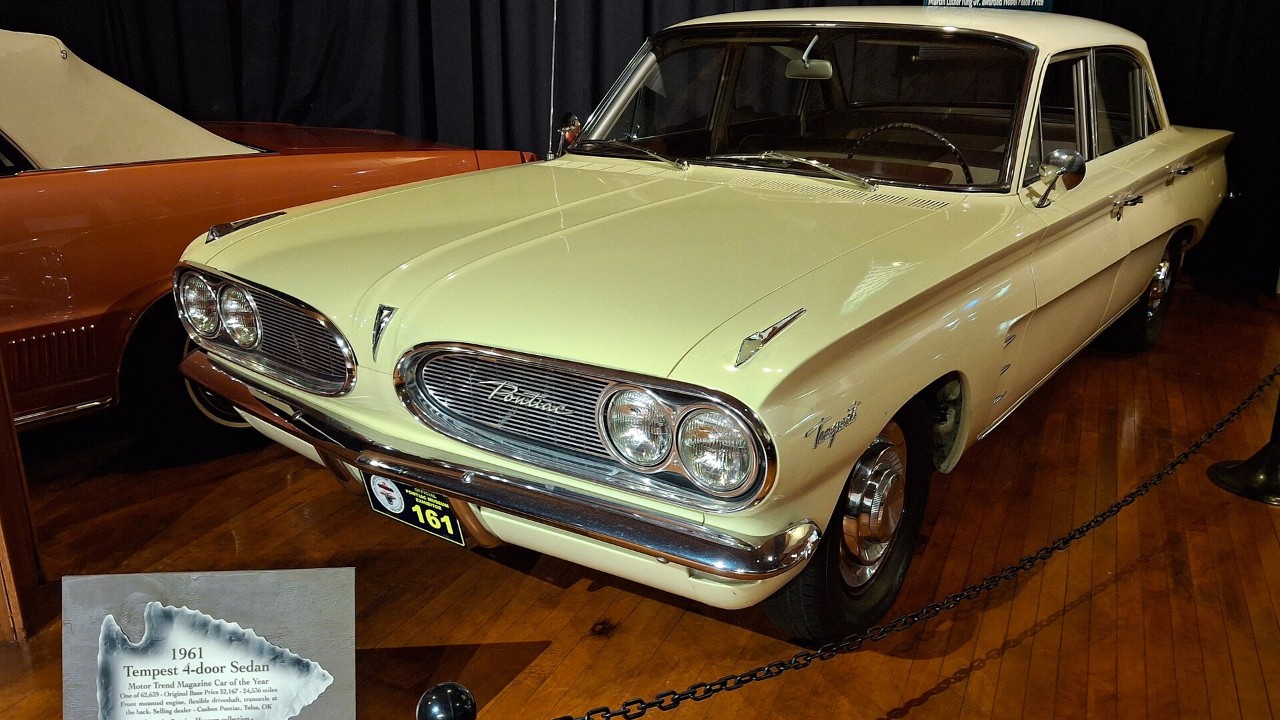
The 1961 Pontiac Tempest rope drive is one of the strangest solutions Detroit ever sold to the public. Instead of a conventional tubular driveshaft, an automatic Tempest turned its rear wheels through a solid steel shaft just 0.65 inch thick. Workers bent that shaft into a gentle arc of almost three inches during assembly, and it worked.
Pontiac had good reasons to try something this odd. Its new compact had to share hardware with the Chevrolet Corvair, yet Pontiac wanted an engine in the front. The answer put the engine up front, the transmission at the back, and a thin, curved shaft in between.
Here is how Pontiac made that shaft, why it bent, and why it didn’t snap.
Why Pontiac needed a curved driveshaft
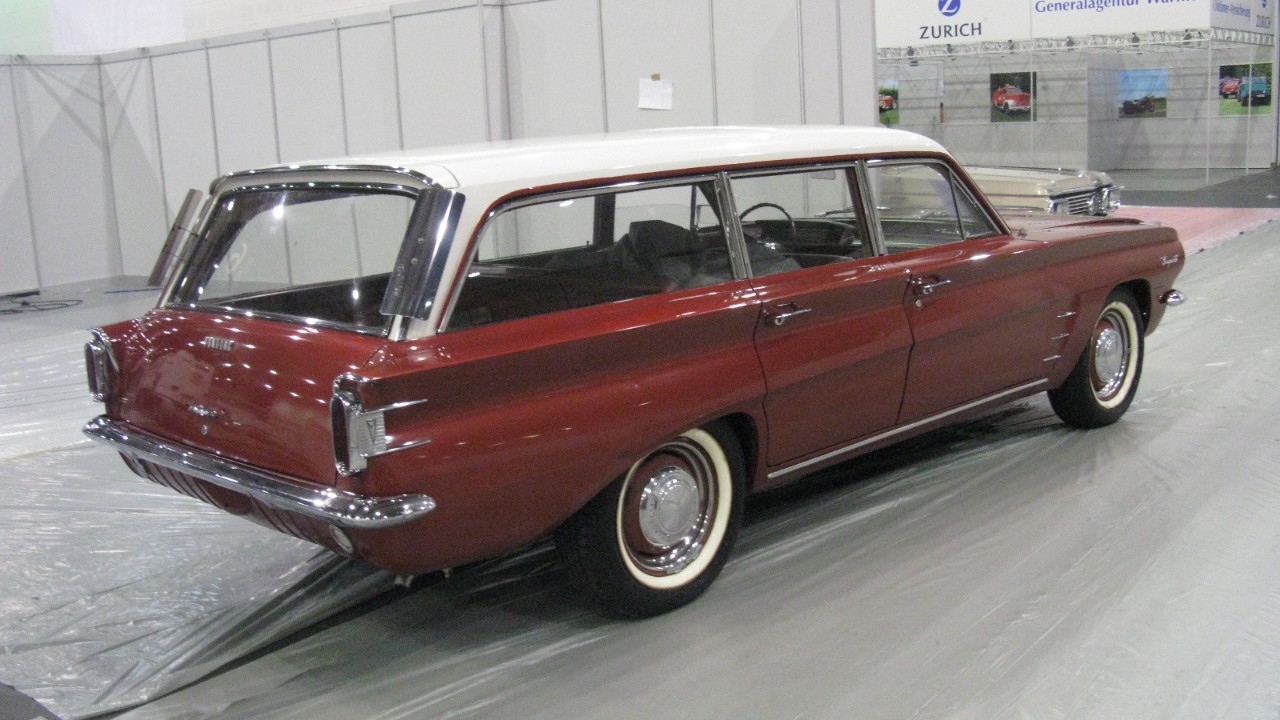
The Tempest grew out of GM’s X-100 compact program, which required the senior compacts to use Corvair-derived mechanical parts. According to Ate Up With Motor, Pontiac had no extra money to make its car different. Even so, John Z. DeLorean, then head of advanced engineering at Pontiac, wanted it to be more than a badge-engineered Corvair.
His solution was a front engine with a rear transaxle. That kept the Corvair’s transaxle and swing-axle rear suspension but moved the engine to the nose. However, the layout needed a long shaft to link the two ends. Ate Up With Motor argues that Pontiac’s talk of handling benefits was mostly rationalization, and that cost and shared parts drove the decision.
The idea itself wasn’t brand new. Mac’s Motor City Garage credits DeLorean with originating the flexible shaft and says GM tested it on 1957, 1958 and 1959 full-size cars. Engineer Bill Collins then saw the chance to apply it to the Tempest. The main goal, the same history says, was a flatter floor in the passenger cabin.
How the Pontiac Tempest rope drive worked
The shaft was a stiff, solid length of steel, not a hollow tube. Pontiac made it from SAE 8660 nickel-chrome-moly alloy. Then the factory ground it, shot-peened it, magnafluxed it and added a scratch-resistant coating, Mac’s Motor City Garage reports.
Size depended on the transmission. In cars with the automatic, the shaft measured 0.650 inch across and 87.25 inches long. Manual cars used a thicker 0.750-inch shaft that was 5.25 inches shorter, because a separate clutch shaft took up room in the bell housing.
The bend came during assembly. When workers bolted the shaft in at its flanges, it bowed downward almost three inches. That curve forms a radius of about 36.5 feet. In other words, a full circle of the same curve would measure nearly 73 feet across. Ate Up With Motor adds that the engine and transaxle tilt about 11 degrees in total to meet the arc.
Around the shaft sat a stamped steel torque tube, 76.2 inches long. Ate Up With Motor describes two rubber-isolated ball-bearing assemblies inside it. Meanwhile, Mac’s Motor City Garage stresses that the tube’s real job was to keep the engine and transaxle aligned and to hold the shaft in its curve.
Why the bent shaft didn’t break
A bent shaft sounds like a recipe for vibration. In practice, the curve helped. Ate Up With Motor explains that bowing the shaft shifted a resonance out of the car’s operating range. Mac’s Motor City Garage makes the same point, noting that the arc put the shaft’s critical speed above the engine’s working speeds.
The engine made that job harder. The Tempest’s base engine was the Trophy 4, a 194.5-cubic-inch slant four made by removing one bank of Pontiac’s 389 V8. A four-cylinder engine produces strong torque pulses, and Mac’s Motor City Garage puts its torque reversals at more than 100 percent. The long, thin shaft acted as a damper, since it could twist about 30 degrees under load, according to Ate Up With Motor.
That flexibility had a bonus. Because the torque tube and transaxle absorbed the engine’s torque reaction, Pontiac could use soft front engine mounts. As a result, less shake reached the cabin. Mac’s Motor City Garage sums up the outcome plainly: “Reports are the setup worked just fine.”
The engine choices were broad for a compact. For 1961, Ate Up With Motor lists the Trophy 4 at 110, 120, 140 or 155 horsepower, depending on compression and carburetor. Buyers could also order Buick’s aluminum 215 V8, and 2,004 did so that first year.
How the Tempest sold, and what came next
The odd engineering didn’t scare buyers. The Tempest rode a 112-inch wheelbase and listed at $2,167 in November 1960. Pontiac built 100,783 for 1961, which Ate Up With Motor says made it the best seller among GM’s Buick, Oldsmobile and Pontiac compacts that year. Motor Trend also named it Car of the Year for 1961.
The automatic was unusual too. Called TempesTorque, it drew on the Corvair’s Powerglide, and it had no Park position until Pontiac added a parking pawl for 1963. Meanwhile, a four-speed manual joined the options for 1962. We looked at the later cars in how the 1963 Pontiac Tempest LeMans surprised engineers.
The rope drive lasted only through the first-generation cars of 1961 to 1963. After that, the Tempest grew into a more conventional car, and the curved shaft disappeared. As Mac’s Motor City Garage notes about the bent-shaft idea, “GM hasn’t used it since.”
More from Fast Lane Only