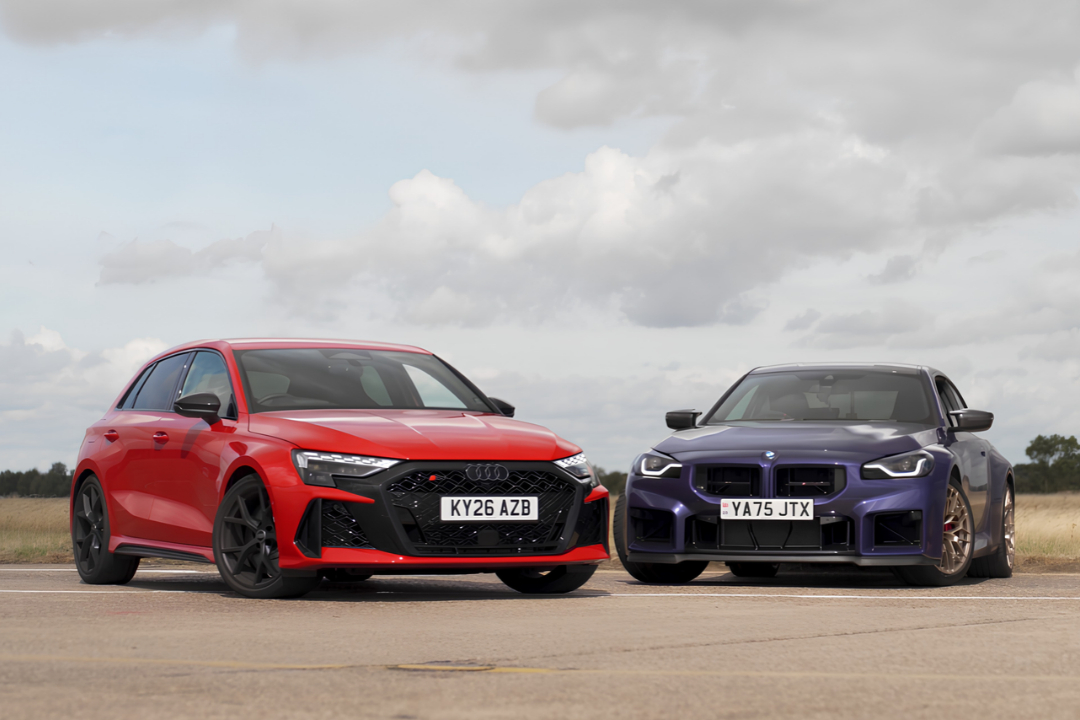
Audi’s RS3 and BMW’s M2 CS represent two different answers to the same question: does raw power win, or does the smarter car win? The RS3 leans on Quattro all-wheel drive and a screaming five-cylinder engine. The M2 CS leans on rear-wheel drive and a straight-six that simply outguns everything nearby. Putting them through a full day of testing was always going to settle more than bragging rights.
The RS3 makes a genuinely compelling case on paper. Its 2.5-liter five-cylinder engine produces 400 horsepower and 500 Newton-meters, and it’s roughly £10,000 (about $13,000) cheaper than a standard M2. But the M2 tested here wasn’t standard. It was the CS variant, with 530 horsepower and 650 Newton-meters, a genuine 50-horsepower jump that meant the RS3’s traction advantage was never going to be the whole story.
A launch advantage that didn’t last
The first drag race ended in a false start, the M2 CS jumping the line and crossing first at 133 mph. On the rerun, the RS3’s launch control did its job perfectly, getting off the line first and holding a clean lead through the opening 20 to 30 meters, exactly the scenario all-wheel drive exists to win.
That lead didn’t survive fourth gear. Once the M2 CS got into its power band, it reeled in the RS3 and passed it before the finish line. Both drivers called the finish a nail-biter, but the result wasn’t really in doubt. The M2 CS’s extra power simply overwhelmed the RS3’s head start once speed climbed high enough for it to matter.
Five features apiece, and one genuine split
The two presenters turned the comparison into a structured challenge: five standout features each. The RS3’s list leaned into personality and everyday usability, its five-cylinder engine, selectable daytime running light patterns, a Sonos sound system, and a “Torque Rear” mode that disables traction control for all-wheel-drive power slides.
The M2 CS countered with a track-focused list: factory carbon ceramic brakes, a carbon roof, carbon mirrors, a carbon ducktail spoiler, electric bucket seats, and a thick Alcantara wheel. The split revealed what each car actually was: one built to be excellent at everything, the other built to be exceptional at one thing. Neither presenter declared an outright winner here, and the lists made clear why.
Not every feature landed as a pure win, either. The M2 CS’s bucket seats have a molded center hump that interferes with left-foot braking, and BMW deleted the CS’s cup holders entirely in favor of wireless charging, a decision that became a genuine inconvenience on a 4,200-mile road trip to Romania when there was nowhere to put a coffee.
The touchscreen test nobody expected to be this lopsided
The final challenge ditched horsepower for something more mundane: basic infotainment usability. Three tasks, set the climate control, unlock the doors, tune the radio, timed head to head.
The results weren’t close. Climate control took 17 seconds in the RS3 against 11 in the M2 CS. Unlocking the doors took 3.48 seconds versus 1.7. Tuning the radio took nearly 20 seconds in the RS3 compared to just over 10 in the M2 CS, a gap traced back to a radio icon that reads more like an antenna symbol than a button. The M2 CS swept all three tasks decisively.
What the numbers actually add up to
None of this makes the RS3 a bad car. It’s meaningfully cheaper, more comfortable day to day, and its five-cylinder engine has genuine charisma. Across the two contests that actually came down to a stopwatch, the drag race and the usability trial, the M2 CS came out ahead both times. The feature showdown, by contrast, was closer to a draw, each car winning on its own terms.
More from Fast Lane Only
- Unboxing the WWII Jeep in a Crate
- 15 rare Chevys collectors are quietly buying
- 10 underrated V8s still worth hunting down
- Police notice this before you even roll window down
*Research for this article included AI assistance, with all final content reviewed by human editors.