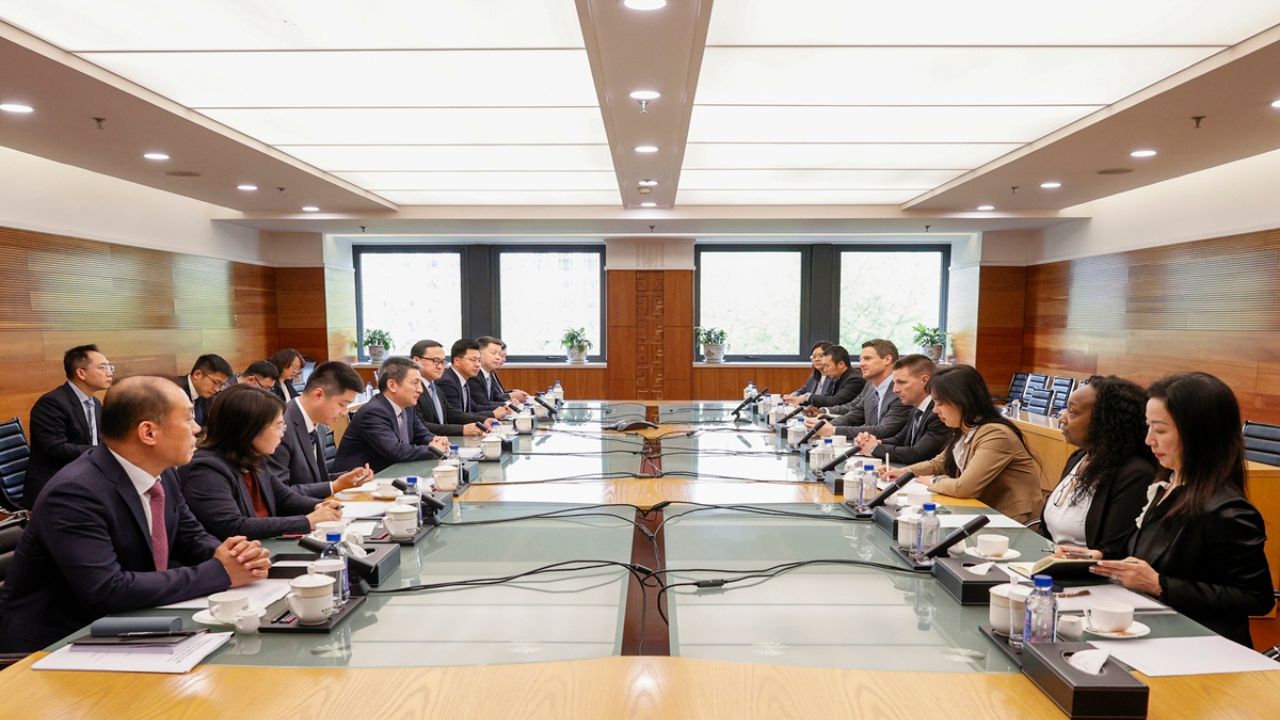
China has delivered a pointed message to Ford Motor Co.: the world’s second largest economy still wants the American automaker to be a bigger player inside its borders. A senior commerce official has urged the company to deepen its investment, expand local partnerships, and treat China as a core market rather than a side bet.
The appeal lands at a delicate moment for global carmakers. China is both Ford’s toughest competitive arena and a vital source of future growth, especially in electric vehicles, even as geopolitical friction and industrial overcapacity reshape the global auto trade.
What happened
China’s Vice Commerce Minister Wang Shouwen met recently in Beijing with a senior Ford executive and called on the company to increase its presence in the Chinese market. According to an official account of the talks, Wang pressed Ford to expand investment, strengthen cooperation with Chinese partners, and participate more fully in the country’s industrial and supply chains. The ministry framed the meeting as part of a broader effort to keep China open to foreign business and to support high-quality development of the auto sector.
The encounter was described as cordial but direct. Wang highlighted what he called China’s vast consumer demand, complete industrial ecosystem, and ongoing policy support for new energy vehicles, and he urged Ford to align more closely with these priorities. The message from the commerce side was that foreign carmakers that commit capital, technology and local jobs will continue to find space in China’s market, even as domestic brands surge.
A brief readout carried by local outlets and amplified through international wires stated that the vice minister encouraged Ford to make better use of China’s “expanding market” and to integrate more deeply into local supply networks. One account of the meeting, shared through official channels, emphasized that Beijing sees the company as an important partner for the country’s auto industry and wants it to keep raising its level of engagement.
Regional media that picked up the ministry’s statement echoed the same themes. A summary distributed through syndicated reports described Wang as calling on Ford to “deepen its market presence” and to seize opportunities in new energy vehicles and smart connected cars. The coverage stressed that the vice minister framed China as a reliable partner for global companies, despite concerns in some Western capitals about rising trade tensions and industrial policy competition.
Chinese state-linked commentary added more color to the official line. A piece in the domestic press portrayed Ford’s talks with Wang as a sign that multinational automakers still view China as a key battleground for electrification and digitalization. The article argued that foreign brands that adapt to local tastes, invest in research and development on the ground, and cooperate with Chinese suppliers can still thrive, even as homegrown companies such as BYD and Geely gain share.
Separate reporting on the same meeting, relayed through international outlets, quoted Chinese officials as urging Ford to “invest more” and “strengthen ties” in an expanding market. The language underscored that Beijing is not simply asking for continued presence, but for a step change in commitment, particularly in advanced manufacturing and green technologies.
A policy-focused brief from development-focused coverage framed the outreach as part of a longer campaign by Chinese authorities to reassure foreign investors. In that account, Wang’s message to Ford sat alongside similar overtures to other multinationals in autos and high-tech manufacturing, all designed to counter perceptions that China is becoming less hospitable to foreign capital.
Why it matters
The vice minister’s appeal to Ford is about far more than one company’s sales figures. It reflects how Beijing is trying to manage three overlapping pressures: slowing domestic growth, intense competition in electric vehicles, and rising scrutiny of Chinese exports in North America and Europe.
For China, keeping global automakers engaged helps anchor jobs, technology and tax revenue at home. The country has built a dense ecosystem of parts suppliers, battery makers, software firms and logistics providers around its auto sector. Officials now want that ecosystem to move up the value chain, with more research, design and high-end manufacturing carried out on Chinese soil. Encouraging Ford to deepen its footprint fits that strategy, especially if it means new investments in electric platforms, battery integration or autonomous driving systems.
The outreach also speaks to concerns about overcapacity. China’s factories can produce far more vehicles, particularly electric models, than domestic demand alone can absorb. That surplus has already triggered trade friction, with Western policymakers accusing Chinese firms of flooding global markets with subsidized EVs. By nudging foreign brands to commit more capital locally, Beijing can argue that its auto industry is not purely a national project, but a joint endeavor with multinational stakeholders. That narrative may prove useful as trade partners weigh tariffs and other defensive measures.
For Ford, the stakes are equally high. China is the world’s largest auto market by volume, and any global manufacturer that aspires to scale in electric and connected vehicles has to contend with Chinese competitors. Ford’s own position in the country has been under pressure as domestic brands gain ground in mass-market segments and premium buyers turn to German luxury marques or high-end Chinese EVs.
Deepening its presence could mean several things for Ford. The company could expand joint ventures with existing Chinese partners, increase local sourcing of components, or shift more research and development to Chinese labs. It might also seek to roll out more models tailored specifically to Chinese consumers, who have shown strong appetite for compact electric crossovers, extended in-car connectivity and advanced driver assistance features that are sometimes more aggressive than regulations in Western markets allow.
At the same time, Ford has to navigate a fraught geopolitical environment. U.S. and European regulators have raised concerns about data security, supply chain dependence and the role of Chinese firms in critical technologies. Any move by Ford to integrate more deeply with Chinese suppliers or to share advanced software could draw scrutiny at home. The company has already faced questions about partnerships that touch on battery technology and data-rich systems, as illustrated by separate reporting that linked Ford’s projects to Chinese entities in the context of technology cooperation. Unverified based on available sources.
There is also the issue of brand positioning. In China’s coastal megacities, Ford competes not only with Toyota, Volkswagen and General Motors, but also with nimble local brands that update software frequently and market aggressively on domestic social platforms. To justify deeper investment, Ford would need a clear strategy for differentiation, whether through advanced driver assistance, performance models under the Mustang and F-150 badges, or tightly integrated services that link cars to consumer apps and payment systems.
From Beijing’s perspective, Ford’s response will send a signal to other Western manufacturers that are weighing their options. If a household name in American industry chooses to double down on China, that could reassure policymakers who worry about capital outflows and diversification of supply chains away from the mainland. If Ford hesitates or scales back, it could reinforce a narrative of gradual decoupling and push Chinese planners to lean even more on domestic champions.
The meeting also fits into a broader pattern of Chinese ministries publicly courting foreign investment while tightening some regulatory levers behind the scenes. On one hand, officials highlight market access, streamlined procedures and support for advanced manufacturing. On the other, foreign firms have faced new data rules, compliance checks and informal pressure to localize sensitive operations. Ford must interpret Wang’s invitation through that dual lens, balancing the promise of growth against operational and political risk.
For the global auto industry, the episode illustrates how strategic and political the sector has become. Cars are no longer just consumer products; they are nodes in digital networks, rolling batteries on wheels, and symbols of national industrial strength. When a vice commerce minister personally urges a foreign automaker to invest more, it shows that governments see these companies as instruments of economic policy as much as private businesses.
What to watch next
The immediate question is how Ford will respond. The company has not publicly detailed any new investment package tied to the meeting, and there is no sign yet of a major shift in its China strategy. Investors and industry watchers will be looking for concrete signals in the coming months, such as announcements of new joint ventures, expanded factory capacity, or fresh research centers in Chinese cities.
One indicator will be Ford’s product roadmap in China. If the company begins to introduce more China-only models, especially in the electric and plug-in hybrid segments, that would suggest a willingness to customize for local demand rather than simply importing global platforms. Similarly, any move to integrate Chinese-developed software into Ford’s in-car systems, or to partner with domestic tech firms on navigation, entertainment or driver assistance, would show deeper operational integration.
Regulatory developments will also shape the path ahead. Trade tensions around electric vehicles are still rising, with Western governments considering tariffs and other measures that could affect how Ford balances production between China and its home markets. If new rules make it harder to export China-made vehicles to North America or Europe, Ford might focus its Chinese operations more squarely on serving local consumers and regional markets in Asia.
On the Chinese side, policymakers are likely to keep up the charm offensive toward foreign investors, particularly in sectors such as autos, batteries and semiconductors that they view as strategic. Future meetings between senior officials and executives from other global carmakers will show whether Ford’s experience is part of a systematic push or a one-off gesture. Any new policy incentives aimed at joint ventures, such as tax breaks or support for research projects, would further clarify Beijing’s intentions.
Another factor to watch is how domestic Chinese automakers react. Local champions have little interest in ceding market share to foreign brands, and some may view deeper engagement by Ford as a threat. That could intensify competition on pricing, features and financing, especially in the mid-range EV segment where margins are already thin. On the other hand, Chinese suppliers of batteries, chips and software may welcome closer ties with Ford as a way to diversify their customer base and gain exposure to global standards.
Ford’s internal calculus will be shaped by its broader financial performance and strategic priorities. If the company faces pressure to cut costs or simplify its global footprint, it might be more cautious about large new commitments in China, particularly if returns look uncertain. Conversely, if its leadership sees China as indispensable for staying relevant in electric and connected vehicles, they may be prepared to absorb higher risk for the sake of long-term positioning.
Investors will scrutinize any reference to China in Ford’s upcoming earnings calls and strategic presentations. Details on unit sales, pricing pressure, and profitability in the Chinese market will offer clues about whether deeper engagement is paying off or whether the company is struggling to maintain share. Analysts will also look for signs that Ford is adjusting its supply chain to manage geopolitical risk, for example by diversifying battery sourcing while still leveraging Chinese expertise.
More from Fast Lane Only