The latest Nissan X-Trail arrives with a sharpened hybrid drivetrain and bolder sheetmetal, signaling a more assertive phase for one of the brand’s global staples. Rather than a mild facelift, Nissan has used this generation as an opportunity to refine its e-Power technology, improve efficiency, and inject some genuine visual attitude into a family SUV.
This blend of upgraded electrified hardware and more expressive styling targets buyers who want practicality and lower running costs without sacrificing character. It also underlines how seriously Nissan now treats the X-Trail as a showcase for its hybrid know-how rather than just a safe, anonymous crossover.
What happened
Nissan has unveiled a new X-Trail that pairs a revised e-Power hybrid system with a thorough exterior and interior refresh. The core layout remains familiar: a petrol engine works primarily as a generator, feeding a battery and electric motors that actually drive the wheels. In this latest version, Nissan has reworked the control software, power electronics, and packaging to deliver smoother transitions, better energy recuperation, and more consistent performance across a wider range of conditions.
The company continues to offer both front wheel drive and all wheel drive variants, with the latter using a second electric motor on the rear axle for what Nissan markets as e-4ORCE torque vectoring. This setup allows the X-Trail to modulate power delivery between the front and rear motors in milliseconds, which in practice gives the car more secure traction on wet or loose surfaces and more confident acceleration when merging or overtaking.
Battery capacity and engine displacement carry over, but the calibration of the hybrid system has changed. The petrol engine now spends more time in its most efficient rev band, cutting unnecessary flare under hard acceleration and reducing noise in everyday driving. Regenerative braking has been strengthened, particularly at urban speeds, so the system can harvest more energy when the driver lifts off the accelerator. Drivers can still select a more aggressive one pedal style mode, where lifting the throttle brings the car down to a near stop without heavy use of the brake pedal.
On the outside, the new X-Trail adopts a more angular, technical look that pushes it closer to Nissan’s latest design language. The front end gains a reinterpreted V motion grille with a more intricate mesh pattern and slimmer, sharper LED headlights. A reshaped bumper incorporates larger air intakes and more sculpted surfaces, which visually widen the car and give it a more planted stance. At the rear, redesigned tail lamps and a cleaner tailgate treatment help the car look broader and lower without compromising cargo access.
Wheel designs have been updated across the range, with larger diameter options that fill the arches more convincingly and give higher spec trims a more premium stance. The color palette now includes several contrasting roof combinations, so buyers can pair a darker roof with a lighter body or vice versa, an increasingly popular cue in the compact and midsize SUV segments.
Inside, Nissan has revised the cabin with a stronger focus on perceived quality and digital integration. The dashboard now houses a larger central touchscreen, paired with a fully digital instrument cluster on higher trims. Physical controls for key functions remain, but the layout has been simplified and the materials on touch points such as the steering wheel, center console, and door cards have been upgraded. Soft touch surfaces now extend further across the dash and door tops, while new seat fabrics and leather options lift the ambience on mid and high grade models.
The three row configuration remains a key selling point. The third row is still best suited to children or short trips for adults, but the flexibility to switch between seven seat and large cargo modes continues to give the X-Trail an edge over some two row rivals. Nissan has also tweaked the folding mechanism for the second and third rows to make it easier to create a flat load floor, which matters for families hauling bikes, strollers, or bulky sports gear.
Driver assistance technology has also been updated. The latest X-Trail integrates Nissan’s suite of active safety systems, including adaptive cruise control, lane keeping assistance, blind spot monitoring, and automatic emergency braking. Tuning of these systems has been refined to reduce abrupt interventions, and the car can now use navigation data to anticipate curves or junctions when adjusting speed on certain roads.
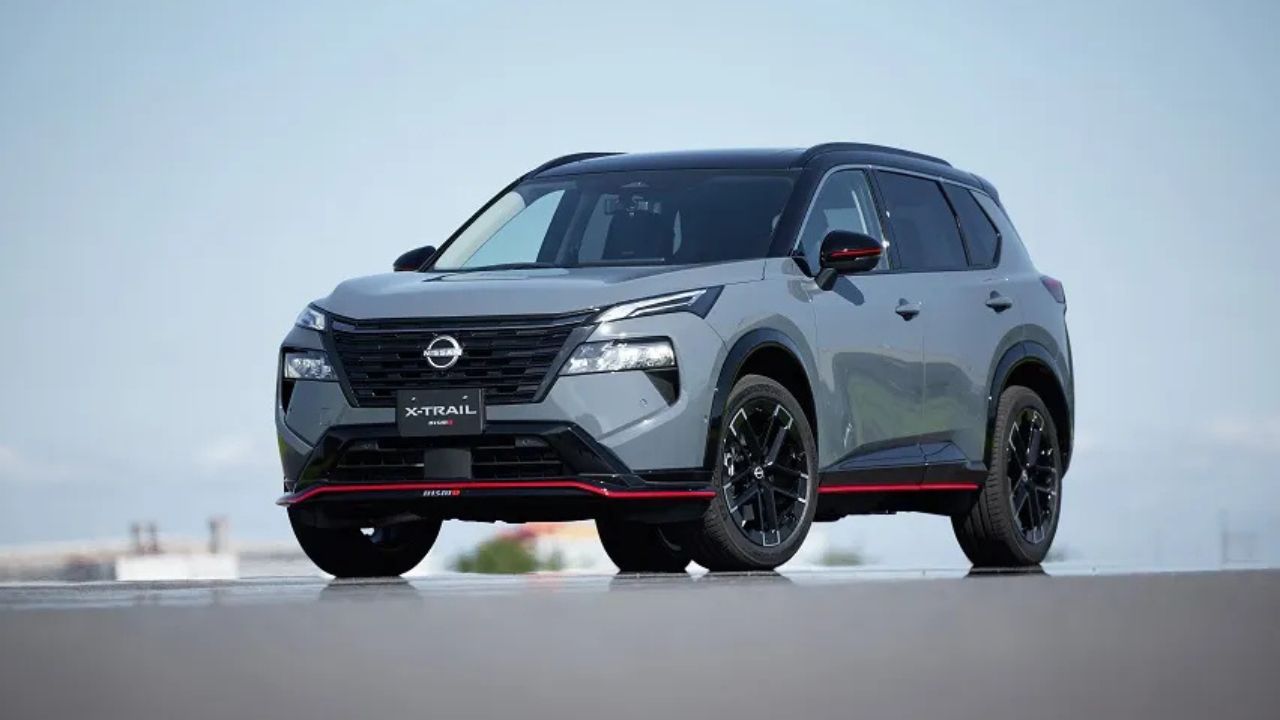
Perhaps the most visually distinctive addition to the family is a performance inspired variant that leans into sportier styling and chassis tuning. This version, badged as a Nismo model in some markets, receives more aggressive bumpers, unique alloy wheels, contrasting trim accents, and a recalibrated suspension that aims to improve body control without sacrificing everyday comfort. According to early drives, the Nissan X-Trail Nismo focuses on sharper handling and aesthetics rather than a significant power increase, which keeps the hybrid system’s outputs aligned with the standard e-Power range.
Why it matters
The latest X-Trail arrives at a moment when hybrid SUVs are doing heavy lifting in the transition to cleaner transport. Fully electric models are gaining traction, but infrastructure gaps, price sensitivity, and charging anxiety still steer a large share of buyers toward hybrids. By investing in a more sophisticated e-Power system rather than treating it as a stopgap, Nissan is betting that series hybrids can bridge that gap for many households.
This model is a global workhorse for Nissan, positioned above the Qashqai but below larger body on frame SUVs. In several markets it serves as the primary family car for buyers who need space for children, pets, and luggage, yet still want manageable running costs. Any change to its powertrain strategy therefore carries weight for the brand’s emissions profile and for how regulators perceive Nissan’s progress on fleet average targets.
Unlike conventional parallel hybrids, where the engine and electric motor both drive the wheels, the e-Power layout keeps the petrol engine decoupled from the wheels. The engine’s main job is to generate electricity, while the electric motors handle propulsion. This approach can deliver a more EV like driving feel, with instant torque and linear response, while still using petrol as an energy source. It also allows Nissan to run the engine in more efficient operating windows, which can translate into better real world fuel economy, especially in stop start urban conditions.
Refining that system in the new X-Trail matters because it shows Nissan is not content to simply carry over hardware. By improving energy management and smoothing out the way the engine cuts in, the company aims to address earlier criticisms about noise and perceived disconnection between engine speed and road speed. Better calibration means the engine is more likely to spin up only when needed, which should make the car feel more natural to drivers coming from traditional petrol or diesel SUVs.
The styling shift also plays a strategic role. The previous X-Trail was competent but visually conservative, which made it easy to overlook in a crowded showroom. The new design, with its sharper face and more muscular stance, gives the car a clearer identity. That is especially important as rivals such as the Toyota RAV4, Hyundai Tucson, and Kia Sportage have all embraced more assertive styling and strong hybrid offerings.
By adding a sport oriented variant with Nismo branding, Nissan taps into a different emotional register. Even without a major power bump, a chassis that feels more tied down and a body kit that signals intent can attract buyers who might otherwise look to performance tinged trims from other brands. It also allows Nissan to stretch the X-Trail nameplate into lifestyle territory, which can support stronger residual values and a broader accessory ecosystem.
The interior upgrades respond directly to where the segment has moved. Midpriced SUVs now routinely feature large screens, soft touch dashboards, and ambient lighting that would have been reserved for premium brands a decade ago. Had the X-Trail carried on with its older cabin architecture, it would have struggled to justify its price against newer rivals. The updated ergonomics and materials help align it with customer expectations for tech and comfort, particularly for families that spend long hours on the road.
Safety technology is another battleground. Regulators and consumer testing bodies increasingly reward cars that can prevent accidents rather than just protect occupants when they occur. By packaging a full suite of driver assistance systems and refining their behavior, Nissan not only improves crash test performance but also strengthens its argument to safety conscious buyers. Features such as adaptive cruise control with lane centering can reduce fatigue on long motorway trips, which is exactly the use case for a family SUV like the X-Trail.
The hybrid focus also has implications for total cost of ownership. Fuel prices remain volatile in many markets, and governments continue to adjust tax regimes to favor lower emission vehicles. A more efficient e-Power system can help owners save at the pump without the upfront cost of a large battery electric SUV. At the same time, the absence of a conventional multi speed gearbox in the series hybrid layout can reduce mechanical complexity, which may benefit long term reliability and maintenance costs.
From Nissan’s perspective, the X-Trail’s success with this updated hybrid setup will inform how aggressively it can deploy e-Power across other nameplates. Strong demand and positive feedback could encourage the brand to expand similar series hybrid systems into more regions and segments, including smaller crossovers and possibly light commercial vehicles. That would give Nissan a clearer electrification story in markets where pure EV demand is still developing.
What to watch next
The key question for the new X-Trail is how buyers respond to the balance Nissan has struck between efficiency, performance, and price. Early impressions suggest the reworked e-Power system delivers smoother, more linear acceleration and quieter operation in typical driving, but real world fuel economy figures from owners will determine whether the upgrade meets expectations. Analysts will be watching how closely those numbers align with official test cycles, particularly in mixed urban and motorway use where hybrids often reveal their strengths and weaknesses.
Market reception to the sportier Nismo variant will also be telling. If customers embrace a handling focused, visually distinctive X-Trail that does not chase headline power figures, Nissan may double down on similar treatments for other models. If, however, buyers demand a genuine performance uplift to match the styling, that feedback could push the brand to explore higher output versions of the e-Power system or to pair the hybrid drivetrain with more powerful motors in future iterations.
Another area to watch is how the X-Trail competes against plug in hybrid rivals. While the series hybrid layout offers simplicity and avoids the need for charging infrastructure, plug in hybrids from other manufacturers can deliver meaningful electric only range for daily commutes. If policy incentives and consumer habits continue to favor vehicles that can run on battery power alone for significant distances, Nissan may face pressure to complement e-Power with plug in options or to accelerate its rollout of full battery electric SUVs in similar size classes.
More from Fast Lane Only