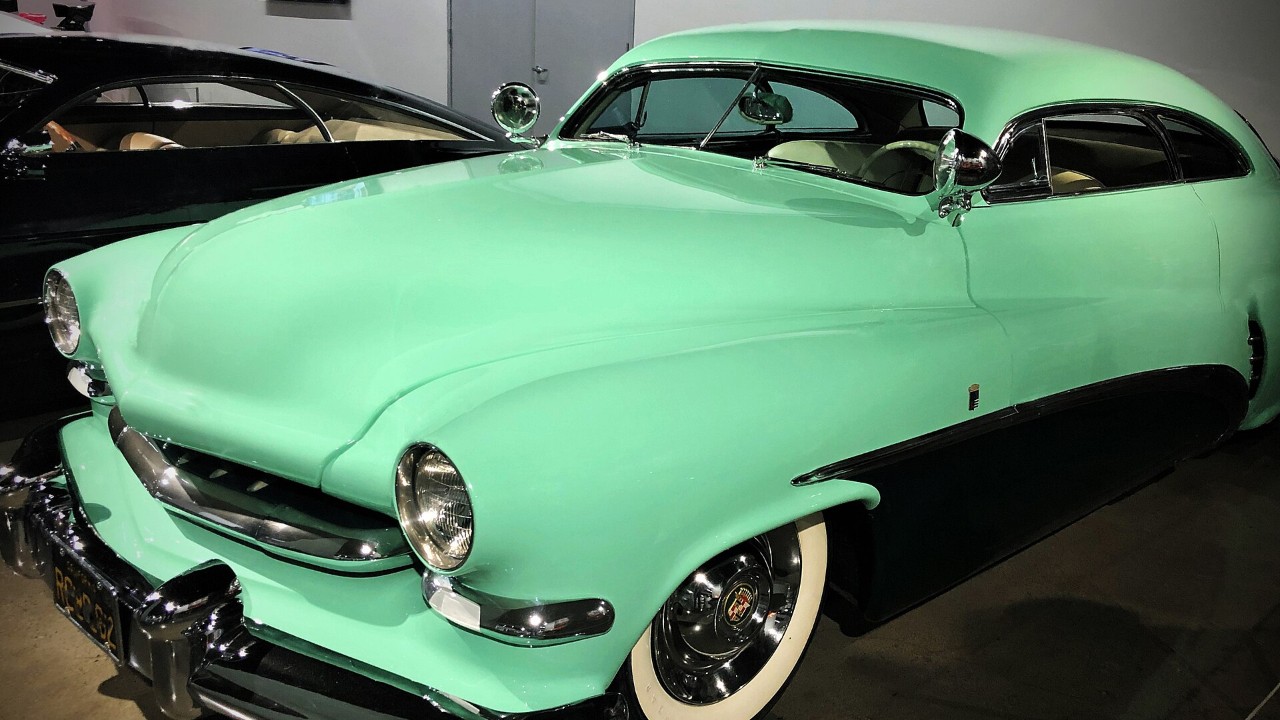
In January 2022, a chopped 1951 Mercury sold for $2.145 million at Mecum’s Kissimmee auction. Hagerty called it the highest-selling custom not tied to a TV series or a movie. That car, the Hirohata Merc, proved that custom cars can be worth as much as the factory classics they started as.
Yet price is only part of the story. Each great custom carries the fingerprints of a builder, a magazine cover and usually a wild idea that worked. Some were lead sleds built in a hurry, while others were bubble-topped fiberglass dreams or TV stars that kids built as model kits.
These are our picks for 12 custom cars we’d refuse to give up. The verdict is ours, and so is the heartbreak of choosing. The builders, dates and sale figures come from auction houses, museums and automotive historians we checked for this story.
1. 1951 Mercury Hirohata Merc, the Barris custom car
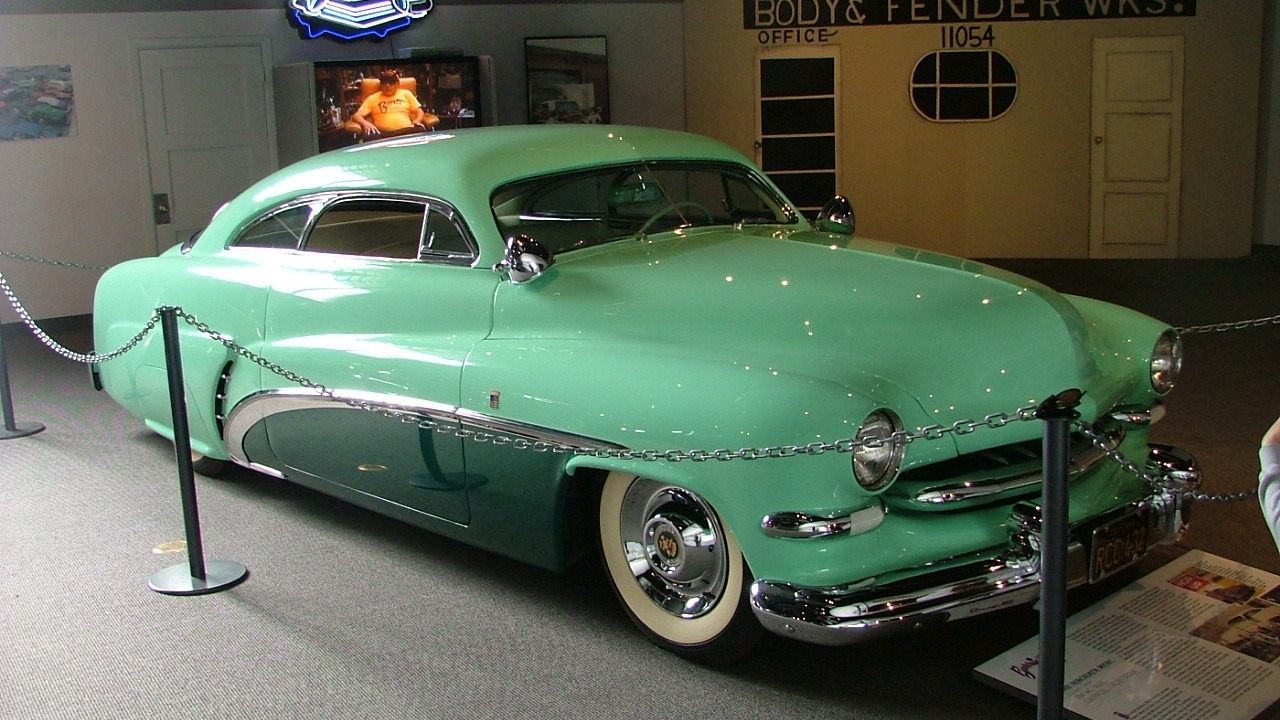
Bob Hirohata came to Barris Kustoms in 1952, fresh out of the Navy, with a 1951 Mercury coupe. Above all, he wanted it finished for that year’s Motorama. According to Hagerty’s history of the 14-day build, as many as 10 people worked on the car at once. For example, its grille came from three 1951 Ford grilles, and the taillights came from a 1952 Lincoln.
Then Hirohata drove it from Southern California to Indianapolis, and the car later appeared in the 1955 film Running Wild. A teenager named Jim McNiel bought it in 1959 for $500 and kept it for the rest of his life. For more on why this Mercury shape suited customizers, see our story on when the 1950 Mercury Eight became a custom car icon.
After McNiel died in 2018, the car went to Mecum. Hagerty reported the $2.145 million sale and noted it was one of only 30 automobiles on the National Historic Vehicle Register. Our take: this is the custom car we’d guard the hardest. A stock 1951 Mercury coupe in top condition is valued at about $55,000, which shows how much the Barris touch adds.
2. 1929 Ford Ala Kart

The Ala Kart began as a 1929 Ford Model A roadster pickup. George Barris, owner Richard Peters and Mike “Blackie” Gejeian started work in 1956 and finished in 1957. Under the hood went a 1954 Dodge 266-cubic-inch Red Ram Hemi. It came out of a wrecked Peters racing boat, which is about as hot rod as a parts source gets.
First, the result won the America’s Most Beautiful Roadster trophy at the Grand National Roadster Show in 1958. Then it won again in 1959. That back-to-back result made the little pickup a star, and it showed up in the background of drive-in scenes in many films.
Its biggest reach, though, came in plastic. AMT released a 1/25-scale Ala Kart kit in 1961, and it became one of the best-selling kits around. Danbury Mint and Hot Wheels also made versions. As a result, many young builders met the Ala Kart as a model long before they could drive. Fortunately, the car is now on display at the Henry Ford Museum in Dearborn, Michigan. In our view, a custom that taught a generation to love roadsters is one you never let go.
3. 1954 Barris Golden Sahara
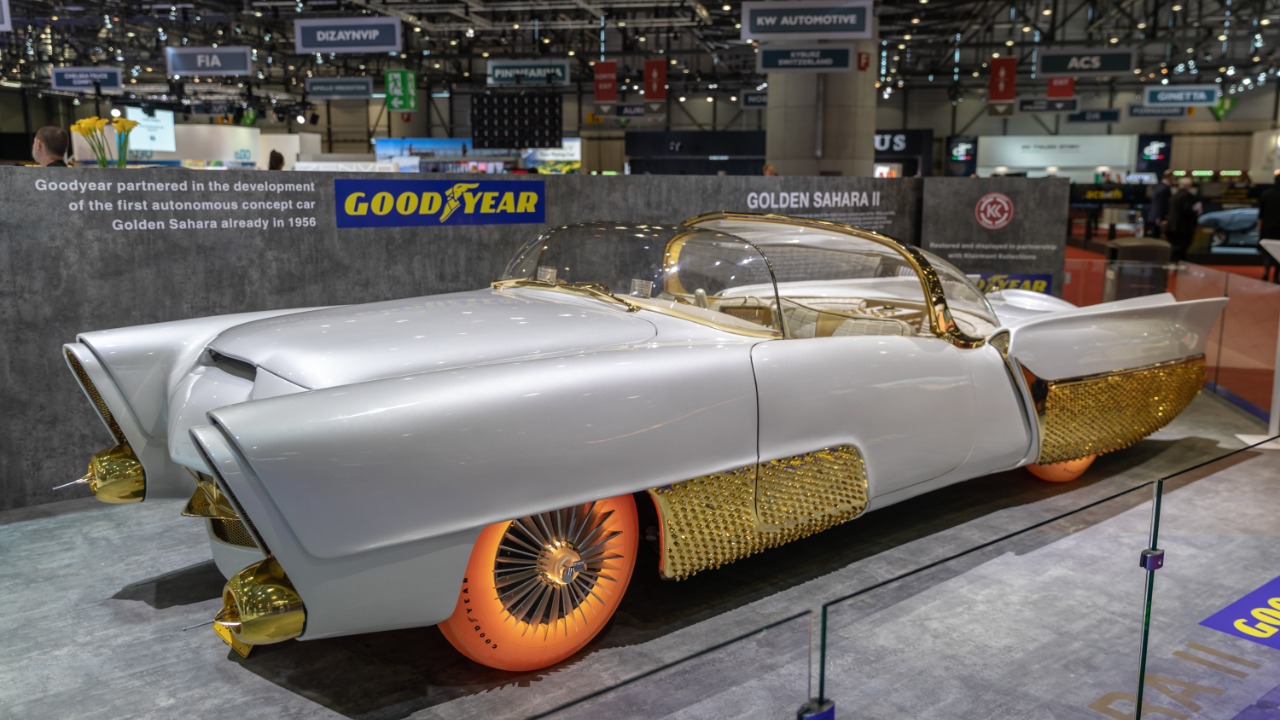
George Barris built the Golden Sahara from a 1953 Lincoln Capri. In fact, the starting point was the damaged chassis of Barris’s own car. He said the design drew on “jet era and futuristic Batmobiles” of the 1950s. Its gold-plated trim and glowing translucent Goodyear tires made it look like it had landed from orbit.
On top of that, the car carried a list of gadgets. It had voice control, a telephone, a television and a cocktail bar, although some of the electronics were dummies. Barris showed it at GM’s Motorama in Los Angeles in 1954. Then he upgraded it to Version II in 1956, and it appeared on several TV programs of the era.
Its influence spread beyond the show circuit, too. The Golden Sahara helped inspire later concept cars, including the Lincoln Futura. After a buyer acquired it at auction in 2018, Goodyear and Klairmont Kollections restored it. It returned to the spotlight at the 2019 Geneva Motor Show. Our take: few customs predicted the gadget-filled future so boldly. Today it is on display at the Blackhawk Museum in Danville, California.
4. 1961 Ed Roth Beatnik Bandit
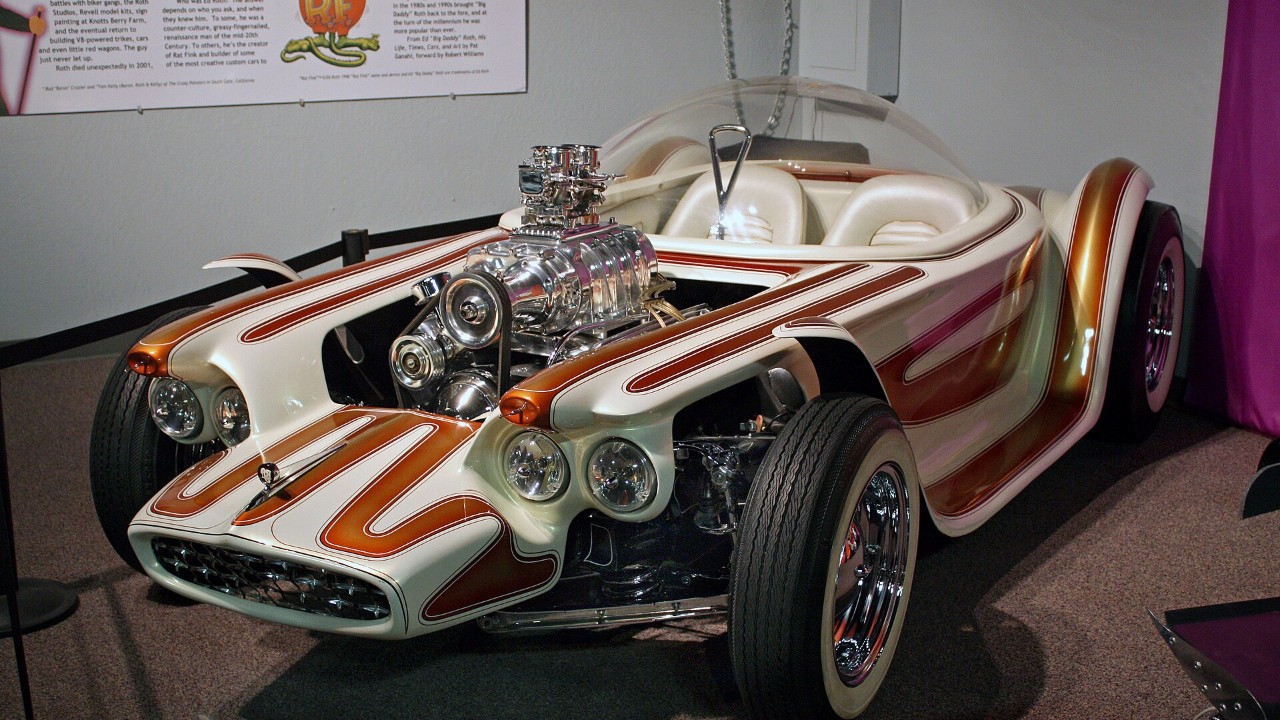
Ed “Big Daddy” Roth built the Beatnik Bandit on a shortened 1950 Oldsmobile chassis. Power came from an Oldsmobile 303-cubic-inch overhead-valve V8. In other words, the Bandit was a real running hot rod under its show-car skin. Roth topped it with a GMC supercharger and two Stromberg 97 carburetors, and that setup is believed to be original to the 1961 build.
Above the cockpit sat a clear bubble cover, the space-age touch that defined 1960s show cars. However, the Bandit’s real fame came from toys. Revell sold a plastic model first, and then Mattel made it one of the first 16 Hot Wheels cars in 1968. That put its shape into toy boxes across the country, far from any car show.
The good news is that the original survives. According to the National Historic Vehicle Register entry, the National Automobile Museum in Reno, Nevada, owns it and displays it publicly. The register lists it as NHVR No. 35. In our view, the Beatnik Bandit is the custom car that linked garage builders to the toy aisle. We’d keep it for that alone, and the supercharged Olds V8 is a bonus.
5. 1964 Ed Roth Orbitron
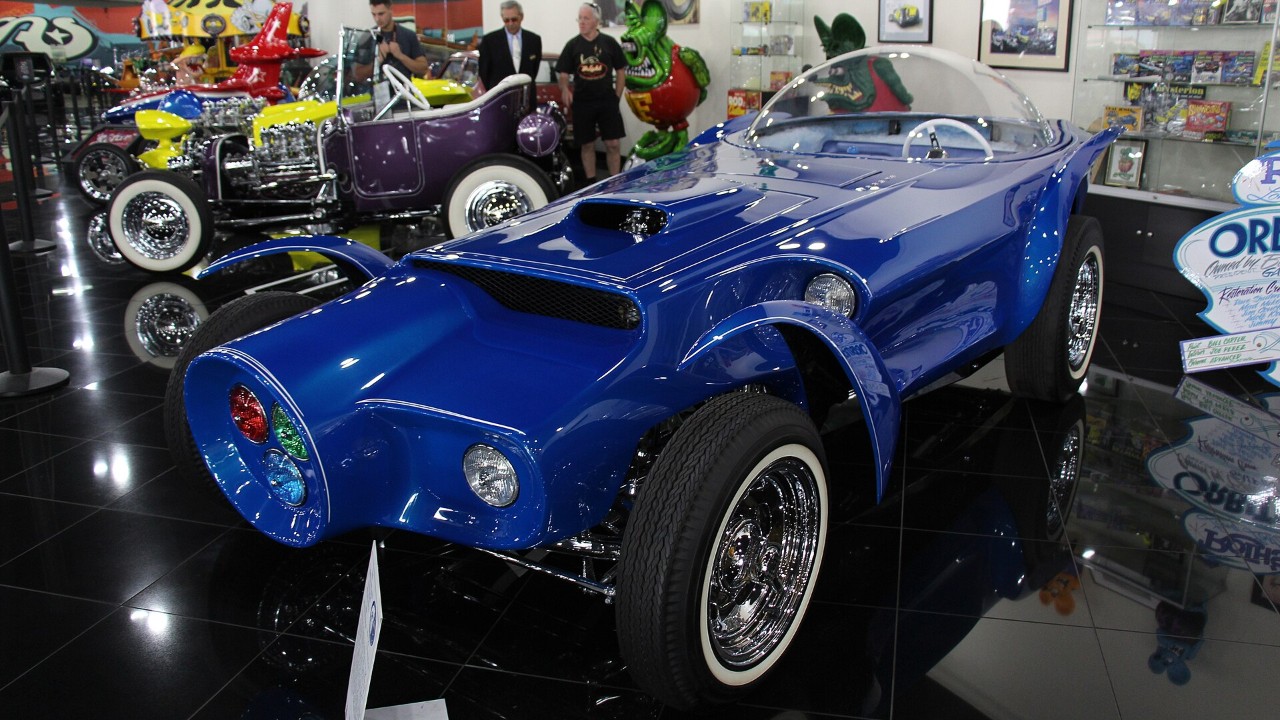
The Orbitron may be the strangest-looking car Roth ever built. Ed “Newt” Newton, a former Roth designer, helped shape it in 1964. Meanwhile, the body was hand-laid fiberglass, and a hydraulic Plexiglas bubble top opened with a doorbell-style button on the hood. Inside, an 11-inch General Electric portable TV sat in the console.
At the front, the asymmetrical nose also carried red, green and blue tinted headlamps. Power came from a mid-1950s Chevrolet V8 with a Powerglide automatic. Even so, the Orbitron later vanished from the custom scene. For years it sat outside an adult bookstore in Ciudad Juárez, Mexico, where it served as a sign to draw customers.
Eventually, restorer Michael Lightbourn tracked it down, negotiated with the owning family and brought it back to the United States. Beau Boeckmann of Galpin Auto Sports then bought it and restored it in about 100 days, finishing in 2009. Newton supervised that work, which kept the restoration close to the original vision. The car made the cover of the March 2009 issue of Hot Rod Deluxe. Our take: a custom car that survived years as a roadside sign has earned a permanent home.
6. 1963 Ed Roth Mysterion
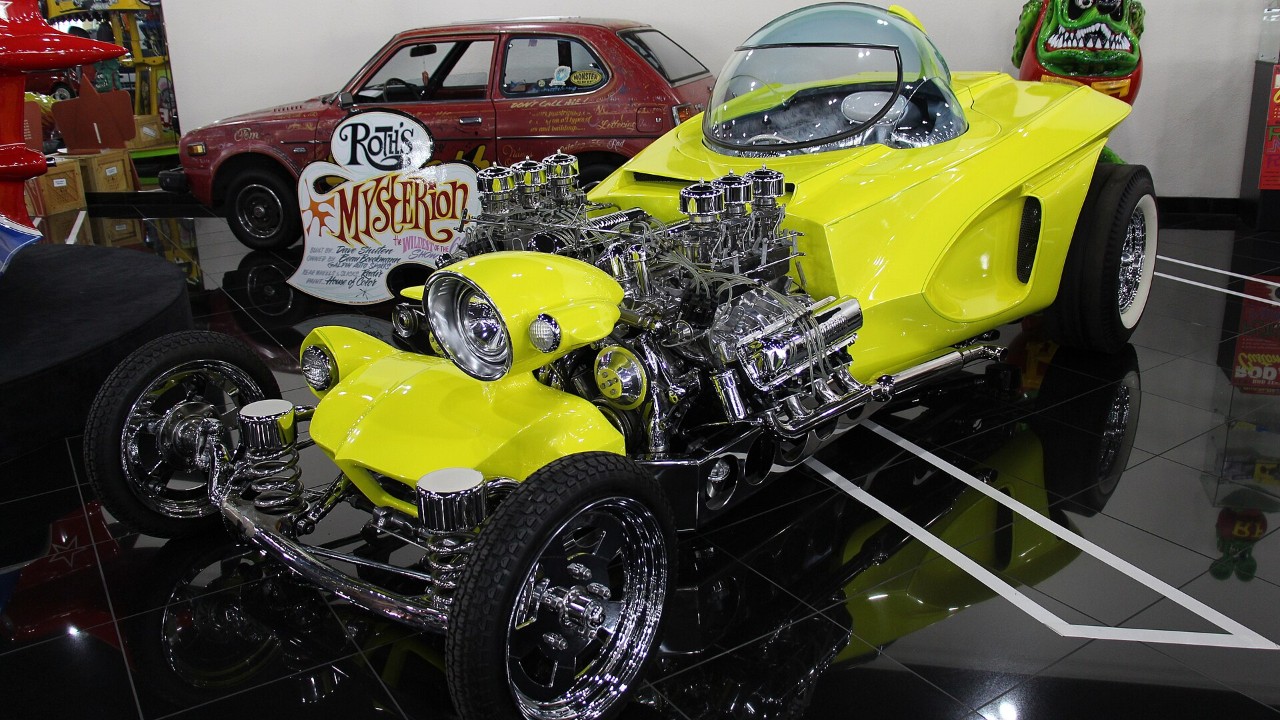
The Mysterion was Roth’s twin-engine show car, and it looked like nothing else at the shows. It carried two Ford 390-cubic-inch big-block V8s, side by side. However, RM Sotheby’s notes that the original never actually ran. Its asymmetrical face had one large pod-mounted headlight on the left and a smaller light on the right. A hydraulic bubble top covered the cockpit.
Sadly, that original custom car no longer exists. According to Hagerty’s account, Bob Larivee traded for it in 1965 and later traded it back to Roth. However, Roth wanted only the axles, and the rest was parted out. Before it disappeared, Revell made a plastic kit, which preserved the design for later fans.
Later, that kit helped a superfan bring it back. Jeff Jones, a petroleum engineer, built a recreation with a new frame and two Ford big-blocks, although only one engine runs. RM Sotheby’s sold the recreation for $246,400 at its Petersen Automotive Museum auction. In our view, the Mysterion is the custom car we’d most like to have saved. Since we can’t, we’d refuse to part with the recreation instead.
7. 1959 Ed Roth Outlaw
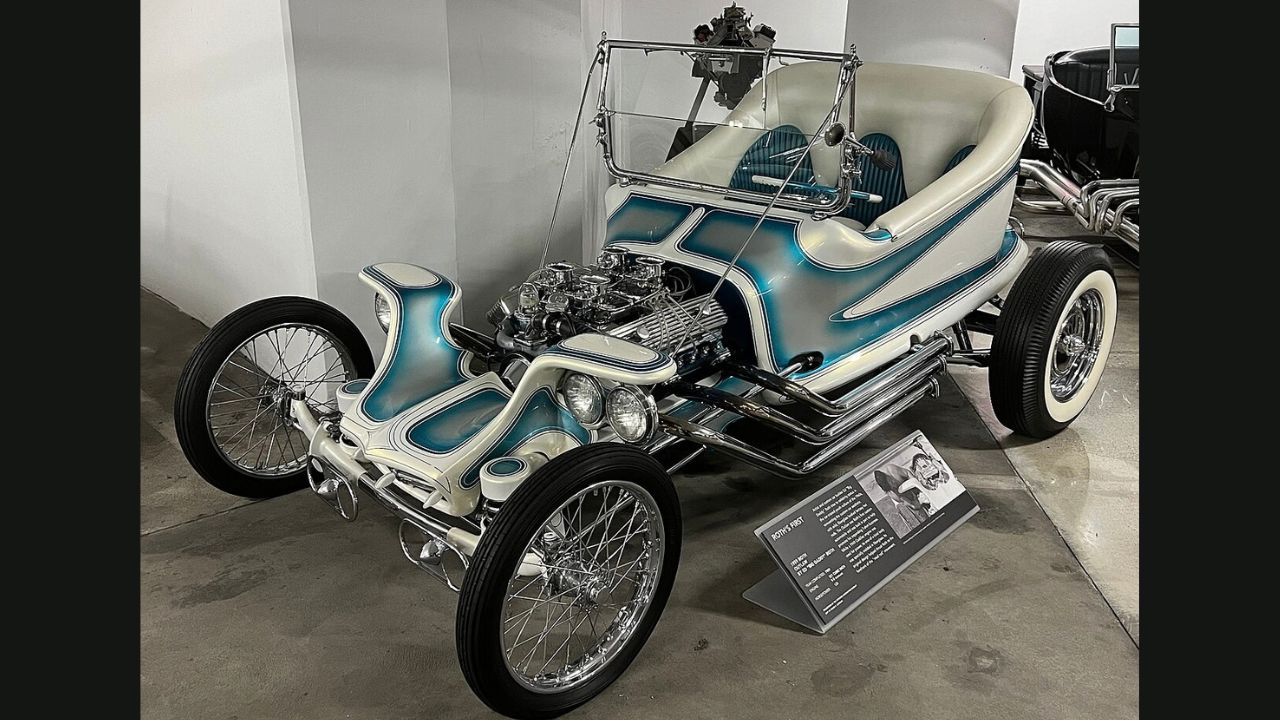
Before the bubble tops, Roth built the Outlaw. He started work in 1957 and finished it in 1959. It was a fiberglass custom hot rod, and much of it, including the body and frame rails, was shaped by hand. The whole car cost $800 to build, mostly with junkyard drivetrain parts.
Under the hood sat a 331-cubic-inch Cadillac V8 with four Stromberg two-barrel carburetors. Meanwhile, a 1939 Ford three-speed transmission sent the power back. The suspension was simple, too, with a solid front axle on coil springs and a live rear axle on a cross spring. Roth first showed it at Disneyland in 1959 as “Excalibur,” named for its sword-handled shifter. However, people struggled to pronounce the name, so Roth renamed it the Outlaw.
Soon after, the car made the January 1960 issue of Car Craft, and it came before the Beatnik Bandit, the Mysterion and the Orbitron. According to the Museum of American Speed’s Outlaw tribute page, Fritz Schenck built a tribute clone in 2008 to honor the original. Our take: the Outlaw is the first chapter of the Roth story, and first chapters are worth keeping. An $800 build that changed a career is hard to beat.
8. 1948 Cadillac CadZZilla

ZZ Top guitarist Billy Gibbons conceived CadZZilla in 1989. By then, he already owned one famous custom car, the Eliminator coupe further down this list. The base was a 1948 Cadillac Series 62 Sedanette. Boyd Coddington’s team built it, with bodywork led by Craig Naff. Jack Chisenhall and Larry Erickson handled the design.
For power, the team chose a 500-cubic-inch Cadillac V8 with custom Holley fuel injection. That kept a Cadillac heart inside a Cadillac body. Out back, a Currie 9-inch rear axle also handled the drive. The total cost ran to about $900,000, a huge sum for a custom at the time. Even so, the result impressed the toughest critics. Hot Rod magazine’s Gray Baskerville reportedly called it the most incredible transformation he had ever witnessed.
CadZZilla changed what a high-end custom could look like at the end of the 1980s. It was no lead sled in the 1950s sense. Instead, it was a modern sculpture that kept the soul of a 1948 Cadillac. In our view, this is the custom that bridged the Barris era and the modern builder age. It has also been shown at the Saratoga Automobile Museum.
9. 1966 Monkeemobile
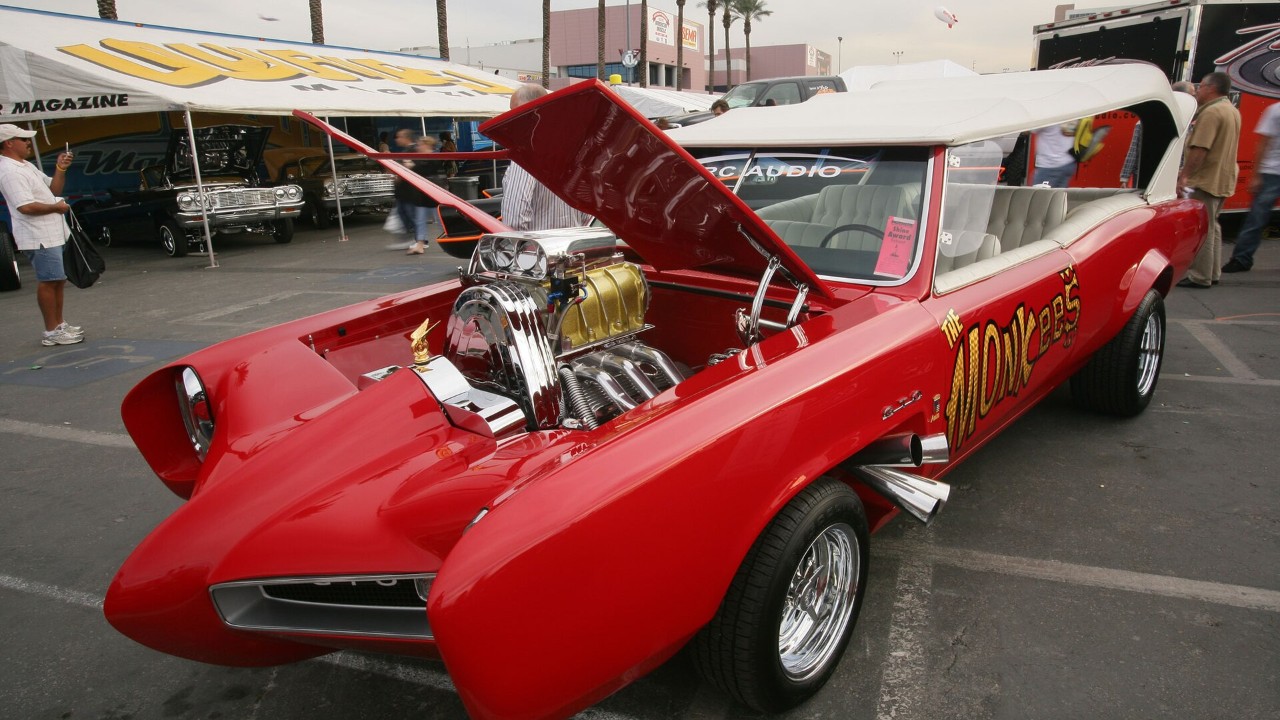
The Monkeemobile began as a 1966 Pontiac GTO convertible with a 389 four-barrel and an automatic. Pontiac’s Jim Wangers supplied the cars, because Pontiac saw The Monkees as a chance to promote its brand. Dean Jeffries designed and built the custom, and his shop finished two cars in about four weeks.
The first version carried a 6-71 supercharger, which made the car hard to drive. So the crew removed the blower and fitted a dummy over a stock Tri-Power setup. Meanwhile, the model kit took off. MPC held the exclusive rights, and its Monkeemobile kit sold more than seven million copies.
After the show, the two cars took very different paths. One went to Australia in 1968 and later turned up as a hotel courtesy car in Puerto Rico. There, it was sold at a government auction in 1992 for $5,000. Meanwhile, the other car joined the Barris collection. In 2008, Barrett-Jackson sold a Monkeemobile at Scottsdale with no reserve, after a frame-off restoration in 2007. Our take: a factory muscle car turned TV star is a rare double, and we’d never let it go.
10. 1966 Batmobile (1955 Lincoln Futura)

The TV Batmobile started as a one-off 1955 Lincoln Futura concept. Ford stylists designed it, and Ghia built it in Turin, Italy, at a reported cost of $250,000. Dean Jeffries began a Batmobile first, but the studio needed a car sooner. As a result, the job went to George Barris.
Famously, Barris bought the Futura from Ford for $1 and “other valuable consideration.” His team then completed the conversion in three weeks at a reported cost of $30,000. Bill Cushenbery did the metal changes, and Herb Grasse handled the design. At the time, the finished car was estimated at $125,000 in 1966 dollars. Barris kept ownership and leased the car to the producers, rather than selling it.
That decision paid off decades later. Barrett-Jackson sold the car on January 19, 2013, and Hagerty puts the price at $4.62 million. If you like comparing the screen cars, our ranking of the top Batmobiles ever driven by the Caped Crusader puts this one first. In our view, no TV custom matters more. Barris also built three fiberglass copies, and all three sit in private collections.
11. 1964 Munster Koach
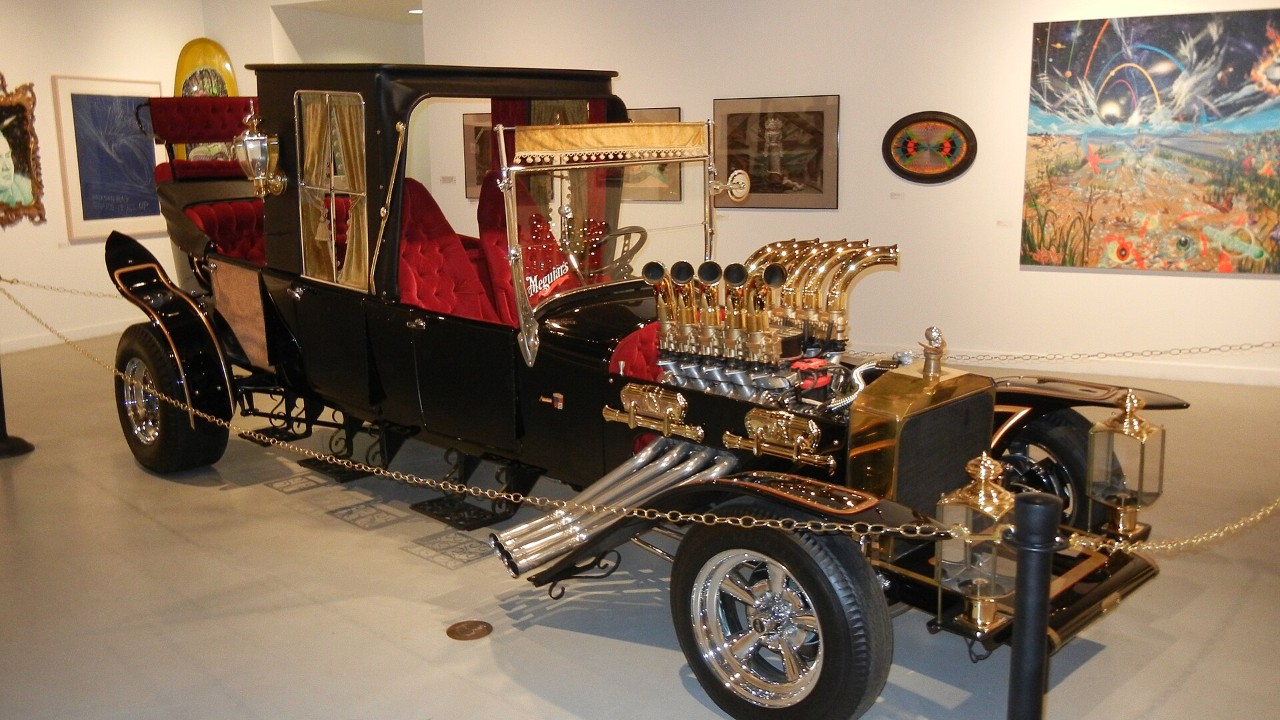
Tex Smith started building the Munster Koach at Barris Kustoms, and Dick Dean finished it. Meanwhile, the design came from Tom Daniel. The crew built it on a hand-made 133-inch frame. Its ornate rolled-steel scrollwork alone took about 500 hours to form by hand. Its Ford 289 V8 was originally meant for a 1964½ Mustang and was dressed with Jahns pistons, an Isky cam and Bobby Barr headers.
After that, the Koach starred in more than twenty episodes of The Munsters during the show’s two-year run. It also appeared in the film Munster, Go Home! That steady screen time turned a hearse-like hot rod into a family favorite. We covered the build in detail in our story on how the Munster Koach was built from three Model T bodies.
Barris auctioned the original in 1983. It has never been restored, and it now stands in the Volo Auto Museum in Illinois. Barris also authorized a second Koach in 1984, which was restored in 2011. Our take: an unrestored original with its TV history intact is the kind of custom car we’d keep exactly as it is. In fact, we’d leave every scuff alone.
12. 1933 Ford ZZ Top Eliminator
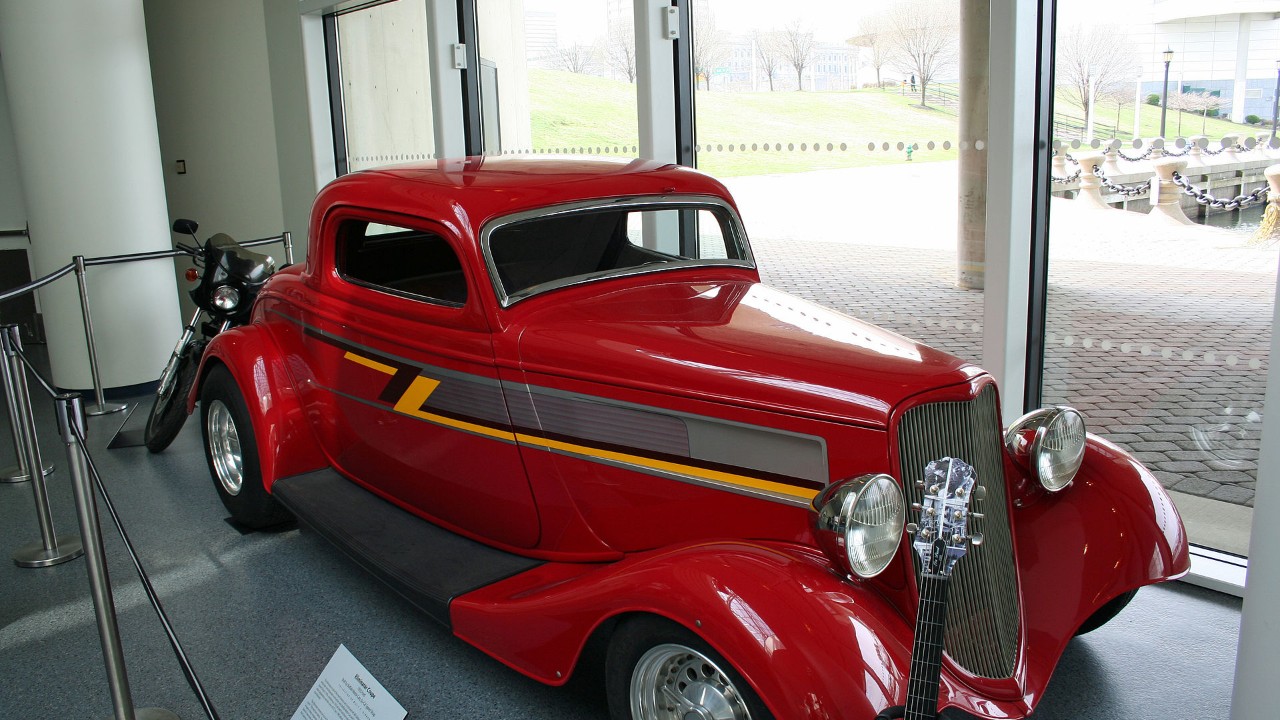
Billy Gibbons’s Eliminator coupe started as a 1933 Ford bought new in Tucson. Don Thelan’s Buffalo Motor Cars did most of the work, under guidance from Pete Chapouris. Steve Davis made the hood, Kenny Youngblood drew the “ZZ” graphics and Thom Taylor designed the interior. In the end, construction took five years.
Underneath, it ran a 350 Chevrolet V8 with a Camaro Z28 cam, a four-barrel carburetor and a Turbo 350 transmission. According to Fuel Curve’s history of the Eliminator coupe, Gibbons credited the red paint and the graphics for the car’s fame. Then it debuted in 1983 on the cover of ZZ Top’s Eliminator album.
After that, MTV did the rest. The coupe starred in the videos for “Gimme All Your Lovin’,” “Sharp Dressed Man” and “Legs.” As a result, a whole generation learned what a hot rod looked like from a music channel. Our take: the Eliminator is the custom that put hot rods back in front of young fans, and we’d never give it up. Fuel Curve notes the car was on loan from the Rock and Roll Hall of Fame in Cleveland.
More from Fast Lane Only