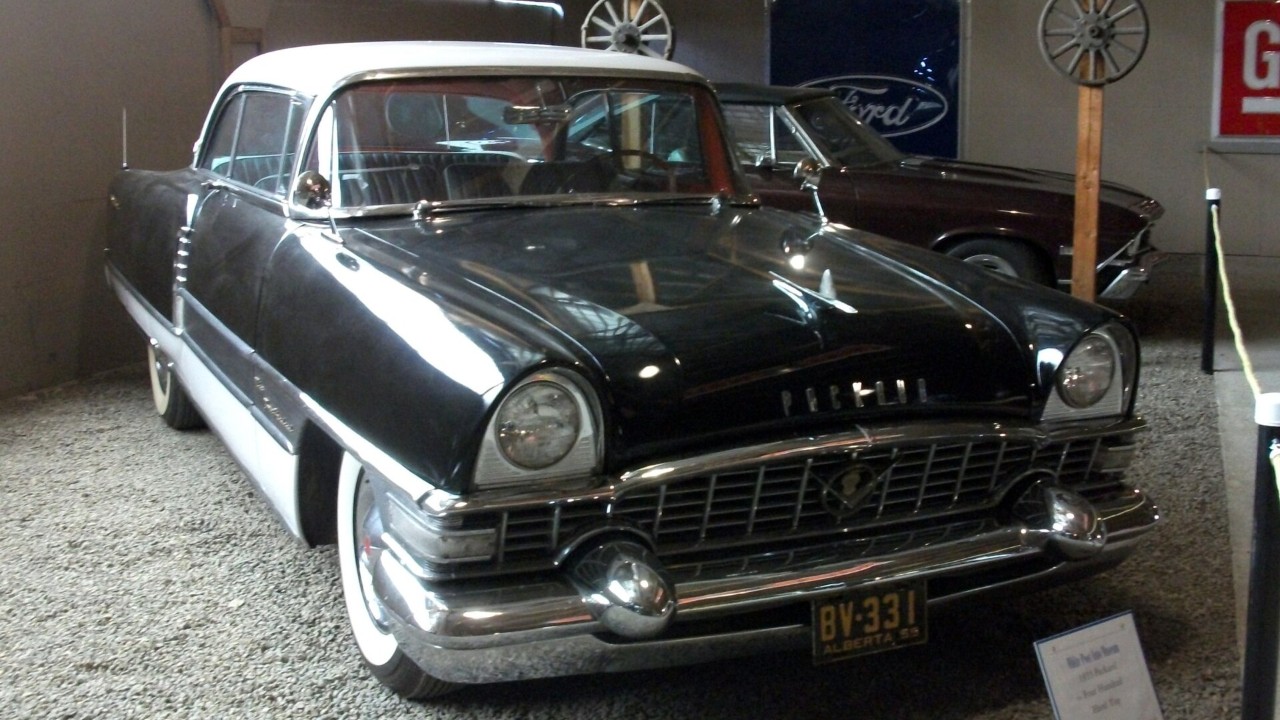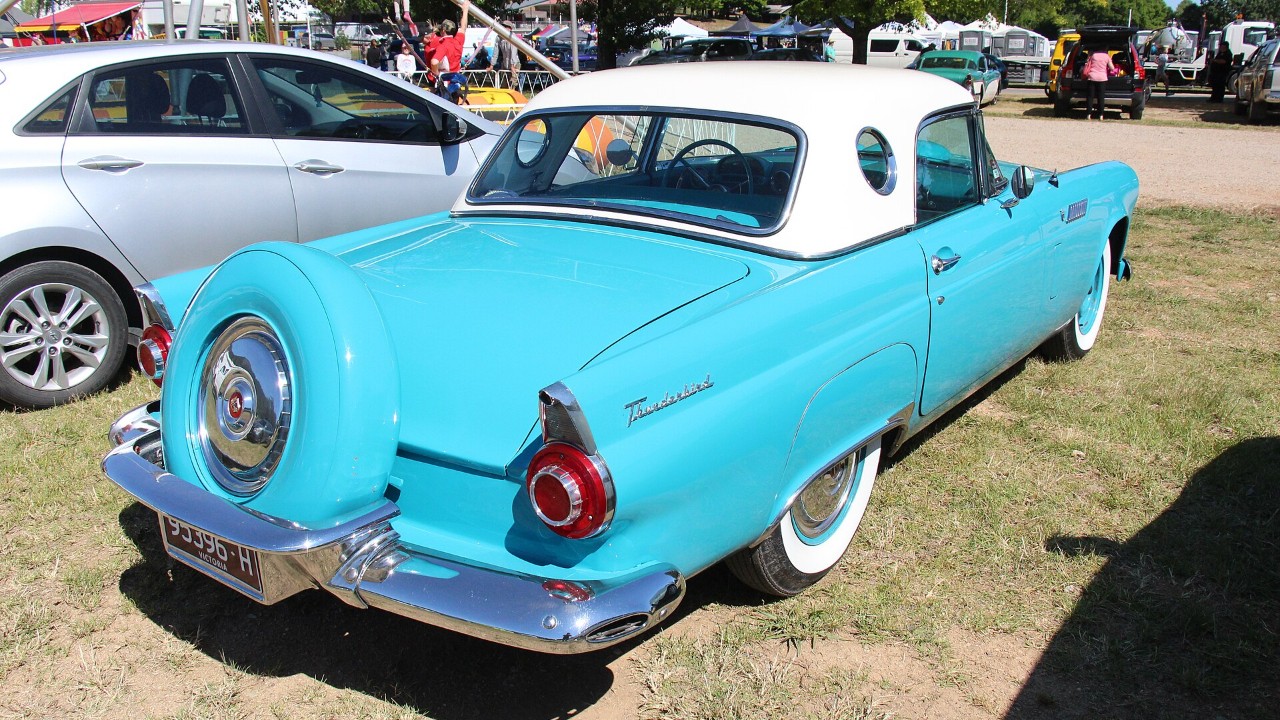
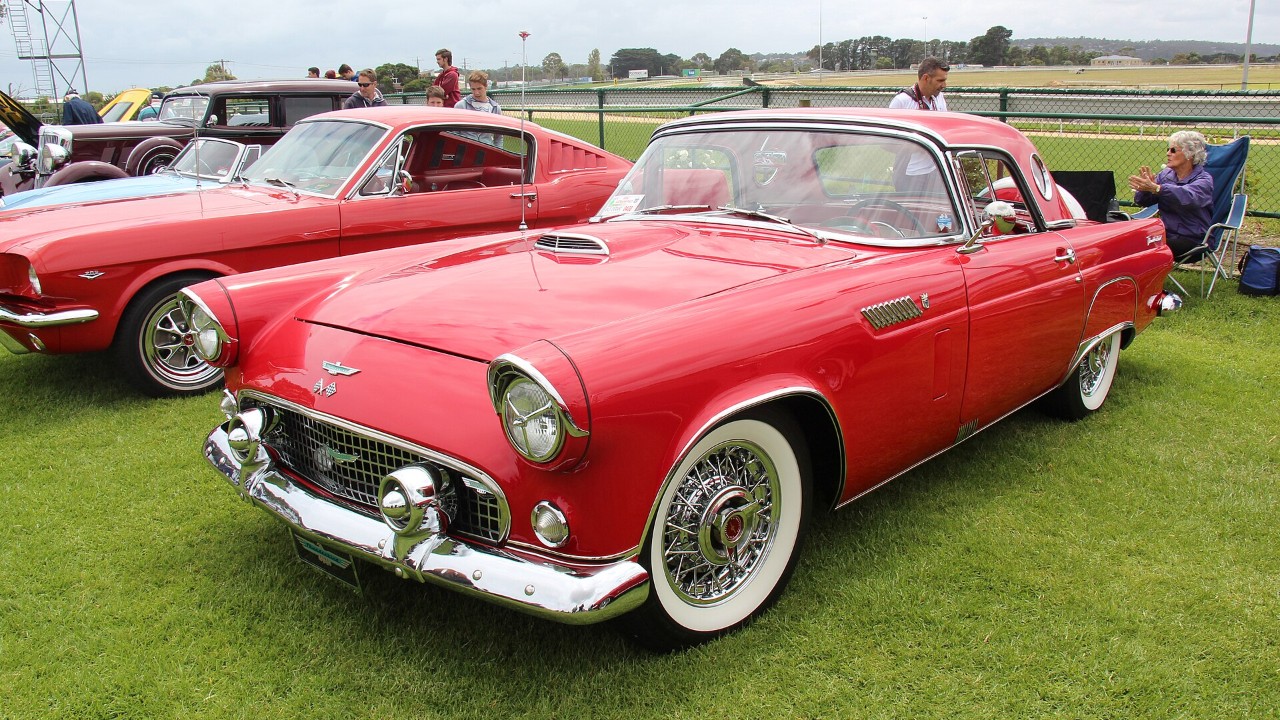
The first Ford Thunderbird was a two-seat car with a V8. In 1955, it also outsold the Corvette by a wide margin. From there, the name spent 50 years changing shape. First it grew back seats, then a formal roof and four doors. Later came a supercharger, and finally a return to two seats for one last run.
Yet most of those Ford Thunderbird icons never got the spotlight that a Mustang or a Corvette did. Instead, they earned their status one driveway at a time. Some carried a pace car’s gold paint. Others brought a new kind of luxury to the middle of the market, and a few were simply the best version of a familiar shape.
So these are our picks, in order of model year. Each is a specific car, down to the trim or edition. In our view, each one marks a turning point for the T-bird. The facts behind each choice come from period records and auction results; the verdicts are our own.
1. 1956 Ford Thunderbird Roadster
The second year of the two-seat Thunderbird fixed what owners of the first one had noticed. First, Ford moved the spare tire outside the trunk to free up luggage room. It also moved the exhaust tips to the ends of the rear bumper. In addition, new air vents behind the front wheels brought more fresh air into the cabin.
Buyers who ordered the removable hardtop could also get round “porthole” windows at no extra cost. They opened up the view over the driver’s shoulder. In our view, they also became the look many people picture for an early T-bird. Under the hood, a 312-cubic-inch Y-block V8 joined the standard 292 as an option.
Ford built 15,631 Thunderbirds for 1956, the smallest total of the three two-seat years. That makes the ’56 the scarcest of the early birds by production. For the story of how it all began, see how the 1955 Ford Thunderbird created a new kind of luxury.
Our take: the 1955 car invented the formula, but the 1956 roadster refined it. With the outside spare and the porthole roof, it turned a clever idea into a shape you can spot across a parking lot.
2. 1961 Ford Thunderbird Indy 500 Pace Car
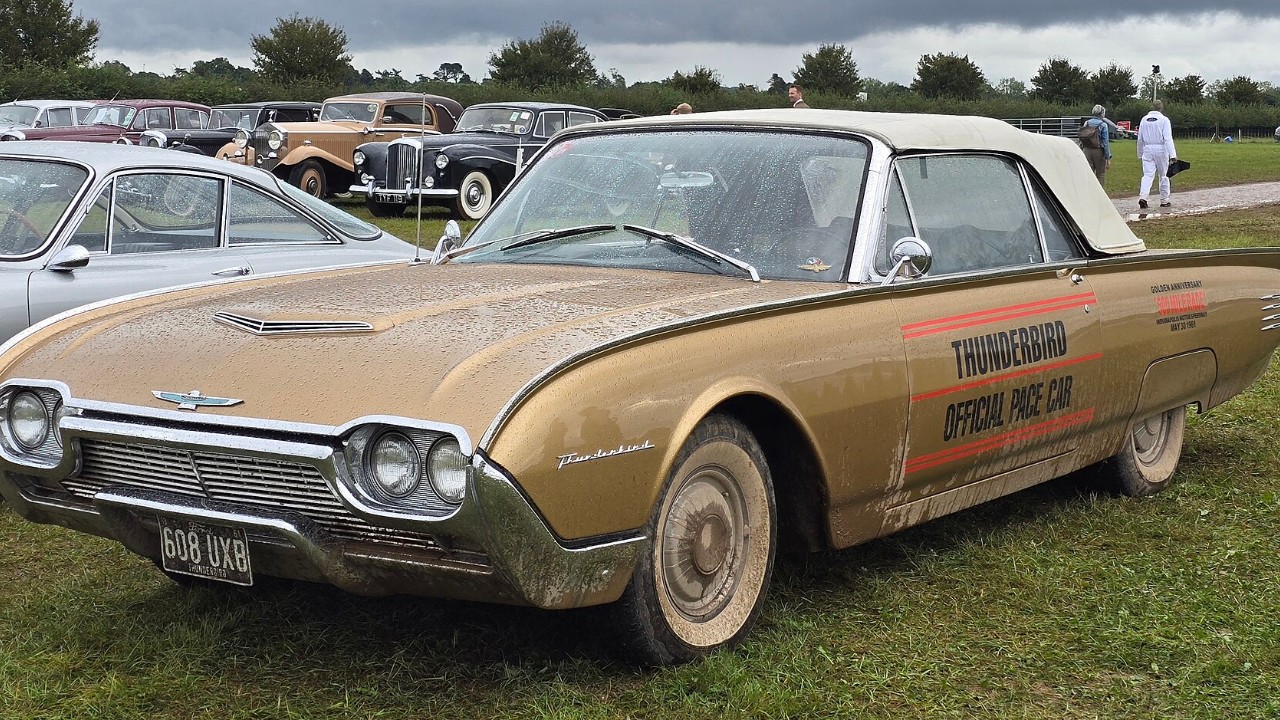
The 1961 Indianapolis 500 marked 50 years since the first race at the Speedway. To celebrate, Ford supplied a gold-painted Thunderbird convertible to pace the field, according to The Henry Ford’s archive. The museum holds a photo negative of the official pace car from race day, May 30, 1961.
However, the program went well beyond one car. Old Cars Weekly reports that Ford sent 34 convertibles to Indianapolis that year. They included an official pace car, an alternate and 32 Festival Cars. The same story says the official car is believed to have gone to A.J. Foyt as part of his winnings.
Under the gold paint sat the new third-generation body. It traded the corners of the late 1950s cars for smooth curves. Meanwhile, power came from a 390-cubic-inch V8 rated at 300 horsepower, the standard engine that year. Meanwhile, the convertible top folded away with the press of a switch on the driver’s door.
Our take: pace car duty turned a new design into a national news photo. Few model launches get a better stage than the 50th anniversary of the Indy 500.
3. 1963 Ford Thunderbird Landau Hardtop
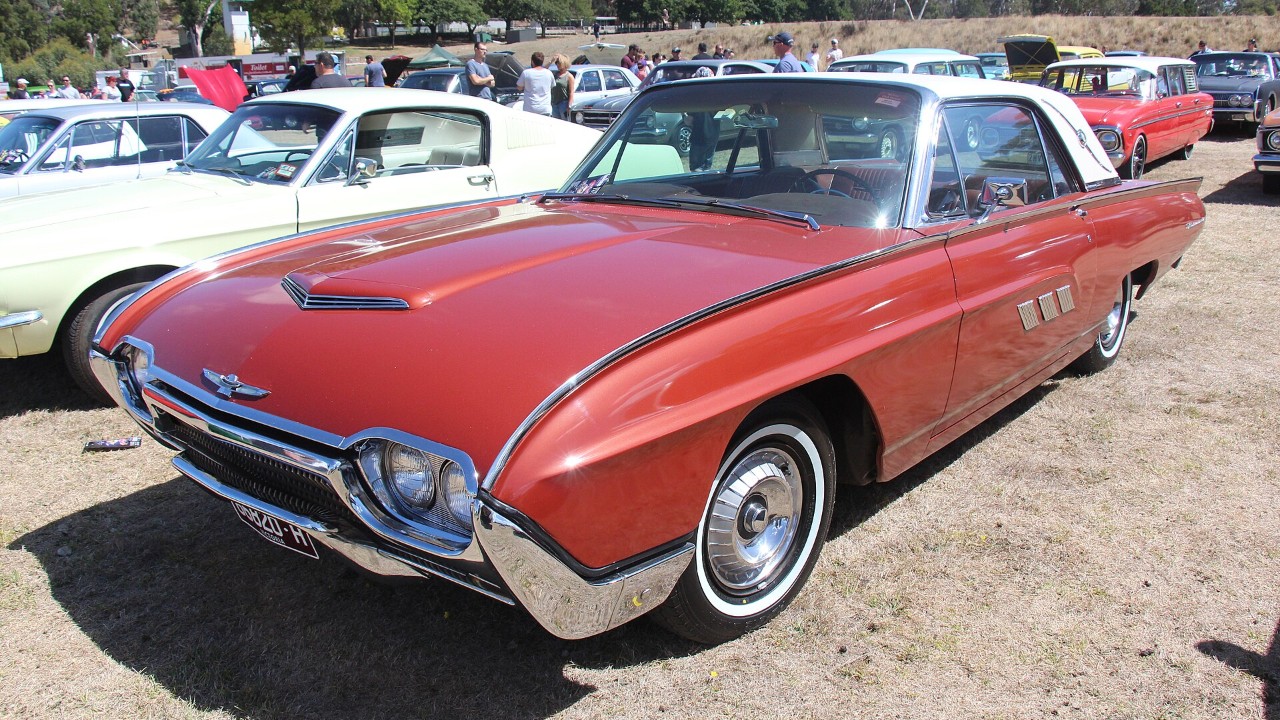
Ford introduced the Landau name on the Thunderbird for 1962. At first, it came with a vinyl roof and decorative S-shaped bars on the rear roof pillars. By 1963, the Landau had become the second best-selling model in the lineup after the standard hardtop, with 12,193 sold.
The 1963 car added simulated wood-grain trim inside, which suited the Landau’s formal style. It also kept one of the most famous gadgets of the era. With the car in park, the Swing-Away steering wheel slid about 18 inches to the right. As a result, the driver could get out more easily. In fact, the shifter stayed locked until the wheel returned to center.
In our view, that vinyl roof was a preview of where the whole Thunderbird line was heading. Later generations kept coming back to padded tops and landau bars.
Our take: the 1963 Landau is the car that showed Ford what Thunderbird buyers really wanted. That was not more speed so much as more presence.
4. 1966 Ford Thunderbird Town Landau
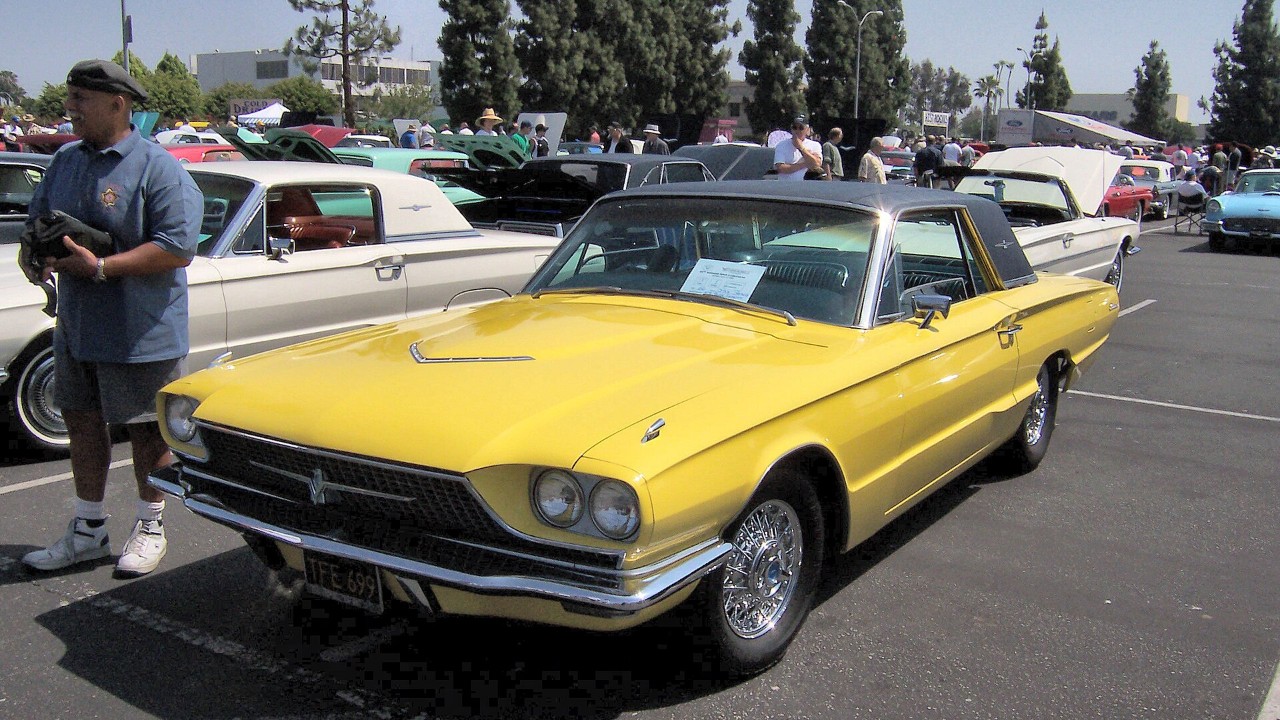
For 1966, Ford added a Town roof to the Thunderbird. It closed off the rear quarter windows entirely, giving the car blind rear pillars and a far more formal profile. The trade-off was a smaller view out the back, but buyers did not seem to mind.
The Town Landau combined that roof with a padded top and the landau bars. In fact, it became the best-selling Thunderbird of the year by a wide margin. Ford built 69,176 Thunderbirds for 1966, and 35,105 of them were Town Landaus. So more than half of all buyers chose that one model.
Under the hood, the 390 V8 went up to 315 horsepower that year. For more pull, buyers could order a 428-cubic-inch V8 rated at 345 horsepower. As a result, the 0-60 mph time dropped to about nine seconds. Two years earlier, the 1964 redesign set up this squared-off generation. We looked at that change in why the 1964 Ford Thunderbird signaled a new direction for personal cars.
Our take: the Town Landau is the roofline that ruled the late 1960s and 1970s. To us, it set the template for the formal, closed-in rooflines that followed.
5. 1968 Ford Thunderbird Fordor
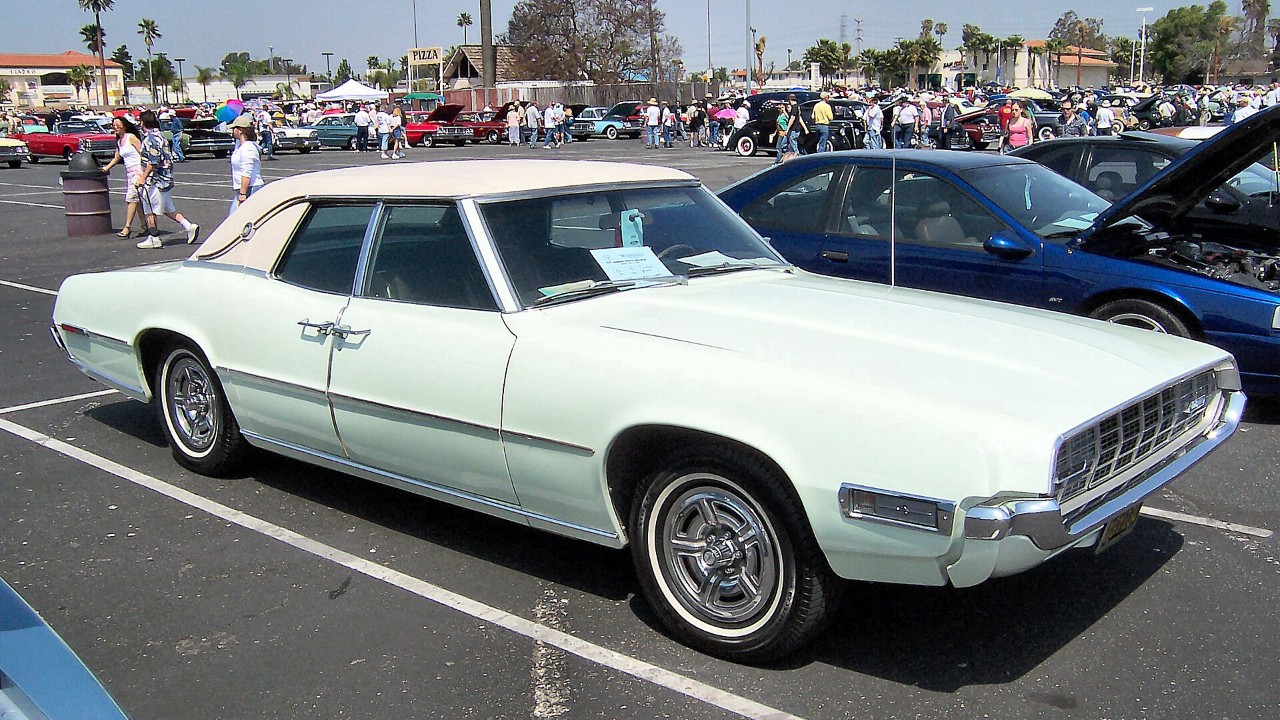
The fifth-generation Thunderbird made its biggest break with tradition. For 1967, Ford dropped the convertible and added a four-door Landau, and its rear doors opened from the front edge. Those rear-hinged doors were also a signature of the Lincoln Continental sedans of the same era.
The change was more than skin deep. Ford also switched from unibody construction to a separate body on a frame, with rubber mounts between the two. The four-door rode on a 117.2-inch wheelbase, compared with 115 inches for the two-doors. This generation also hid its headlights behind a wide “fishmouth” grille.
For 1968, the new 429-cubic-inch “Thunder Jet” V8 arrived, rated at 360 horsepower (gross). In total, Ford built 64,391 Thunderbirds that year across all body styles.
Our take: on paper, a four-door Thunderbird sounds like a contradiction. Yet the Fordor proved the name could stand for comfort and luxury rather than a body style. Today, those rear-hinged doors are a big part of its charm.
6. 1979 Ford Thunderbird Heritage Edition
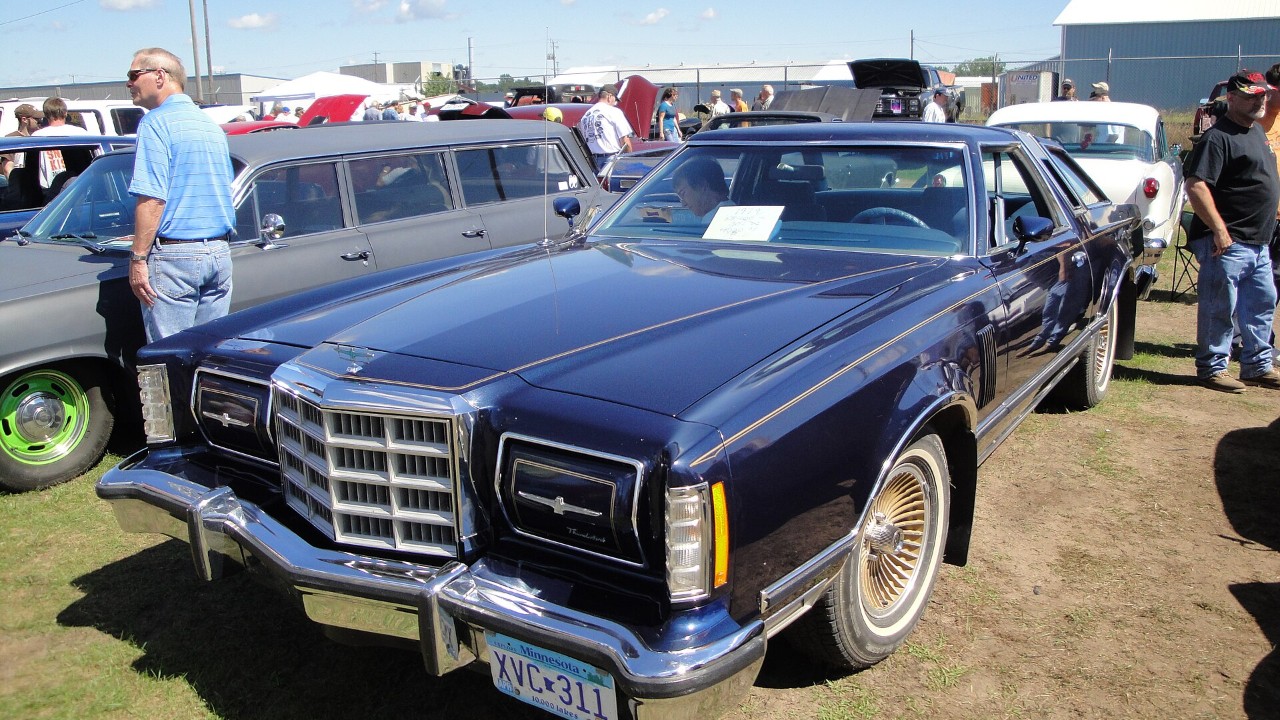
The 1977 redesign moved the Thunderbird onto an intermediate chassis shared with the Mercury Cougar and Ford LTD II. At the same time, Ford cut the price by $2,700 compared with 1976, and sales soared. By 1979, the top of the range was the Heritage. This option package followed the 1978 Diamond Jubilee and came in maroon or light medium blue.
A 1979 Heritage that sold through Hagerty’s marketplace shows what the package looked like up close. For example, it wore Light Medium Blue paint with a Medium Blue vinyl roof, opera windows and blue luxury cloth inside. It also had concealed headlights, cast-aluminum wheels and a 351-cubic-inch Windsor V8 with a three-speed automatic.
That car sold with no reserve for $5,595 in September 2026, showing 90,700 miles. For the top-of-the-range model from the T-bird’s best-selling era, that is a low price of entry.
Our take: the Heritage is the late-1970s Thunderbird at full volume, from the coordinated blue roof to the plush cabin. This era put the T-bird in more driveways than ever. As a result, it remains one of the easiest ways into the hobby.
7. 1990 Ford Thunderbird SC
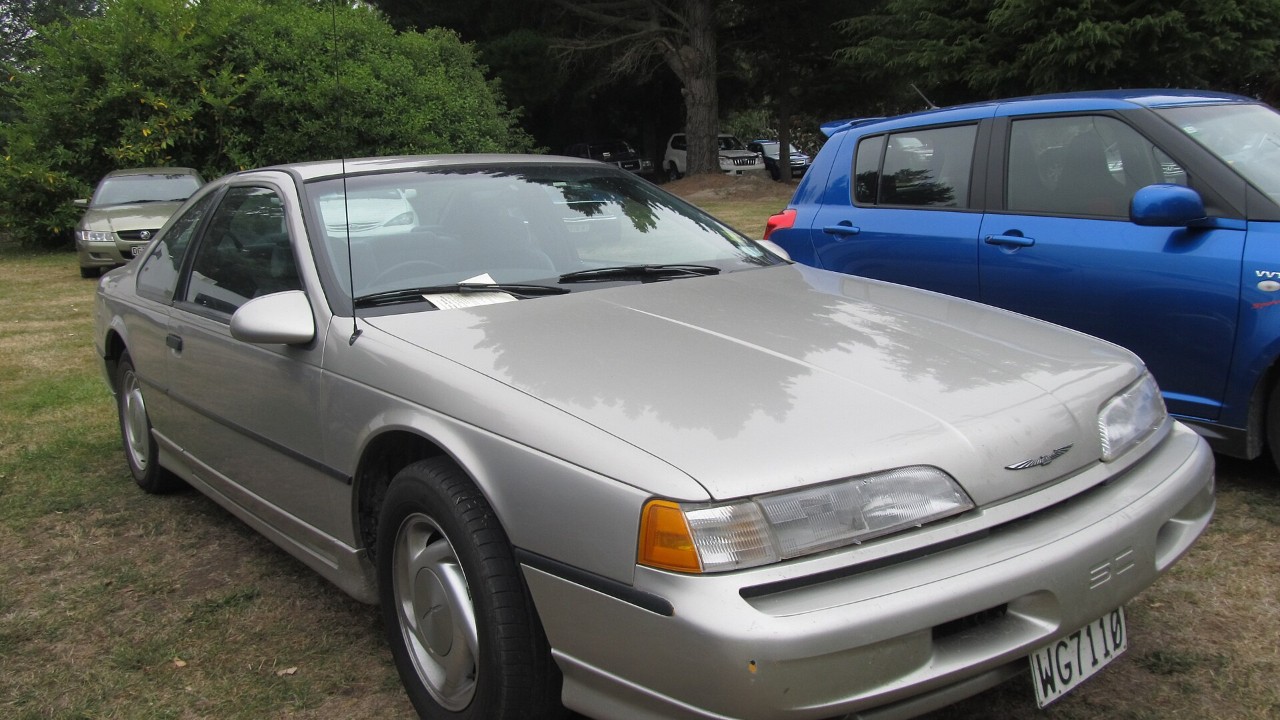
In 1989, Ford rebuilt the Thunderbird on its new MN12 platform with independent rear suspension. The Super Coupe was the performance model. Its supercharged and intercooled 3.8-liter V6 made 210 horsepower and 315 lb-ft of torque. As The Truth About Cars notes, Motor Trend gave the Super Coupe its Car of the Year award.
The SC was a driver’s car in a personal-luxury suit. Buyers could also choose between a five-speed manual and a four-speed automatic. Meanwhile, adjustable shocks, four-wheel disc brakes and anti-lock brakes came with the package. For 1990, Ford also built 3,371 black 35th Anniversary Super Coupes.
For a sense of value, look at a one-owner 1990 SC with a five-speed and 45,600 miles. It sold with no reserve for $13,375 on Hagerty’s marketplace in October 2026.
Our take: the Super Coupe is the Thunderbird that brought performance back to the name after years of comfort-first cars. With a manual gearbox, boost and a Traction-Lok rear end, it shows a different idea of a T-bird.
8. 2005 Ford Thunderbird 50th Anniversary Edition
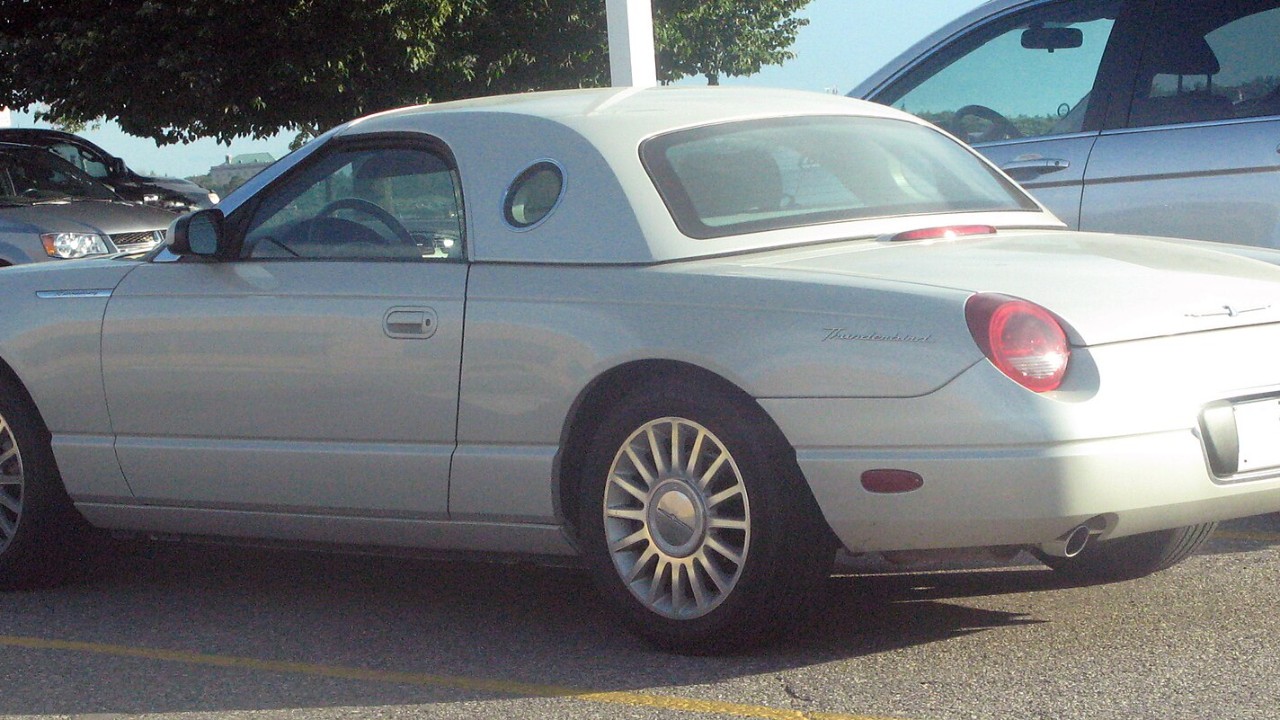
The last Thunderbird returned to the original idea: two seats, a removable top and a V8. Ford first put the retro car on sale in August 2001. Later, it announced that 2005 would be the final model year, with production at Wixom ending that July, NBC News reported. Ford Division president Steve Lyons explained the decision. “We promised all along that this Thunderbird would have a limited production run, and we’re being true to our word,” he said.
To mark the name’s 50th anniversary, Ford unveiled this edition at Wixom on November 5, 2004. According to The Auto Channel’s report, production was limited to 1,500 cars for North America. Each one also wore Cashmere tri-coat paint with a matching hardtop and Cashmere leather seats.
Inside, a Soft Gold 50th Anniversary badge sat on the dashboard, with the logo embossed on the seatbacks. In addition, a numbered plaque in the glove box told each owner exactly which car they had.
Our take: as a send-off, this is the right car to close the list, because it ends where the story began. By the time Ford announced the end, it had sold 54,360 of the new-generation cars. The 50th Anniversary Edition is the numbered, limited version of that final model year.
More from Fast Lane Only