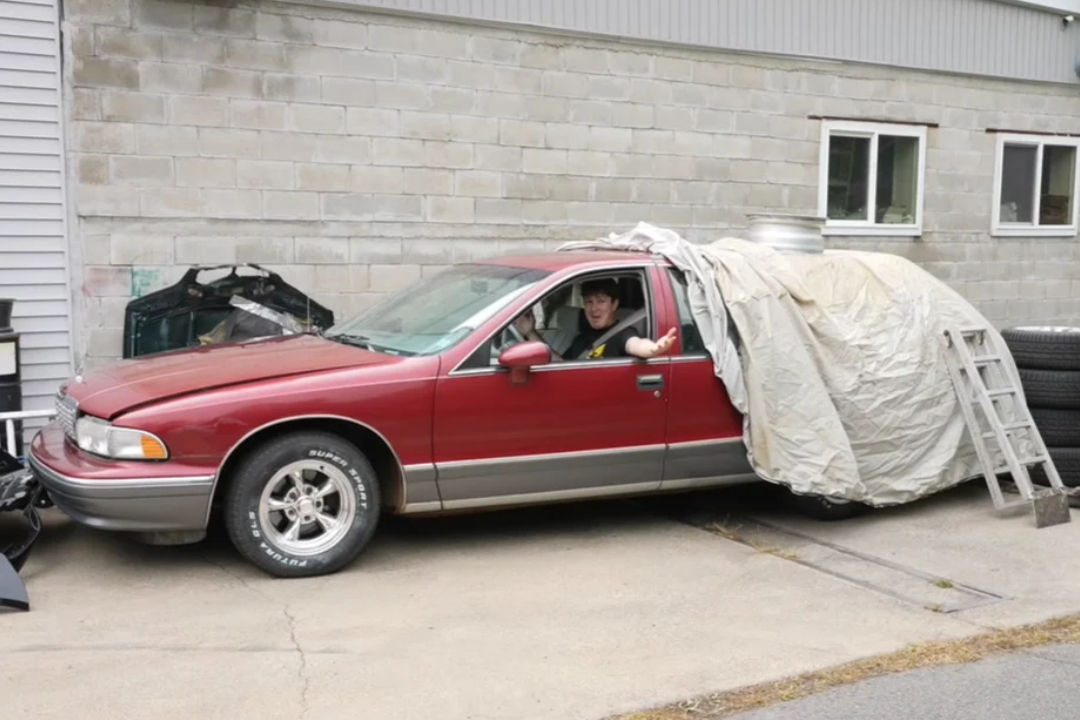
Some cars get restored because they are valuable. Others get restored because somebody refuses to let them disappear. A Chevrolet Caprice station wagon that spent three decades abandoned on an island falls firmly into the second category, and the fact that it is now road-legal enough to attempt 2,400 miles of Route 66 says more about stubbornness than it does about craftsmanship.
The Caprice wagon belonged to Justin’s grandfather, a man whose dream had always been to drive Route 66 in this exact car. That dream sat untouched for thirty years while the wagon weathered on an island, and it stayed untouched even after Justin brought it home last summer and cleaned it up. Bringing a car back from thirty years of neglect means discovering, piece by piece, everything wrong with it.
With three weeks left before a planned road trip retracing his grandfather’s dream, Justin found that “worse than I remember it being” was an understatement. The engine was not running right, several systems barely functioned, and the exhaust was shooting open flame out from underneath the car. That last detail was less a maintenance item and more a countdown clock.
Chasing flames before chasing miles
The exhaust was not a cosmetic problem. Headers dumping straight out under the floor meant real fire near a moving vehicle, and Justin’s first attempt to fix it, a budget retrofit using leftover tubing, flex pipe, and hose clamps, did not survive first contact with a running engine. The car sputtered, leaked, and refused to idle properly.
A second attempt, built with stainless tubing and clamps from CarQuest and AutoZone, looked more legitimate but produced the same result. The instinct was to blame the muffler, maybe a blockage or a nest built up over months of sitting idle. The actual answer was simpler and considerably more embarrassing: the car was almost out of gas. Once fuel went in, the freshly fabricated exhaust worked exactly as intended, and a car that had spent the morning shooting flames suddenly sounded, in Justin’s own assessment, better than expected for something held together with off-the-shelf clamps.
A checklist built from thirty years of neglect
With the exhaust handled, the rest of the wagon’s problems came down to a list that read less like a restoration plan and more like a survival checklist for a desert crossing. An electric cooling fan, wired in at some point to replace the original engine-driven unit, had a disconnected lead and a loose mount, which is not something you want to discover halfway through a hot climate. Reattaching the wire to the battery terminal and securing the fan with spare bolts and zip ties solved a problem that could have ended the trip in the first afternoon.
The tailgate’s rear glass, a feature Justin remembers fondly from riding in the wagon’s rear-facing seats as a kid, would not stay open on its own anymore. New gas struts fixed that with a simple clip-in swap. The rearview mirror was a tougher fight. It had fallen off the windshield more than once, and the adhesive meant to hold its mounting button in place failed on the first attempt entirely. A second, more generous application finally held, giving the wagon a working mirror for the first time in longer than Justin could say.
Wheels came off for rebalancing after Justin admitted an earlier job had been rushed and done poorly, a problem that would have turned into serious highway vibration over a multi-thousand-mile drive. New chrome lug nuts replaced originals that had corroded to the point of barely doing their job. Dim, decades-old headlight bulbs were swapped for brighter replacements, an easy fix that made an outsized difference in visibility.
The rust that almost swallowed the battery
Not every problem was solved with a bolt and a wrench. A section of sheet metal beneath the battery tray had rusted through completely, threatening to let the battery drop straight out of the car during the drive. Justin ground away the corroded metal, shaped a patch panel by hand, and fit it in place to give the battery something solid to sit on. It was not a permanent repair, and it was not meant to be. The goal was simply to stop the rust from spreading and keep the car’s electrical heart from falling out somewhere in the desert.
That kind of triage defined most of the build. This was a list of the failures most likely to strand the car, tackled in the order that made a road trip possible rather than perfect.
One last vacuum leak standing between the wagon and the highway
The final holdup traced back to a decision Justin had made months earlier, when he swapped in an aftermarket air intake chasing a small horsepower gain. The intake looked good and did little else, shaking loose over time and creating enough vacuum leaks to make the engine idle rough and stall. Pulling it and installing a properly fitted intake solved the rough running for good, and with that, every item on Justin’s checklist finally carried a green check mark next to it.
Ready enough for 2,400 miles
None of this turned Grandpa’s Caprice into a finished restoration. There is still no air conditioning for a trip that runs through desert heat, and Justin was upfront that the engine could still fail somewhere along the way. What the wagon has instead is a fighting chance, built system by system out of a checklist that started with an open flame under the floor and ended with a fuel system, cooling fan, suspension, lighting, structure, and intake that all actually work.
The wagon is being loaded onto a transport truck to begin the drive its original owner never got to make. Whatever happens between the start of Route 66 and the Audrain Concours in Newport, Rhode Island, this Caprice is finally attempting the trip it was always meant for, thirty years and one deeply patched battery tray later.
More from Fast Lane Only
- Unboxing the WWII Jeep in a Crate
- 15 rare Chevys collectors are quietly buying
- 10 underrated V8s still worth hunting down
- Police notice this before you even roll window down
*Research for this article included AI assistance, with all final content reviewed by human editors.