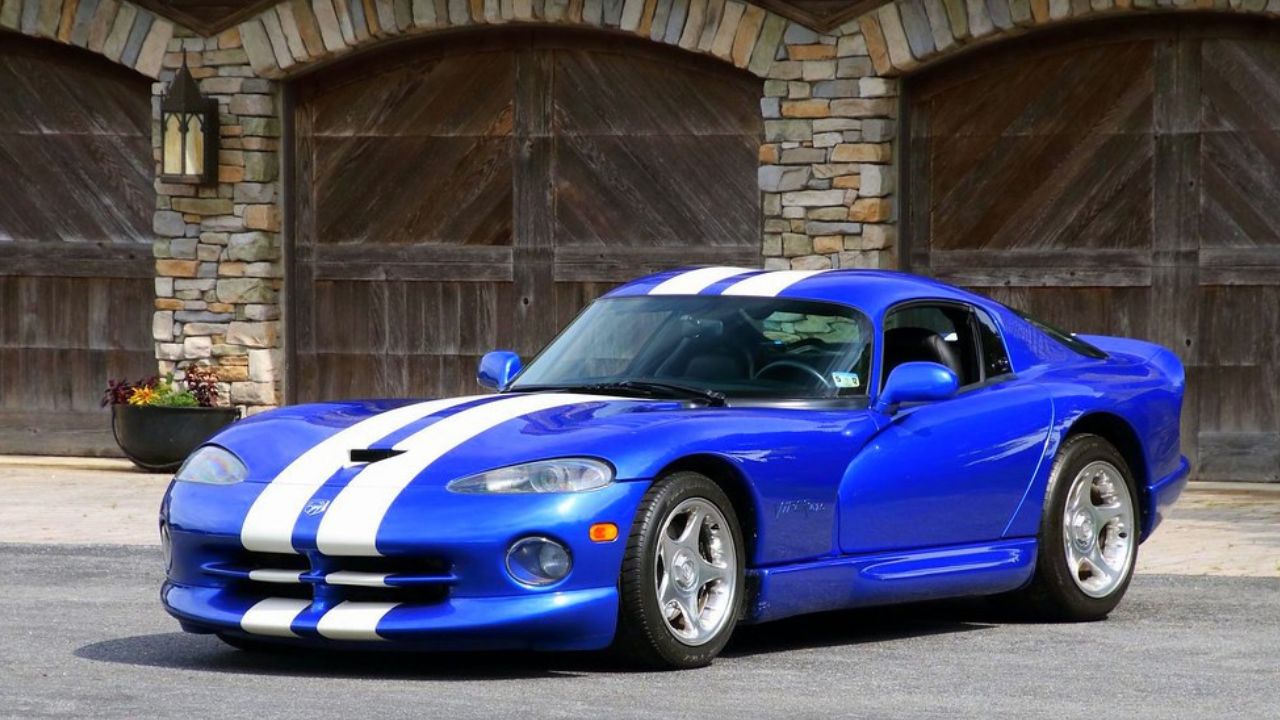
The 1996 Dodge Viper GTS arrived as a rare moment when a production car looked, sounded, and behaved like the exaggerated machines on bedroom walls. With its blue paint, white stripes, and outrageous V10, it crystallized a certain 1990s idea of American performance. Nearly three decades later, it still commands attention on auction blocks and in pop culture, proof that some shapes and stories do not age.
From raw roadster to refined coupe
The Viper story began with a brutal open-top roadster, but the 1996 GTS coupe marked a turning point. The new fixed roof changed the car’s whole character, trading the original’s rough, kit-car feel for something closer to a proper grand tourer. Its double-bubble roofline, shaped to clear helmets, instantly gave the silhouette a race-car stance.
Beneath the surface, the GTS was more than a styling exercise. Engineers revised the 8.0-liter V10 for more power and a higher redline while also improving drivability. Weight dropped compared with the earlier RT/10 roadster, and the chassis gained extra stiffness from the coupe body. For a car already known for its ferocity, the changes made the performance feel sharper and more cohesive rather than simply louder.
Inside, the GTS moved a step closer to mainstream expectations. It introduced features such as power windows and a better-finished cabin, broadening its appeal without softening its image. The car still felt like a racer that had wandered onto public roads, but now owners could live with it on longer journeys.
The look that launched a thousand posters
What made the 1996 GTS an instant poster car was not only performance, but a design that could be recognized in a single glance. The long hood, cab-backward proportions, and side-exit exhausts were already dramatic. The coupe roof and the signature blue paint with white stripes turned that drama into iconography.
The color scheme was a deliberate nod to American racing heritage, echoing classic sports racers that wore similar stripes. On the GTS, those stripes visually stretched the car even further, emphasizing its width and low stance. The result was a shape that looked fast even when parked and translated perfectly to magazine covers, video game menus, and die-cast models.
Where some contemporaries relied on complex surfaces or fussy details, the Viper GTS used simple, muscular forms. That simplicity helped it age gracefully. Modern supercars often appear intricate or aggressive, but the GTS still reads as clean and purposeful, which explains why enthusiasts continue to celebrate its styling at shows and online.
Performance that matched the image
Poster cars cannot live on looks alone. The Viper GTS backed up its image with serious performance that, at the time, rivaled or exceeded many European exotics. The naturally aspirated 8.0-liter V10 delivered towering torque from low revs, giving the car a distinctive character compared with the high-revving V8s and V12s of the era.
There was no turbo lag, no complex electronics, and no all-wheel drive. Power went through a manual transmission to the rear wheels, and the driver had to manage everything. That raw, analog experience became part of the legend. Owners and testers described the car as demanding but rewarding, a machine that punished sloppy inputs yet felt alive in skilled hands.
On track, the GTS formed the basis for the Viper’s motorsport program, which soon collected class wins at major endurance races. Those successes fed back into the road car’s reputation. When a car that already looked like a racing machine started winning in real competition, the poster on the wall felt less like fantasy and more like a street-legal version of a proven weapon.
Why the 1996 GTS still matters to enthusiasts and collectors
Nearly thirty years after its debut, the 1996 Viper GTS continues to matter in two overlapping worlds: enthusiast culture and the collector market. Among enthusiasts, it represents a type of analog, high-displacement performance that has largely disappeared. Modern performance cars often rely on downsized engines, turbocharging, and layers of electronic assistance. The GTS belongs to a different era, where displacement and mechanical grip carried the day.
That contrast has become more significant as emissions rules tighten and electrification expands. For many fans, the Viper GTS now stands as a reference point for what a pure, combustion-only American supercar could be. Its place in video games and movies keeps it visible to younger audiences, which helps sustain demand for surviving examples.
In the collector market, the car’s status is even clearer. Auction results show strong interest in low-mileage, original-condition coupes. One 1996 Viper GTS with just 45 miles sold for 133,000 dollars, a figure that reflects both rarity and nostalgia. That price places the car firmly in the modern-classic bracket, where limited production and cultural impact translate into serious money.
Collectors are particularly drawn to early GTS models in the original blue-and-white specification. Those cars connect most directly to the model’s launch story and media presence. As more examples accumulate miles or modifications, untouched cars from the first year become even more desirable, reinforcing the perception that the 1996 GTS is the version to own.
How the GTS helped define American supercar identity
The Viper GTS also shaped how American performance is perceived globally. Before the Viper, American sports cars were often framed as muscle machines that excelled in straight lines but struggled to match European rivals on track. The GTS, especially in its racing forms, challenged that stereotype by delivering credible handling and endurance results.
Its success gave domestic manufacturers a template for a different kind of halo car. Instead of chasing luxury or complex technology, the Viper leaned into raw power, simple construction, and a focus on the driver. That approach influenced later American performance models that embraced big engines and aggressive styling while gradually improving refinement.
At the same time, the GTS showed that a car could be unapologetically American yet still earn respect in Europe and Asia. The combination of outrageous displacement, striking design, and real-world performance created an exportable image. For many overseas enthusiasts, the blue-and-white coupe became their primary reference for modern American supercars.
What the Viper GTS means in a future of EVs and digital nostalgia
As the industry accelerates toward electrification, the 1996 Viper GTS occupies a new role. It serves as a tangible reminder of a peak internal-combustion moment, when emissions rules were looser and manufacturers could still build low-volume, high-displacement specials. That context helps explain why values have climbed and why owners tend to drive these cars sparingly.
The GTS also benefits from digital nostalgia. Many current buyers first encountered the car in video games and online forums rather than on the street. For that audience, owning a real Viper is a way to connect childhood memories with adult means. As long as those digital representations remain widely available, interest in the physical cars is likely to persist.
Looking ahead, the car’s collectability will probably hinge on originality and documentation. Early coupes with factory paint, unmodified drivetrains, and low mileage are positioned to remain the most sought after. Special editions and later performance variants add depth to the story, but the first-year GTS keeps the central role in the narrative.
In a market where many modern supercars feel interchangeable, the 1996 Dodge Viper GTS still stands apart. Its combination of dramatic styling, unfiltered performance, and cultural imprint turned it into a poster car the moment it arrived, and those same qualities now anchor its status as a modern classic. For enthusiasts and collectors alike, it represents a high point in analog performance that is unlikely to be repeated.
More from Fast Lane Only
- Unboxing the WWII Jeep in a Crate
- 15 rare Chevys collectors are quietly buying
- 10 underrated V8s still worth hunting down
- Police notice this before you even roll window down
*Research for this article included AI assistance, with all final content reviewed by human editors