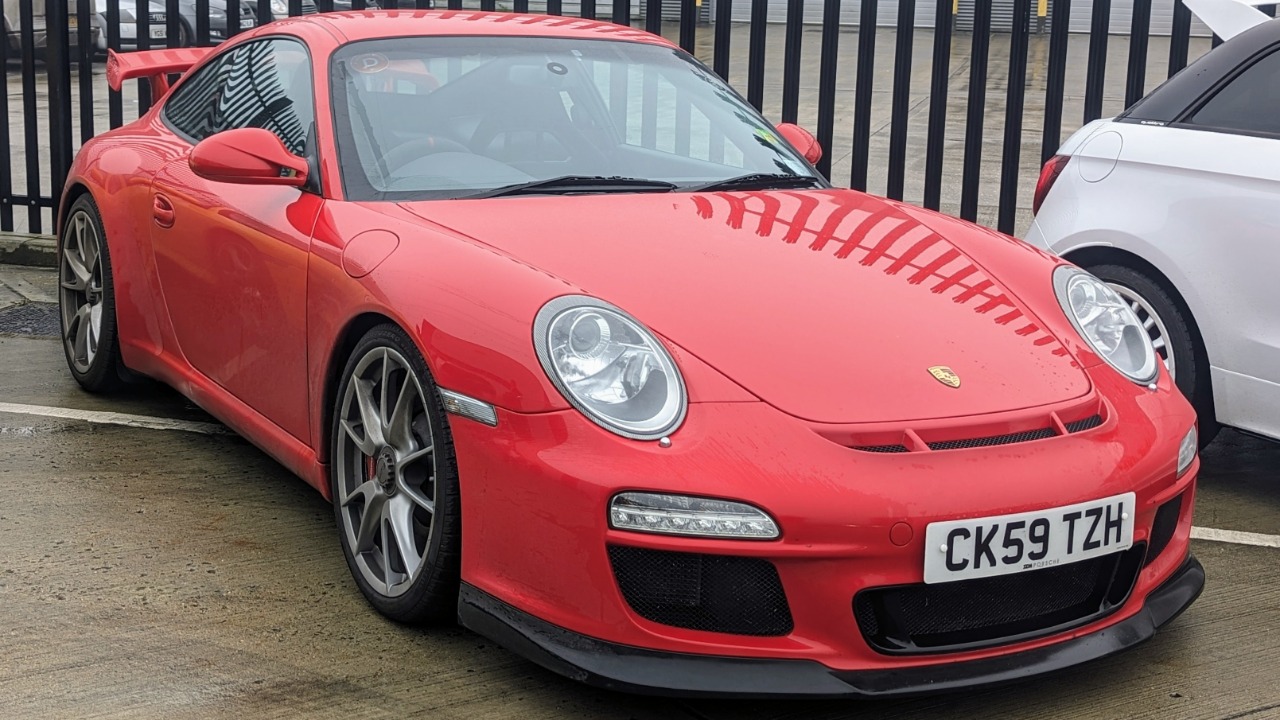
The 2009 Porsche 911 GT3 arrived at a moment when performance cars were racing toward electronics, dual‑clutch gearboxes and digital filters between driver and road. Instead of chasing that trend, it doubled down on feel, feedback and mechanical honesty, turning a familiar 997 shape into one of the clearest expressions of purist driving of its era. To understand why it still resonates, you have to look at how Porsche sharpened the hardware, stripped the cabin of distractions and quietly set the template for every analogue‑leaning GT3 that followed.
The GT3 lineage and the 2009 turning point
By the time the 2009 car arrived, the GT3 badge already carried serious weight inside the 911 family. The line had started with the 996-generation 911, a model that took Porsche’s motorsport know‑how and distilled it into a road car that enthusiasts treated as a reference point for driver involvement, a role later road tests would describe as being Regarded as a kind of sacred cow. When the 997 generation arrived, the GT3 formula matured, but it was the 2009 update that really crystallised the car’s identity as a benchmark for people who cared more about steering feel than lap‑time bragging rights.
Porsche’s own retrospective on the model underlines how decisive that update was. When the 911 G T3 was revised in 2009, engineers increased the engine’s displacement to 3.8 litres and significantly raised output compared with the earlier 3.6‑litre car, yet they kept the recipe naturally aspirated and rear‑drive. That decision, in an era already flirting with turbocharging and automated gearboxes, signalled that this version of the 911 was still being built first and foremost for people who wanted to feel every mechanical step between their right foot and the rear tyres.
Mechanical purity: engine, gearbox and chassis
At the heart of the 2009 car’s appeal is its powertrain, a Mezger‑based flat‑six that trades outright numbers for response and character. Contemporary descriptions of the GT3 family stress that in every 911 G T3 you can count on a naturally aspirated flat‑six that thrives on revs and a chassis tuned for track work with very little in the way of creature comforts, a pattern that later generations continued as a daily‑driveable but uncompromising machine. The 3.8‑litre unit in the 997.2 sharpened that formula, revving hard and clean, with a throttle that felt wired directly to the driver’s synapses rather than filtered through software.
Crucially, all of that power flowed through a six‑speed manual, not a dual‑clutch. A detailed buyer’s guide to the broader 997 range notes that Transmission options across the series included Manual, Tiptronic and PDK, with Early 997.1 m cars offering both three‑pedal and automatic choices. The GT3, however, stayed resolutely manual, even as PDK became respected for its performance advantage, and that stubbornness is exactly what endeared it to drivers who wanted to work for every shift rather than let software chase the last tenth.
Designing for the driver, not the spec sheet
Slide into a 997.2 GT3 and the priorities are obvious before you even turn the key. Period road tests of earlier hardcore 911s talked about a fascia dominated by a central tachometer, with a red line that cuts the dial in half and a driving position that puts your legs, arms and sightlines in perfect alignment, a layout one reviewer memorably framed as the Perfect Porsche for the purist. The 2009 GT3 carries that same philosophy, with pedals ideally spaced for heel‑and‑toe work and a cabin that feels more like a cockpit than a lounge.
Outside, the car looks purposeful but not theatrical, with classic 911 proportions and subtle aero that only reveals its aggression when you notice the fixed rear wing and deep front splitter. A detailed listing for a low‑mileage 2009 example describes it as a wonderfully immersive analogue sports car, a 911 built on the 997.2 platform and showing just 15,379 MILES, sending power to the rear wheels via an engaging six‑speed manual transmission, a combination that underlines how PORSCHE deliberately kept the car focused on the person behind the wheel rather than on headline aero figures.
On the road and track: why it feels so “right”
Out on the road, what strikes me most about the 997.2 GT3 is how naturally it flows from one input to the next, as if the car has been calibrated around human reflexes rather than lap‑time simulations. Owners and reviewers of similar‑era cars talk about the steering being pure hydraulic, with feedback that is raw, direct and full of detail, something you simply do not get in later electrically assisted systems, a trait highlighted in a description of a 2010 Porsche 911 GT3 where the writer notes that, Plus the steering is pure hydraulic, so the feedback is raw. The 2009 car shares that same rack, and it is a huge part of why the car feels alive at any speed.
That sense of connection carries over when you push harder. A video review of a 2010 911 G T3 on the 997.2 platform describes it as a favourite precisely because it demands proper technique, with the driver working the gearbox, brakes and steering in concert rather than relying on electronics to tidy things up, a sentiment echoed in a clip simply titled Porsche 997.2 GT3 test drive and review. The car’s balance, its willingness to rotate under trail braking and the way the rear tyres dig in on exit all reward smooth, committed driving, which is exactly what purists look for when they talk about a car “talking” to them.
Purist intent in a changing GT3 world
To really appreciate how the 2009 GT3 embraced purist driving, it helps to see it in the context of what came next. Later in the 997 era, the GT3 RS variant became a cult favourite, with enthusiasts relishing the way it sharpened the already intense base car, something you can sense in footage of Driving Richard Hammond in a 997 G T3 RS as he revels in its immediacy. As the GT3 moved into the 991 and 992 generations, power and grip climbed, with modern versions delivering figures like 375 k W and 510 PS at 8,400 RPM and 460 Nm of torque, numbers quoted in a product breakdown that frames the latest 911 G T3 as closer to motorsport than ever, complete with a 6‑speed GT sports manual transmission option, a package summarised under the heading By the numbers.
Yet even as the GT3 became faster and more capable, the 997.2’s relatively modest footprint and analogue feel kept it at the centre of enthusiast debates about the “purest” 911. Modern commentators still describe the GT3 line as the benchmark for what a modern driver’s car should be, praising the way the 911 G chassis, Mezger‑derived engines and detailed feedback make every drive feel special, language that appears in a social‑media deep dive that opens with the phrase Porsche 911 G T3 as benchmark. When people call the 997.2 GT3 the sweet spot, what they are really saying is that it captures that benchmark feel before electronics and aero pushed the car further into race‑car territory.
Manual loyalty and the wider GT3 philosophy
One of the clearest ways the 2009 GT3 signalled its loyalty to purist values was by sticking with a manual gearbox even as the rest of the performance world embraced dual‑clutch speed. Later GT3s would flirt with dropping the stick entirely, prompting concern from enthusiasts who saw the car as a last bastion of three‑pedal engagement, a tension that surfaced when reports noted that the 911 G T3 was Regarded by many as the purest of the Porsche 911s just as PDK loomed. The 997.2 sits on the safe side of that divide, a car that never asked its owners to choose between involvement and performance because it simply refused to offer the automated alternative.
Interestingly, the broader GT3 story since then has shown that manual loyalty and outright pace are not mutually exclusive. Recent coverage of a new 911 G T3 setting a Nürburgring benchmark with a stick shift notes that, Even without the automated, super‑fast and precise gearshifts of PDK, the car could beat the time of its predecessor with PDK, a point echoed in another report that repeats the line that Even without the automated, super‑fast and precise gearshifts of the PDK the manual GT3 could still carve seconds off its predecessor. That arc, from the 997.2’s quiet insistence on a six‑speed to today’s lap‑record‑chasing manuals, shows how right Porsche was to trust that there would always be drivers who valued the process as much as the result.
Everyday usability without diluting the edge
For all its track focus, the 2009 GT3 never forgot that it was still a 911, a car expected to handle school runs and commutes as well as circuit days. Owners of later GT3s often talk about how the handling is so good, the car so light and nimble, that you get a lot of fun out of simply throwing it along a back road, a sentiment captured in a video asking whether you can daily drive a Porsche 911 that shows a driver enjoying the balance and compliance of a modern GT3‑flavoured 911 on real‑world roads, as seen in the clip titled Can You Daily Drive A Porsche 911. The 997.2 GT3 shares that duality, firm but not punishing, with a cabin that, while sparse by luxury‑car standards, still offers enough refinement to make long journeys feel like an event rather than an ordeal.
That blend of usability and intensity has become a defining GT3 trait. A recent road test of the 992‑generation car points out that Porsche’s GT3 line began with the 996-generation 911 and has evolved into a machine that can be specced with a manual transmission even as it laps circuits at supercar speeds, a continuity highlighted in a piece that opens with Porsche 911 GT3 (992) road test. The 997.2 sits near the start of that arc, a car that proved you could have a focused, naturally aspirated, manual 911 that still worked as a daily, and in doing so it set expectations that every GT3 since has been judged against.
How the 2009 GT3 shaped the purist ideal
Looking across the GT3’s 25‑year story, the 2009 car stands out as the moment when Porsche locked in a philosophy that still guides the badge today. Later commentators describe the GT3 as one of the most engaging cars ever built, inviting drivers to Step inside the cockpit of a 911 G T3 and feel the emotion of true performance, from its naturally aspirated flat‑six to its precise steering and chassis tuning, language that appears in a video urging viewers to Step into the Porsche 911 GT3. The 997.2 version distilled those traits into a package that was still compact, still relatively simple and still utterly focused on the driver’s senses.
That influence shows up not just in later GT3s but in how enthusiasts talk about performance cars more broadly. Modern reviews of the 992 G T3 describe it as the purest driving experience in the current 911 range, with Hammond confirming that the 911, 992 G and 911 G T3 remain incredibly light and communicative thanks to carefully tuned dampers and suspension. Social‑media clips celebrate the GT3 as a naturally aspirated, high‑revving sports car that connects driver and machine in a way few modern cars manage, with one reel simply inviting viewers to watch a Porsche 911 G T3 at full song. When people reach for an example of what “purist driving” looks like in the real world, they still end up describing the qualities that defined the 2009 GT3: a howling flat‑six, a manual gearbox, hydraulic steering and a chassis that rewards skill more than it flatters mistakes.
More from Fast Lane Only: