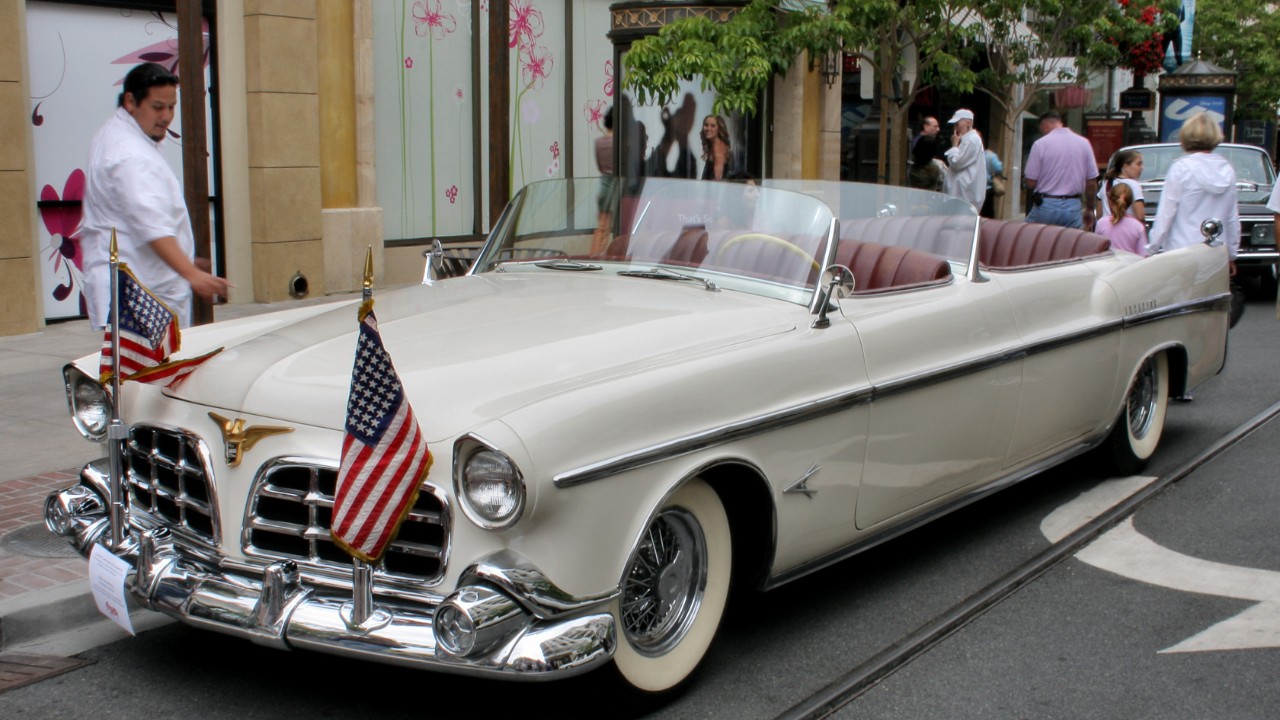
Chrysler built three Imperial Parade Phaeton cars in 1952, each one a dual-cowl open car more than 20 feet long. Two went to New York and Los Angeles. The third was meant as a gift for the White House, but federal policy on gifts meant Washington couldn’t take it. So Chrysler kept that one titled in Detroit and lent it out whenever a president needed it.
For more than seven decades, these three cars have carried presidents, astronauts and generals through cheering crowds. Two of them still belong to the cities that received them.
They were also a bold piece of publicity. Instead of selling these cars, Chrysler built them to be seen with the most famous people of the era.
Why Chrysler built the Imperial Parade Phaeton
The idea came from Chrysler chairman K.T. Keller in 1951, according to Bill Siuru’s history for Old Cars Weekly, reprinted by the Imperial Club. Stylist Cliff Voss, chief body engineer Harry Chesebrough and Virgil Exner turned it into metal. Siuru says the three phaetons cost Chrysler “a mere $100,000” to develop.
Under the body sat a Crown Imperial limousine chassis, with the wheelbase stretched two inches to 147.5 inches. Power came from Chrysler’s 331.1-cubic-inch Hemi V8, rated at 180 horsepower. Siuru adds a Fluid-Torque transmission and Hydraguide power steering. That last item mattered, because Fox News puts each car at roughly three tons.
The body was the real showpiece, though. A second steel cowl behind the front seat split the car into two separate compartments, Paul F. Heinzman writes in The Imperial Eagle. Each compartment had its own curved, one-piece windshield and its own clock. As a result, the guest of honor rode in an open rear cockpit, well apart from the driver.
Three cities, three colors
Each car wore its own colors in 1952, Heinzman reports. The New York car was black with a light gray interior. Meanwhile, the Detroit car was metallic green with natural pigskin, and the Los Angeles car was cream with a rose interior.
New York put its car to work first. Its opening parade came on December 18, 1952, carrying Lt. Gen. Willis D. Crittenberger, according to Fox News’ 2022 profile of the car. Chrysler lent the car to the city at first and then donated it in 1961.
The Imperial Parade Phaeton meant for the White House
The third car had the grandest job. Chrysler intended it for the White House, but the federal government did not accept gifts, as autoevolution explains. Instead, the car stayed with Chrysler and went on loan to the White House when it was needed.
That arrangement still put it in front of history. According to autoevolution, Presidents Dwight Eisenhower, John F. Kennedy and Richard Nixon all used it. Across the three cars, Siuru’s list of riders also includes Lyndon Johnson, Winston Churchill, Nikita Khrushchev, Haile Selassie and John Glenn.
A 1955 facelift and a long afterlife
By the mid-1950s, the 1952 styling looked dated. So the cars went back to the factory in mid-1955 for a facelift, Heinzman says. Siuru lists the changes: 1955–56 front sheet metal and bumpers, a split grille, Imperial eagle emblems, tail fins and gun-sight taillights. Mechanically, they gained a four-barrel carburetor and higher compression.
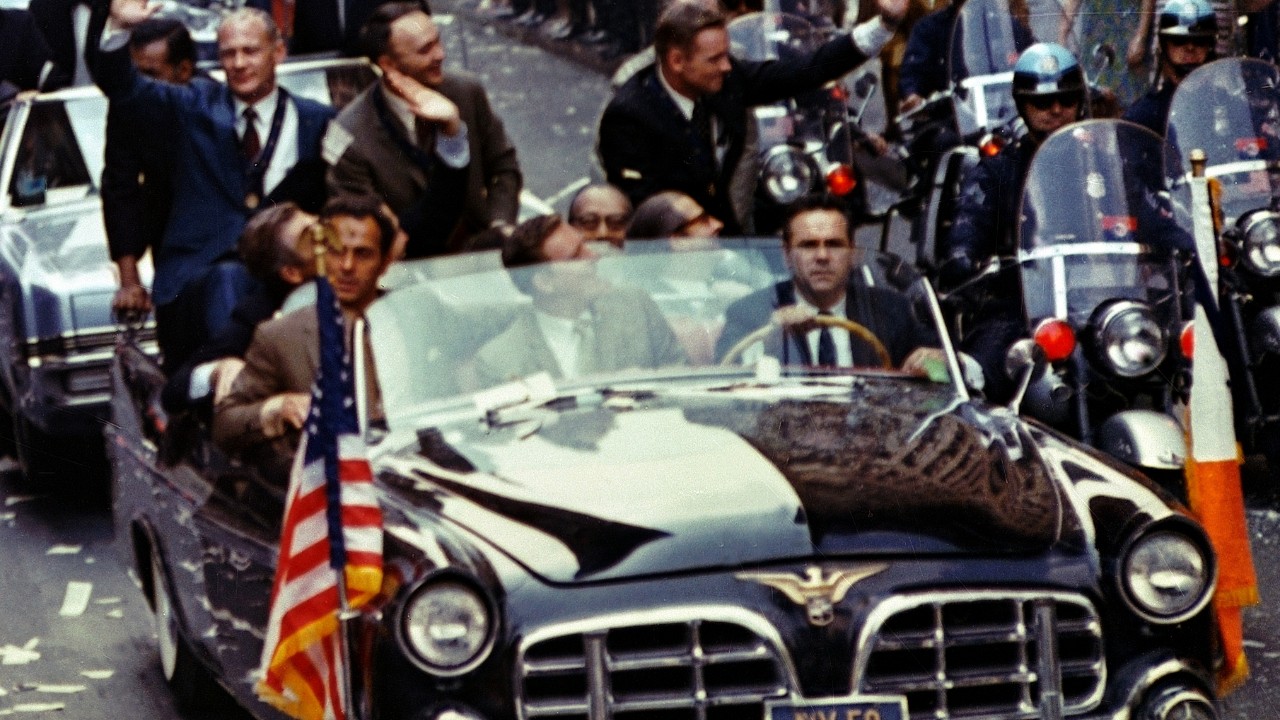
Their colors changed, too. New York’s car became off-white with red, Detroit’s turned desert sand with red, and Los Angeles’ went metallic silver-blue. However, New York’s car later went back to its original black during a 1980s restoration, Fox News reports.
The New York car went on to carry the Apollo 11 astronauts on August 13, 1969, with the crew perched on a padded platform over the trunk. Glenn rode in it after his orbital flight in 1962 and again in 1998. That makes him the only person paraded in it twice, Fox News says.
Where the three Imperial Parade Phaetons are now
Chrysler sold the Detroit car in 1970, autoevolution reports. Afterward, it spent years in the Imperial Palace collection in Las Vegas. Then the Petersen Automotive Museum bought it in 2001.
The other two never left public hands. Fox News reports that Los Angeles still owns its car. Meanwhile, New York’s administrative services department keeps the black car in Brooklyn and runs it regularly. Hagerty’s John Wiley told Fox News it could top $1 million at auction, but the city has no plans to sell it.
That leaves the car the White House couldn’t accept on display at the Petersen Automotive Museum in Los Angeles, where it has been since 2001.
More from Fast Lane Only