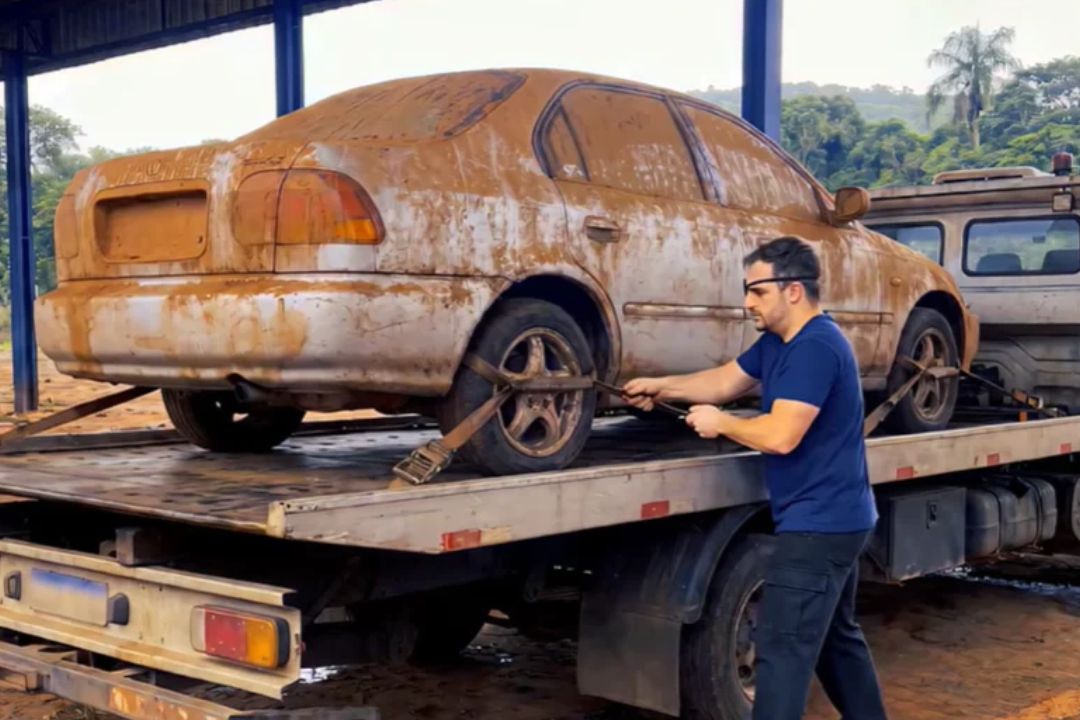
Nobody wanted this Civic. Not one single bid. It rolled into the auction lot dripping mud, wearing 106,000 miles and an engine that had gone for a swim, and every buyer in the room did the smart thing and scrolled right past it.
The host of Percepcar USA did the opposite. He looked at a flood car nobody would touch and saw the cheapest possible starting point for the Civic he’d always wanted to build. Five hundred dollars later, including the auctioneer’s fee, it was his. What came out the other end was a K20 turbo build with a manual swap, metallic blue paint and a brand-new electrical system from the ground up. But before any of that could happen, somebody had to crack the thing open and find out exactly how bad the water damage really was.
The $500 Civic looked cheap for a reason
The first job was getting the mud off. Pressure washing exposed the silver paint underneath, along with scratches and small dents that weren’t obvious in the auction photos. The car’s underside received the same treatment, with mud coming out of the wheel wells and other places the auction listing couldn’t show. Fortunately, the structure itself appeared intact, with no terminal rust found during the inspection.
The engine was another story. After checking the dipstick, spark plugs and electrical connectors, the mechanic decided it had to come out of the car. Once opened on the workbench, the reason became obvious: there was water where there should have been oil, rust marks had appeared on the cylinder walls and the original wiring harness had suffered enough moisture exposure that repairing it wasn’t considered worthwhile. At that point, rebuilding the old engine no longer made much sense.
The flood killed the original plan
Instead of spending money trying to bring the flooded engine back, the owner decided that the Civic was already being taken apart, so he might as well change the entire plan. The automatic transmission came out too, making room for a manual setup with a pedal box, flywheel and three pedals. The cheap auction car was no longer being restored to its original specification. It was becoming something completely different.
The new plan called for a K20 four-cylinder with a turbocharger, intercooler and custom piping, backed by a manual transmission. The exterior would also receive a full makeover, with metallic blue paint covering the body, door jambs and pillars, plus a carbon fiber hood, rear wing and 17-inch bronze wheels. By this point, the $500 Civic had become a serious project rather than a cheap repair.
Where the money actually went
By the time everything was tallied, the build’s final cost came to $11,850. That figure covers the engine, turbocharger and manual transmission conversion together at $6,000, a new wiring harness at $700, the carbon fiber hood, rear wing, bronze wheels and tires at roughly $3,150, and paint and body work at $2,500.
The wiring was particularly important because the original harness had effectively been written off after the flood. The mechanic installed the replacement harness connector by connector before reprogramming the injection map for the turbocharged K20. Then came the moment that would tell them whether all the work had actually paid off. The key turned, and the replacement engine fired up.
The finished Civic was worth more than the starting point, but not by much
The final step was putting the Civic on the dyno and letting the turbo spool. The video does not give a specific horsepower or torque figure, but the owner says the finished car makes more than three times the factory horsepower.
As for the finished car’s value, the owner estimates that a Civic like this could sell for around $18,000 if it is properly registered with the turbo modification listed on the title. Without the paperwork, he says it would be worth less than the money invested. By his own admission, the math doesn’t work out to a profit once labor is factored in at any real rate — it only works because he did the labor himself.
And that’s the real lesson behind this $500 purchase. The flood didn’t just leave mud on the seats. It put water inside the engine and damaged the electrical system badly enough to make saving the original drivetrain a poor bet. The owner wasn’t chasing a profit anyway. He wanted to prove that a car nobody wanted could become the foundation for the Civic he actually wanted to build.
More from Fast Lane Only
- Unboxing the WWII Jeep in a Crate
- 15 rare Chevys collectors are quietly buying
- 10 underrated V8s still worth hunting down
- Police notice this before you even roll window down
*Research for this article included AI assistance, with all final content reviewed by human editors.