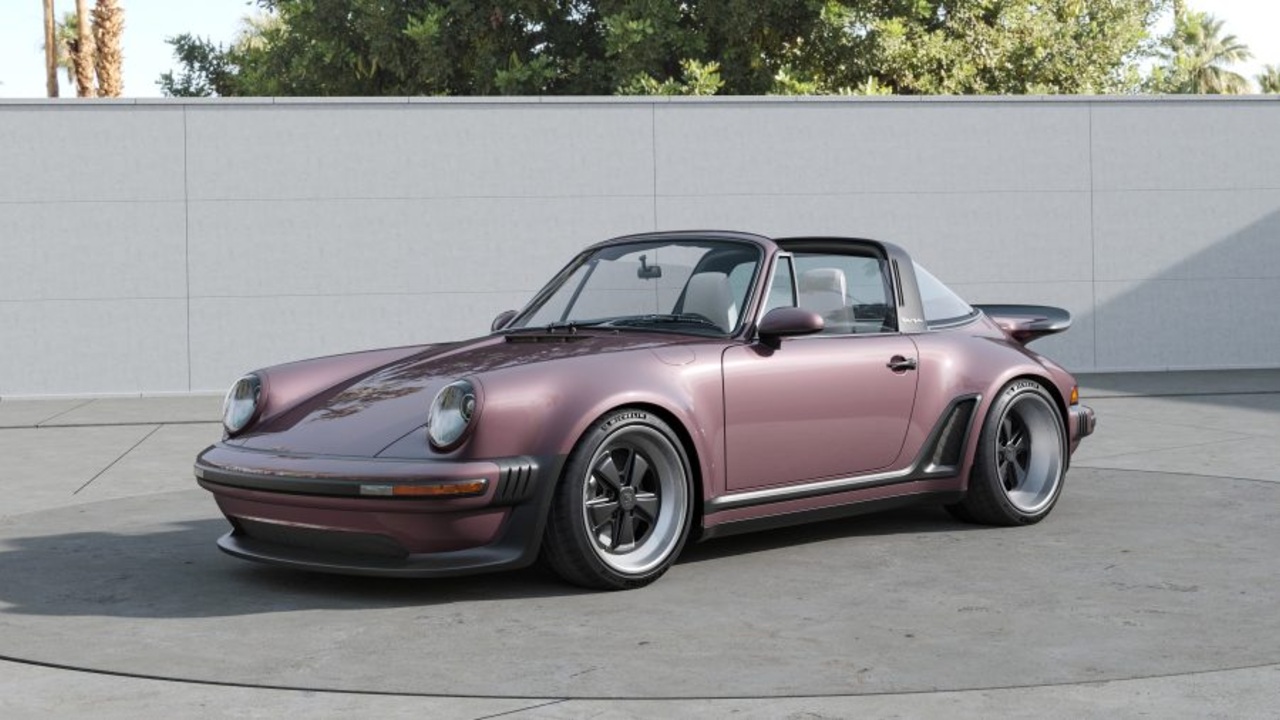
Singer Vehicle Design has built its reputation on reimagining the Porsche 911 with obsessive attention to detail, but its latest move reaches far beyond traditional restoration craft. To cure the age‑old flex of open‑top 964 chassis, the California company has turned to Red Bull Advanced Technologies, the engineering arm behind modern Formula 1 success, and to extensive use of carbon fiber. The result is a restomod program that treats structural stiffness with the same rigor usually reserved for a contemporary race car.
By pairing motorsport‑grade analysis with lightweight composite reinforcements, Singer aims to give its Targa and Cabriolet projects the torsional backbone of a coupe while preserving the character of the original Porsche Type 964. The collaboration signals how deeply F1‑style tools such as Finite Element Analysis are now shaping the upper tier of the 911 restomod world, and how far owners are willing to go to perfect a car that left the factory more than three decades ago.
Why Singer needed F1 help for open‑top 964s
Even in period, the open‑roof versions of the Porsche 911, particularly the Type 964 Targa and Cabriolet, were known to trade some structural integrity for fresh‑air driving. Removing a steel roof inevitably weakens torsional stiffness, and on an older platform that compromise can translate into scuttle shake, creaks, and a sense that the chassis is working harder than it should. For a company like Singer, which already treats the 911 and 964 architecture as a canvas for high‑performance reinterpretation, leaving that weakness untouched was increasingly at odds with the rest of its engineering ambitions.
Singer’s restoration services are built around owners sending in a Porsche 911 (Type 964) as the starting point, then commissioning a transformation that can include extensive chassis work from the very beginning of The Restoration Process. That approach has already produced highly developed coupes, but the open‑top cars still carried the inherent limitations of the original 964 shell. To close that gap, Singer turned to Red Bull Advanced Technologies, the high‑performance vehicle engineering division linked to Red Bull’s motorsport programs, asking it to help bring F1‑level structural thinking to these 911 restomods.
How Red Bull Advanced Technologies re‑engineered the chassis
Red Bull’s engineers began by treating the 964 like a clean‑sheet project rather than a nostalgic icon. They digitally scanned and manually measured the 964 chassis in detail, creating a precise virtual model of the open‑top structure. That model then went through Finite Element Analysis, often shortened to FEA or Finite Element An in some technical references, to map how loads travel through the body, where the shell twists most under cornering and braking, and which areas offer the best leverage for reinforcement without adding unnecessary mass.
Using this FEA work, Red Bull could calculate the torsional stiffness of different variants of the car, both with and without proposed reinforcements, and iterate virtually before any physical parts were made. The goal was clear: achieve stiffness comparable to a coupe whilst minimizing additional weight. By simulating multiple layouts and materials, the team identified where targeted bracing would have the greatest effect, and where the original 964 metalwork could be left untouched to preserve both weight and authenticity.
Carbon fiber as the new backbone
Once the weak points were mapped, the solution centered on a suite of carbon fiber components that effectively give the open‑top 964 a new spine. Instead of resorting to heavy steel subframes or crude bracing, Red Bull and Singer specified structural carbon elements that integrate with the existing shell, turning previously flexible zones into load‑bearing members. These Carbon parts are designed not as cosmetic add‑ons but as primary structure, picking up key suspension and body mounting points to tie the car together.
The payoff is significant. Reporting on the project notes that the carbon fiber reinforcements boost the torsional rigidity of the open‑top 964 by a huge 175 percent, transforming the way the chassis responds to inputs. In practical terms, that means the steering rack, suspension, and tires can work with far greater precision because the underlying 911 structure is no longer twisting as much under load. For owners, the promise is a Cabriolet or Targa that feels closer to a modern high‑performance coupe in response, yet still looks and sounds like an air‑cooled 964 from the outside.
What it means for Singer’s broader 911 program
This structural project does not exist in isolation. Singer’s entire business is built around the Porsche 911, particularly the Type 964, and the company has steadily expanded its offerings from early “Reimagined” coupes to more extreme studies such as the Dynamics and Lightweighting Study and the later DLS Turbo. The official description of its services emphasizes that owners of Type 964 air‑cooled 911 cars can commission highly tailored restorations, and that chassis work is considered from the very beginning of each build. Bringing Red Bull into the process extends that philosophy, treating stiffness as a core attribute rather than a secondary upgrade.
Recent News from Singer itself has highlighted how Red Bull Advanced Technologies Joins Forces with Singer across multiple projects, not only for the open‑top cars but also in the context of advanced builds like Singer Presents “Sorcerer”, described as The First example of a new DLS Turbo Services direction. In that environment, the F1‑derived carbon backbone for 964 Cabriolet and Targa models becomes part of a broader toolkit that can be applied wherever owners request the highest possible performance from their 911. It signals that structural engineering, once a quiet part of the restomod story, is now a headline feature alongside power and design.
The new benchmark for open‑top restomods
The specific application of this technology is already visible in projects such as the 2026 Singer Porsche 911 Cabriolet, where Singer partners with Red Bull Advanced Technologies to structurally reinforce 964 Cabriolet shells. In that car, the combination of digital scanning, Finite Element Analysis, and bespoke carbon fiber parts is credited with increasing torsional rigidity by 175 percent compared with the original configuration. For a platform that began life as a relatively flexible open‑top 911, that figure represents a fundamental redefinition of what an air‑cooled Cabriolet can be.
More broadly, the collaboration between Singer and Red Bull shows how the line between motorsport engineering and high‑end restoration has blurred. Singer and Red Bull Advanced Technologies Team Up to Reinforce Open Top Porsche 964s not as a marketing flourish but as a technical necessity for the performance targets now expected in this segment. As Singer, Red Bull, Porsche and their shared customers continue to push the 911 and 964 platforms further, the use of F1‑grade tools and Carbon structures is likely to become a reference point for other specialists who want their open‑roof classics to feel as tight and composed as their coupe counterparts.
More from Fast Lane Only