There was a time when American cars weren’t afraid to be bold. Chrome sparkled under the sun, hoods stretched toward the horizon, and designers treated sheet metal like a blank canvas. By 1970, however, muscle cars were stealing headlines while luxury cars often played it safe. Then the Buick Riviera arrived to remind everyone that sophistication and swagger could share the same driveway.
The 1970 Buick Riviera wasn’t just another luxury coupe. It was a rolling work of art that blended dramatic styling with effortless power, proving that personal luxury cars could still turn heads without shouting.
A Shape That Refused to Blend In
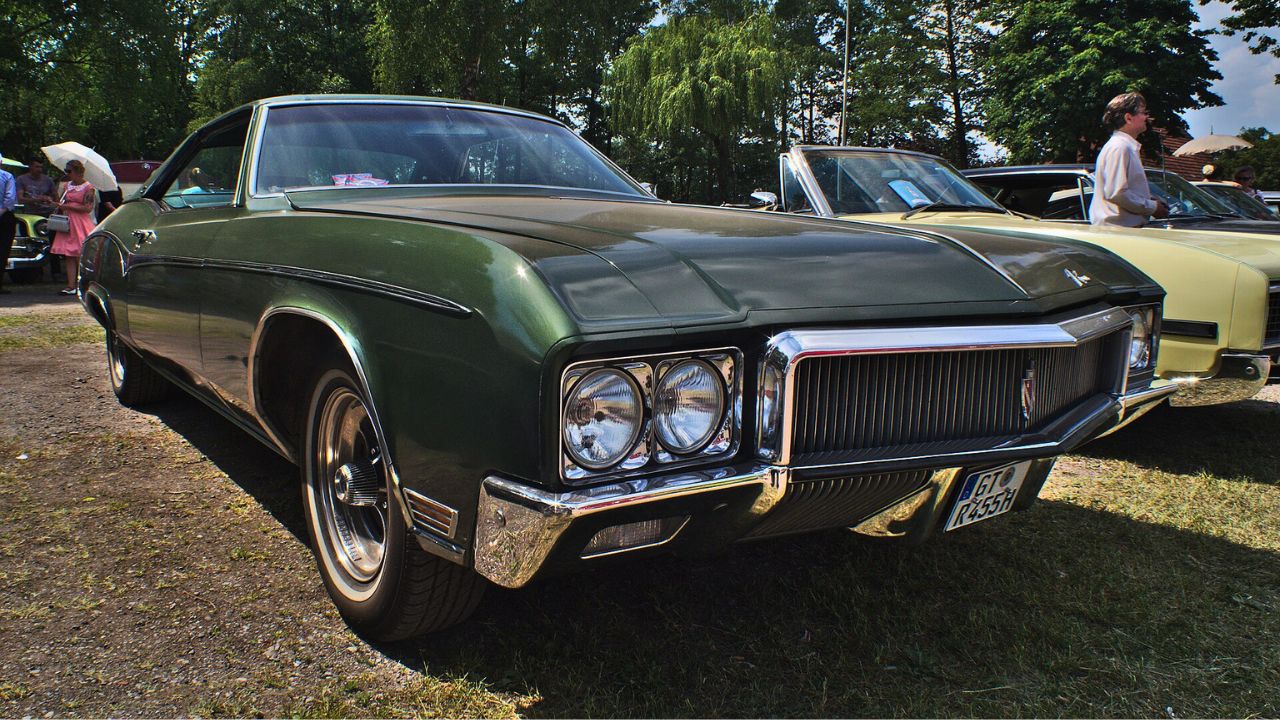
Few cars of the era looked quite like the Riviera. Its long hood, sharply pointed nose, and distinctive “boattail” profile made it instantly recognizable from nearly any angle. While the dramatic boattail design is more closely associated with the 1971-1973 models, the 1970 Riviera introduced many of the styling cues that pushed Buick toward a more sculptural, European-inspired direction.
Hidden headlights gave the front end a clean, uncluttered appearance, while crisp body lines replaced the excessive chrome that had defined much of the previous decade. It looked expensive because it was designed with confidence rather than excess.
Today, the Riviera’s styling still sparks conversation. Some admire its understated elegance, while others see it as one of Detroit’s last truly artistic designs before stricter regulations reshaped automotive styling in the 1970s.
Comfort Was the Main Attraction
Slip inside the Riviera, and Buick’s mission becomes clear. This wasn’t a stripped-down performance machine. It was built for long highway drives, quiet cabins, and first-class comfort.
Deeply cushioned bucket seats welcomed both driver and passenger, while woodgrain trim, plush carpeting, and a driver-focused dashboard created an upscale atmosphere. Power windows, air conditioning, cruise control, and premium audio systems were available, making the Riviera one of the most luxurious American coupes of its day.
Instead of chasing lap times, the Riviera focused on making every mile feel effortless.
Big-Block Power with Refined Manners
Luxury didn’t come at the expense of performance.
Under the hood sat Buick’s massive 455-cubic-inch V8, producing an impressive 370 horsepower and a mountain of torque. Mated to a smooth Turbo Hydra-Matic automatic transmission, the Riviera delivered brisk acceleration with almost no drama.
Unlike many muscle cars that demanded constant attention, the Riviera’s power came in smooth waves. It accelerated confidently, cruised comfortably at highway speeds, and remained remarkably composed for such a large automobile.
Its suspension favored comfort over razor-sharp handling, but that was exactly the point. This was grand touring, American style.
Standing Apart from the Crowd
During an era filled with Chevrolet Chevelles, Pontiac GTOs, and Ford Mustangs, the Riviera occupied its own niche.
It appealed to buyers who wanted style without sacrificing comfort, performance without harshness, and exclusivity without the price tag of a European grand tourer.
The Riviera’s closest competitors included the Cadillac Eldorado, Oldsmobile Toronado, and Ford Thunderbird. Yet Buick managed to strike a unique balance between elegance and athleticism, giving the Riviera an identity all its own.
A Classic That Keeps Turning Heads
Collectors continue to appreciate the 1970 Riviera because it represents the end of an era. It arrived just before tightening emissions standards, rising insurance costs, and the oil crisis fundamentally changed the American automobile.
Well-preserved examples remain highly sought after, especially those equipped with factory options and original drivetrains. While it may never command the sky-high auction prices of some muscle cars, the Riviera has earned something equally valuable: enduring respect.
It’s a car that rewards those who appreciate thoughtful design, smooth power, and timeless presence rather than raw speed alone.
The Last Word
The 1970 Buick Riviera proved that personal luxury didn’t have to fade into the background. It offered elegance without being stuffy, performance without being unruly, and styling bold enough to leave a lasting impression more than five decades later.
In a world increasingly obsessed with practicality, the Riviera served as a reminder that driving could still be an event. It wasn’t built simply to get you somewhere—it was built to make the journey memorable, one graceful mile at a time.
More from Fast Lane Only