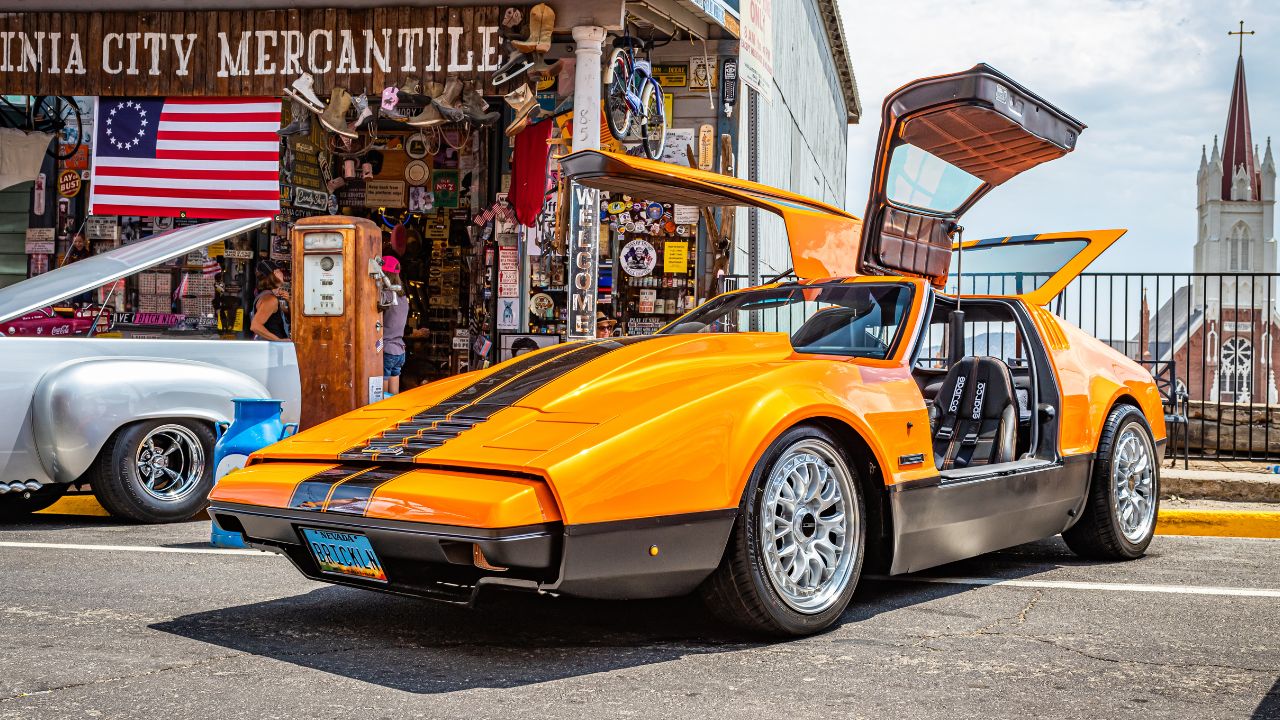
The 1974 Bricklin SV-1 represented a pioneering attempt to merge the thrill of sports car performance with groundbreaking safety features. Designed by Canadian entrepreneur Malcolm Bricklin, the SV-1 aimed to redefine automotive safety in an era dominated by raw power and speed.
Background of the Bricklin SV-1
Malcolm Bricklin, a visionary entrepreneur, founded Bricklin Automotive with a clear mission: to create a safer sports car that would not compromise on performance. Established in the early 1970s, Bricklin’s venture was a response to increasing public concern over automotive safety. At that time, the market was saturated with high-powered vehicles, yet few manufacturers prioritized the safety of the driver and passengers. The Bricklin SV-1 emerged as a direct challenge to this trend, incorporating innovative safety features while still delivering exhilarating performance.
The early 1970s marked a period of significant change within the automotive landscape. Regulatory pressures began to mount as safety standards evolved, largely influenced by a growing awareness of the dangers associated with car accidents. The National Highway Traffic Safety Administration (NHTSA) was founded in 1970, and by the mid-1970s, it became evident that consumers were increasingly seeking vehicles that would protect them in the event of a crash. The SV-1’s introduction came at a critical juncture, and its design reflected Bricklin’s commitment to addressing these pressing safety concerns while still appealing to the sports car enthusiast.
The SV-1’s role in the evolution of sports cars cannot be overstated. With its unique blend of performance and safety, it paved the way for future innovations in automotive design. The SV-1’s legacy continues to influence how automotive manufacturers approach safety in sports cars today, demonstrating that high performance and safety can coexist.
Design Innovations
The Bricklin SV-1 boasted several unique exterior features that set it apart from its contemporaries. Among these was its distinctive gullwing door design, which not only added a touch of flair but also provided practical benefits. These doors allowed for easier access to the cabin, especially in tight parking spaces. The aesthetics of the SV-1 were further enhanced by its sleek lines and aggressive stance, which hinted at the performance capabilities hidden beneath its fiberglass exterior.
Speaking of materials, the SV-1 utilized advanced materials such as fiberglass during its construction, which contributed to both reduced weight and enhanced safety. The choice of fiberglass allowed for a robust yet lightweight structure, which was crucial in maintaining performance while also providing a degree of flexibility during impact. This was a forward-thinking approach, as many contemporary sports cars relied heavily on steel, which, although durable, added significant weight and could compromise handling.
Incorporating aerodynamic principles into the SV-1’s design was another key innovation. The car’s shape was meticulously crafted to minimize drag, improving both fuel efficiency and stability at high speeds. This focus on aerodynamics was particularly significant at a time when many sports cars prioritized raw power over efficiency. By integrating these principles, the Bricklin SV-1 not only offered a thrilling driving experience but also set a precedent for future designs that balanced performance with practicality.
Safety Features
The Bricklin SV-1 was groundbreaking in terms of its safety features. One of the car’s most notable innovations was its reinforced body structure, designed to absorb impacts in the event of a collision. This was a significant advancement in automotive safety, as many sports cars at the time lacked adequate protection for occupants. The SV-1’s structure aimed to minimize injury by dispersing energy away from the cabin, reflecting a thoughtful design philosophy focused on driver and passenger safety.
Additionally, the SV-1 introduced several advanced safety technologies that were ahead of its time. Features such as a comprehensive seatbelt anchorage system and energy-absorbing bumpers were integrated into the design, enhancing the overall safety profile of the vehicle. These elements were not standard in many sports cars of the era, which often prioritized speed and style over safety features. By incorporating these advancements, the SV-1 challenged the status quo and set a new benchmark for safety in the sports car segment.
When compared to contemporary sports cars like the Porsche 914 and Datsun 240Z, the SV-1’s safety measures stood out. While those models offered spirited performance, they did not emphasize safety in the same way. The Bricklin SV-1’s commitment to integrating safety with performance was a crucial step forward, influencing the design philosophies of many manufacturers in the years that followed. As the industry evolved, it became increasingly clear that safety could no longer be an afterthought.
Performance Capabilities
Under the hood, the Bricklin SV-1 featured a choice of two engines, both of which were designed to deliver exhilarating performance. The base model was equipped with a 360-cubic inch V8 engine, producing around 220 horsepower, while an optional 400-cubic inch version pushed the performance envelope further, generating up to 250 horsepower. These powertrains provided ample acceleration and made the SV-1 a formidable competitor on the road.
The handling and driving dynamics of the SV-1 were influenced by its safety features. The lightweight fiberglass structure, combined with the car’s low center of gravity, resulted in nimble handling and stability during cornering. While some critics noted that the SV-1’s weight distribution could have been better balanced, the overall driving experience was generally well-received. Automotive reviews highlighted the SV-1’s ability to deliver a thrilling ride while maintaining a focus on safety, an impressive feat for a car in this segment.
Consumer feedback also played a crucial role in shaping the SV-1’s reputation. Many enthusiasts praised its unique design and innovative safety features, while others appreciated the car’s performance capabilities. However, some reviews indicated that the SV-1’s performance did not quite match that of its established competitors, such as the Corvette and Porsche. Regardless, the SV-1’s commitment to safety made it a standout option for those seeking both excitement and peace of mind on the road.
Challenges and Criticisms
Despite its innovative design and safety features, the Bricklin SV-1 faced numerous challenges during its production run. Financial difficulties plagued Bricklin Automotive from the outset, as the company struggled to secure adequate funding to sustain production. The ambitious plans for the SV-1’s rollout were hampered by these financial constraints, leading to several delays and production setbacks. As a result, the company was forced to limit its output, which hindered its ability to compete effectively in the sports car market.
Critiques regarding the SV-1’s reliability and build quality also emerged during its production. Some owners reported issues with electrical systems and other components, casting a shadow over the car’s reputation. While the SV-1 was designed with safety in mind, its execution was not without flaws. This led to a mixed reception from consumers, many of whom had high expectations for a vehicle that promised both performance and enhanced safety.
The oil crisis of the 1970s further complicated the SV-1’s market reception. With rising fuel prices and a shift in consumer preferences towards more fuel-efficient vehicles, the demand for high-performance sports cars diminished significantly. The Bricklin SV-1, with its larger V8 engines, struggled to find its place in a rapidly changing market. Ultimately, these challenges contributed to the company’s decline and the eventual cessation of SV-1 production.
Legacy and Impact
The legacy of the Bricklin SV-1 extends far beyond its brief production run. The vehicle’s innovative approach to automotive safety has influenced future sports car designs and safety regulations, prompting manufacturers to prioritize occupant protection in their vehicles. The SV-1’s commitment to merging safety and performance has inspired a generation of engineers and designers to rethink how sports cars are conceived and built.
Moreover, the SV-1 paved the way for more safety-conscious automotive innovations in the years that followed. As the industry evolved, manufacturers began to recognize the importance of incorporating safety features into their designs without sacrificing performance. The Bricklin SV-1’s vision of a safer sports car has become a guiding principle for many carmakers, leading to advancements in safety technologies that continue to be refined today.
Today, the Bricklin SV-1 holds a special place among collectors and car enthusiasts. Its unique design, innovative safety features, and rich history make it a sought-after classic. The vehicle’s rarity only adds to its allure, with well-preserved models often fetching impressive prices at auctions. As interest in classic cars continues to grow, the SV-1 remains a symbol of a bold era in automotive history and a reminder of the importance of safety in performance vehicles.
Comparative Analysis
When comparing the Bricklin SV-1 to other safety-focused cars of its era, such as the Porsche 914 and Datsun 240Z, it’s evident that the SV-1 made significant strides in integrating safety with performance. While the Porsche 914 was lauded for its handling and the Datsun 240Z for its affordability and spirited performance, neither model prioritized safety to the extent that the SV-1 did. The Bricklin’s reinforced body structure and advanced safety technologies positioned it as a forward-thinking alternative in an industry that often overlooked these crucial aspects.
Examining how the SV-1 stands up against modern safety standards reveals a fascinating evolution in automotive design philosophies. Today’s vehicles are equipped with advanced systems such as electronic stability control, adaptive cruise control, and a plethora of airbags, which were not common during the SV-1’s era. While the Bricklin SV-1 was revolutionary for its time, modern sports cars have taken safety to new heights, demonstrating a commitment to occupant protection that aligns with consumer expectations.
The evolution of design philosophies in sports cars over the decades has shifted dramatically. The focus has expanded beyond mere performance metrics to encompass aspects such as safety, efficiency, and sustainability. The Bricklin SV-1 serves as a notable milestone in this evolution, illustrating that high performance can indeed coexist with a strong emphasis on safety. As the automotive industry continues to innovate, the lessons learned from the SV-1 remain relevant, shaping the future of car design and safety.
More from Fast Lane Only