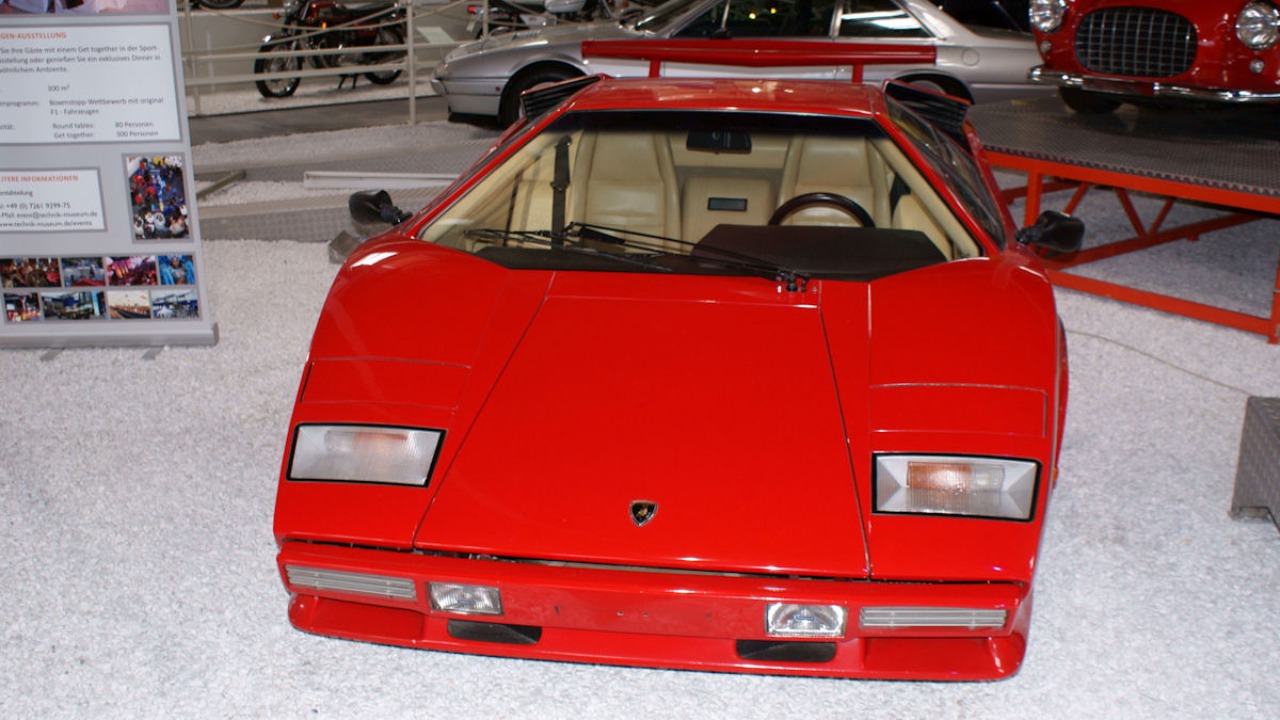
The Lamborghini Countach is one of the most recognizable supercars ever built. Its sharp wedge-shaped body, scissor doors, and impossibly low profile defined the look of exotic cars throughout the 1970s and 1980s. While its dramatic styling made it an automotive icon, those bold design choices came with compromises that owners experienced every time they drove the car. The Countach proved that breathtaking appearance often required sacrificing everyday practicality.
Style and Aerodynamics Shaped Every Curve
When the Countach debuted as a concept in 1971 before entering production a few years later, Lamborghini wanted a car that looked unlike anything else on the road. Designer Marcello Gandini of Bertone created an angular wedge profile that emphasized speed even while standing still.
The low nose, sharply sloped windshield, and wide stance were not purely artistic decisions. They also helped reduce aerodynamic drag and package the car’s powerful mid-mounted V12 engine. Every surface was designed to create a futuristic appearance while supporting high-performance engineering.
The result was a supercar that immediately became the poster vehicle of its generation.
Its styling influenced exotic car design for decades to come.
Visibility Was the Price of the Shape
The Countach’s dramatic bodywork created one of its biggest drawbacks: limited visibility. The low seating position, steep windshield, wide rear pillars, and tiny rear window made it difficult for drivers to judge traffic and parking situations.
Reversing became especially challenging because the rear view was so restricted. Many owners developed the unusual habit of opening the driver’s scissor door and sitting partially on the door sill while backing up, allowing them to look directly behind the car.
Although this technique became closely associated with the Countach, it highlighted the practical compromises required by its striking design.
Its unforgettable appearance came at the expense of everyday convenience.
Packaging Created Both Advantages and Challenges
The Countach’s mid-engine layout delivered excellent weight distribution and thrilling performance, but fitting a large V12 into such a low body required creative engineering. Lamborghini mounted the transmission ahead of the engine, with a driveshaft running through the oil sump to the rear differential.
This unusual arrangement helped achieve a compact wheelbase while maintaining balanced handling. However, the tightly packaged engine bay also made maintenance more difficult, and the cabin became noticeably warm due to its proximity to the powertrain.
As later versions gained wider tires, larger fender flares, and optional rear wings, the car’s dramatic appearance became even more pronounced. Those additions improved grip and visual impact but also increased weight and, in some cases, aerodynamic drag.
Performance and practicality remained in constant balance.
An Icon Defined by Its Compromises
Despite its quirks, the Countach became one of the most admired supercars in history. Enthusiasts embraced its challenging nature because every compromise reinforced the sense that it was a machine built to prioritize excitement over convenience.
Its influence can still be seen in modern Lamborghinis, from angular styling to scissor doors and bold proportions. Collectors continue to value the Countach not only for its rarity and performance but also for its uncompromising character.
Looking back, the forgotten tradeoff behind the Lamborghini Countach’s dramatic design was that achieving one of the most spectacular automotive shapes ever created required accepting genuine everyday limitations. Those compromises became part of the car’s legend, reminding enthusiasts that some of history’s greatest automotive icons succeeded by daring to be extraordinary rather than practical.
More from Fast Lane Only
- Unboxing the WWII Jeep in a Crate
- 15 rare Chevys collectors are quietly buying
- 10 underrated V8s still worth hunting down
- Police notice this before you even roll window down
*Research for this article included AI assistance, with all final content reviewed by human editors