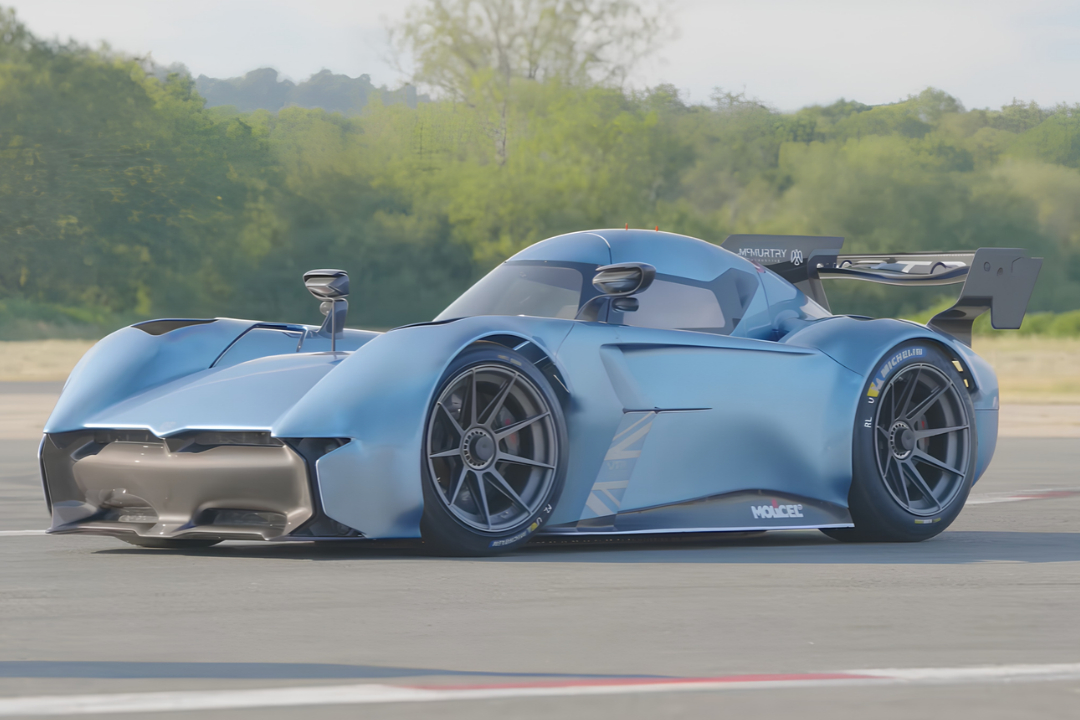
Beating a Formula 1 car’s lap time on a normal road course sounds like the kind of claim that gets thrown around a lot and rarely holds up. Most of the time it comes with an asterisk the size of the car itself. This time, the car making the claim looks less like a race car and more like something that wandered off the set of a superhero movie, and the asterisk turns out not to matter much at all.
The McMurtry Spéirling is an electric hypercar built around a genuinely strange idea. Two fans mounted underneath suck the car down onto the track, generating roughly 2,000 kilograms of downforce that doesn’t depend on wind speed the way a wing does. That means it can pull serious cornering forces at speeds where a normal car, or even an F1 car, would still be building up grip. Pair that with around 1,000 horsepower and you get a machine that does its most impressive work in corners most cars are still slowing down for.
Travis Pastrana got a turn behind the wheel at the Top Gear Test Track in England, the same circuit where the Spéirling already holds the outright lap record, a mark that reportedly beats a Formula 1 car’s time by about three seconds. What followed was a day that started with careful shakedown laps and ended with a quarter mile run, a seized engine in an entirely different car, and a very sincere warning about touching wildflowers.
Learning to trust the fans
The early sessions were about easing into a car that behaves unlike almost anything else on the road or track. With the suction fans dialed low and traction control turned up, Pastrana spent his first laps getting used to the seating position and the steering before anyone let him near full power. Even at reduced settings, the corner named Hammerhead was enough to make an impression, mostly because nothing else built like a car takes it the way the Spéirling does.
The real revelation came once the fans were switched on properly. Pastrana described the car transforming from something that felt like a very good go-kart into something that gripped the track with an almost unnerving stability, holding its line over bumps that would normally unsettle a car at speed. He put it plainly afterward, saying he was almost nervous to drive a normal car again after feeling how planted the Spéirling stayed underneath him.
A Caterham pays the price for enthusiasm
Not every vehicle on hand that day fared as well. In between McMurtry sessions, Pastrana squeezed himself into a Caterham, a car built small enough that his head barely cleared the top of the cockpit. He drove it the way you’d expect a professional stunt driver to drive anything handed to him, which turned out to be too much for the little car to handle.
Running the engine hard through second gear for an extended stretch eventually seized the motor entirely, locking up mid-corner and bringing the Caterham to an abrupt stop. It was a reminder that not every car on the lot that day was built for the kind of punishment Pastrana was dishing out, and that enthusiasm without much regard for redlines has a way of finding a car’s limits quickly.
Full power, full downforce, and a quarter mile to prove it
With the Caterham sidelined, attention shifted back to the Spéirling for a session run at full power and maximum downforce. Pastrana described corners where he was certain he was carrying too much speed to make the turn, only to find the car simply didn’t let go the way physics would normally suggest it should. Braking points that would have been unusable in almost anything else turned out to be entirely workable once the fans were doing their job.
That confidence carried into a multi-vehicle drag race organized on a 400-meter strip, where the Spéirling lined up against everything from a quad bike to a shifter kart to a bicycle. Pastrana launched with zero wheelspin and covered the quarter mile in under eight seconds at 160 miles per hour. Traction control was dialed up specifically to keep the tires hooked up off the line, and it did exactly that, turning what could have been a chaotic launch into a clean one. It was less a race than a formality, the kind of result that makes the rest of the lineup feel like they were there for scenery.
By the end of the day, one car had proven exactly why it holds a lap record over actual Formula 1 machinery, and another had proven exactly why it doesn’t. Somewhere between an engine seizing itself solid and a hypercar treating a professional race track like a warmup lap, the difference between a fast car and a genuinely strange one became pretty easy to spot.
More from Fast Lane Only
- Unboxing the WWII Jeep in a Crate
- 15 rare Chevys collectors are quietly buying
- 10 underrated V8s still worth hunting down
- Police notice this before you even roll window down
*Research for this article included AI assistance, with all final content reviewed by human editors.