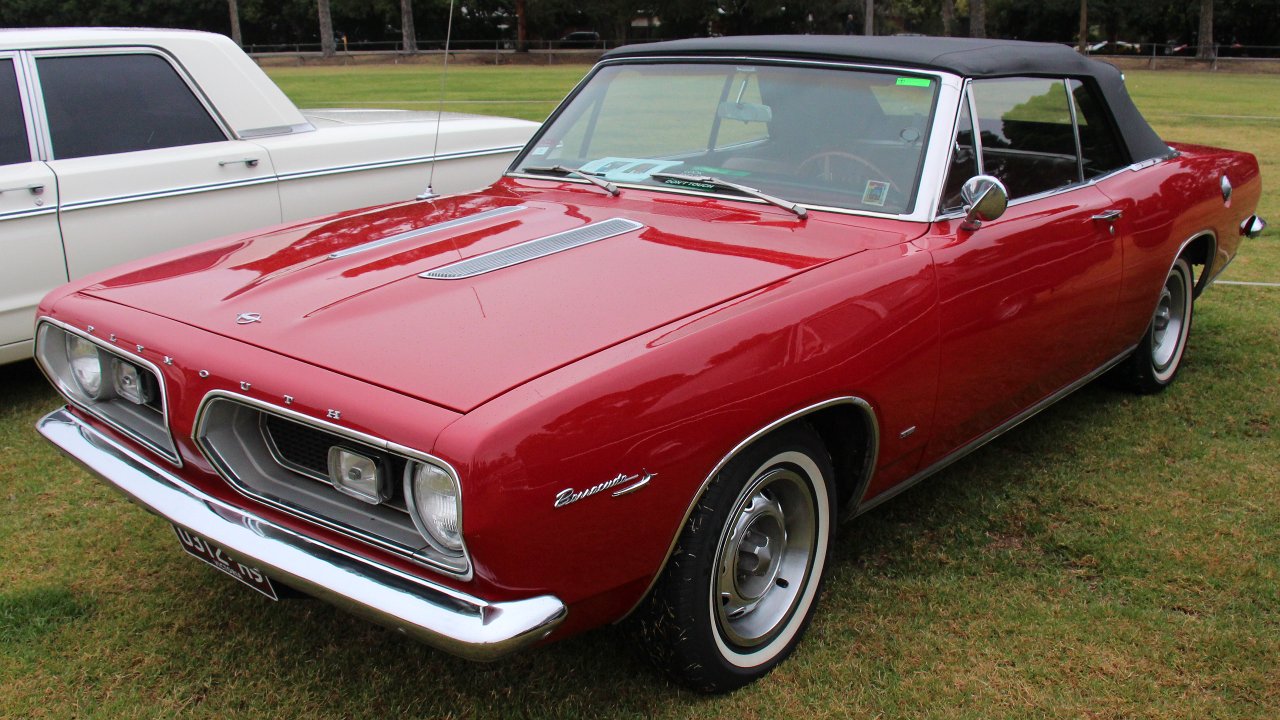
The Plymouth Barracuda 383 Formula S arrived at a pivotal moment for Detroit performance, when compact bodies and big-block power were starting to collide in earnest. By tracing when and how Plymouth built this specific combination, and then looking at what collectors pay for it now, I can show why this once underrated package has become one of the most closely watched Mopar pony cars in the market.
The story starts with the Barracuda’s evolution from early pony car to serious street weapon, then narrows to the short window when the 383 engine and Formula S handling package came together. From there, the focus shifts to production rarity, period performance, and current valuation data that explain why these cars now trade for serious money when the right options and condition line up.
From early pony car to big-block contender
The Plymouth Barracuda began life as a compact fastback, but it quickly moved into the thick of the pony car power race. The Plymouth Barracuda was built by Chrysler Corporation from 1964, and that first generation focused more on style and practicality than outright muscle, even as V8 power crept in. The second generation, which arrived later in the decade, sharpened the Barracuda’s mission and set the stage for the 383 Formula S by pairing a more aggressive body with a broader engine lineup, including small-block and big-block options that went far beyond the early slant-six roots of The Plymouth Barracuda.
By the time the second generation matured, Plymouth was clearly positioning the car as a compact performance machine rather than just a sporty commuter. Reporting on a restored late-sixties Barracuda Formula S notes that the second generation was designed to deliver the kind of power and handling buyers had started to expect from Detroit pony cars, while still building on what the model had been known for in its first generation. In that same coverage, the 273 V8 is described as making its final appearance In 1967, underscoring how quickly the Barracuda’s engine range was moving up the displacement ladder toward the 383-V choices that would define the Formula S halo models.
How and when the 383 Formula S arrived
The 383 Formula S package did not appear out of thin air, it was the product of a deliberate push to drop serious big-block power into Plymouth’s compact pony car. A detailed retrospective on the 1969 Plymouth Barracuda Formula S 383 explains that, throughout the mid to late sixties, Plymouth steadily escalated the Barracuda’s performance, culminating in the 383 option that turned the car into a genuine straight-line threat. That same analysis, published on Dec 6, 2022, frames the 383-equipped Formula S as the high point of a development arc that began with earlier small-block cars and ran through The Predecessors Of The later 1969 Plymouth Barracuda For buyers who wanted more speed.
Evidence from individual cars backs up how focused this configuration was. A feature on Dennis Jackson’s 1967 Barracuda Formula S notes that Dennis’ Barracuda was equipped with a 383 from the factory, and that this big-block was an option only on the Formula S models that year. That detail shows how Plymouth used the Formula S badge as the gateway to its most serious engine in the Barracuda line, rather than scattering the 383 across lower trim levels. The same piece emphasizes that the 383 delivered substantial torque, reinforcing why this package quickly earned a reputation as a compact car that could run with much larger muscle machines.

Power figures, performance gains, and model-year differences
Once the 383 Formula S was in play, Plymouth kept refining the package, and the power numbers tell a clear story. Valuation data for the 1967 Plymouth Barracuda Formula S notes that 1968 saw a modest power gain for the 383, to 300 hp, which still left the car slightly behind some rivals on paper but significantly stronger than earlier small-block Barracudas. That same source points out that 1969 saw another gain, and that by the end of the decade the Barracuda could hold its own handily, especially in 383 guise, which confirms how quickly the model evolved from mild pony car to serious performance contender.
Other period references help pin down the top of the curve. A discussion of a 1969 Plymouth Barracuda Formula S with a 383 engine notes that in 1969 the 383 Darts and Barracuda were rated at 330 hp, crediting improved exhaust manifolds and other changes for the jump. That account, shared by Dale Finger and dated Jun 22, 2025, highlights how the same basic 383 architecture could be tuned for different outputs as Chrysler Corporation refined the package. When I set that 330 figure alongside the earlier 300 rating, it underlines how late-sixties Barracuda buyers who waited for the final model years of the second generation were rewarded with a noticeably stronger version of the same big-block Formula S concept.
Production volume and rarity of 383 Formula S cars
Performance numbers only tell part of the story, because the 383 Formula S also owes its current appeal to how few were built relative to the broader Barracuda population. A detailed look at a 1969 Plymouth Barracuda Formula S 383 notes that Plymouth built 31,987 Barracudas for 1969, a figure that covers all body styles and engine combinations. Within that total, the number of 383 Formula S cars is a fraction, especially when broken down by transmission and body style, which is why surviving examples with original drivetrains are treated as especially desirable. The same reporting on that 1969 Plymouth Barracuda Formula S 383 SPECIFICATIONS and PRODUCTION mix underscores how the 383 cars sat near the top of the range, both in price and in performance, which naturally limited how many buyers stepped up.
Later coverage of a restored 1968 Barracuda Formula S reinforces the sense of scarcity. That piece describes the car as a Rare 383-V Mopar Jewel and Costs How Much, and while the language is colorful, the underlying point is that a correct 383-V Formula S from this era is not something that appears in every classifieds search. The report also notes that In 1967 the 273 small-block was on its way out, which meant that by 1968 and 1969, more buyers were gravitating to larger engines, yet the 383 Formula S still remained a relatively low-volume configuration inside the overall Barracuda lineup. When I combine the total 31,987 Barracudas for 1969 with the emphasis on rarity in these later profiles, the conclusion is straightforward: the 383 Formula S sits in a narrow slice of production that helps support its modern values.
Market values today and what drives them
Current valuation data and recent sales coverage show that the market has caught up with the historical significance of the 383 Formula S. Pricing guides for the 1967 Plymouth Barracuda Formula S track how values have risen as collectors recognize the car’s blend of compact size, big-block power, and limited availability. Those tools highlight the importance of condition and originality, especially for cars that still carry their factory 383 and Formula S equipment, and they note that the 383 configuration is a key driver of higher prices compared with small-block or six-cylinder Barracudas from the same years. When I read those figures alongside the documented power gains to 300 hp and beyond, it is clear that buyers are paying a premium for the most capable versions of the second-generation Barracuda.
Individual car features help translate those guide numbers into real-world expectations. The report on the Restored 1968 Barracuda Formula S that is described as a Rare 383-V Mopar Jewel and Costs How Much walks through the cost of bringing a tired car up to show-ready condition and then compares that investment with current asking prices. That story, dated Jun 5, 2024, makes the point that a properly restored 383-V Formula S can command a substantial sum, particularly when the car retains its original drivetrain and documentation. When I set that against the broader valuation tools for the 1967 Plymouth Barracuda Formula S and the production context that Plymouth built 31,987 Barracudas for 1969, the pattern is consistent: the 383 Formula S has moved firmly into the realm of blue-chip late-sixties pony cars, with values that reflect both its performance credentials and its scarcity.