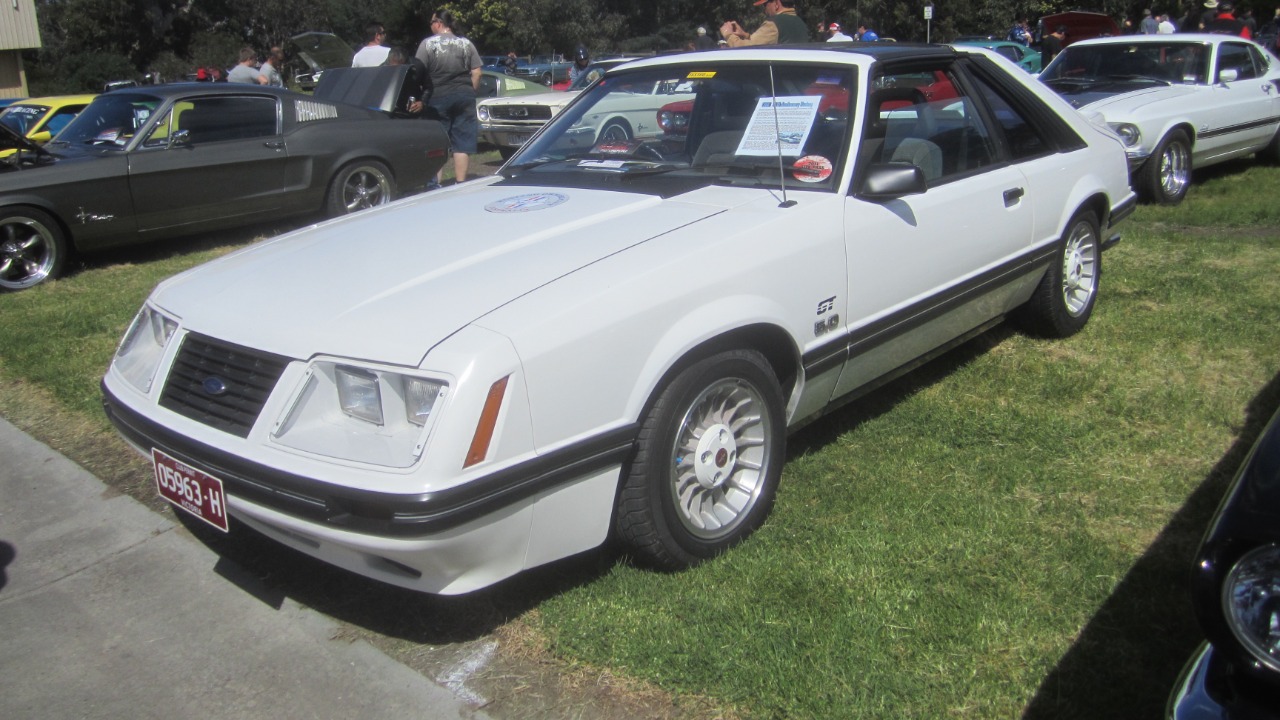
The 1984 Ford Mustang SVO arrived at a moment when American performance cars were trying to remember what speed felt like, yet it refused to follow the familiar V‑8 script. Instead of chasing cubic inches, it chased technology, balance, and road course pace, and that choice sent it down a very different path from the five‑liter bruisers parked across the same showroom. To understand why, I want to trace how the SVO’s engineering, timing, and pricing pushed it into cult‑car territory rather than mainstream Mustang legend.
A turbo four in V‑8 country
When most people picture a fast Ford Mustang, they still think of a burbling V‑8, but the 1984 Mustang SVO deliberately broke that pattern. Ford Special Vehicle Operations treated the Fox‑body as a clean sheet for a more European‑flavored performance car, and the team chose a small displacement turbocharged and intercooled four‑cylinder instead of the familiar five‑liter. Despite what many think, that decision was not primarily about fuel economy, it was about trimming weight off the nose and sharpening the car’s reflexes, with the turbo engine coming in roughly 68 kg lighter than a comparable V‑8 according to Despite the usual assumptions.
That lighter front end let engineers dial in a more neutral chassis, and they backed it up with hardware that would have looked more at home on a European touring car than on a pony car. The SVO received four‑wheel disc brakes, a quicker steering rack, and a thoroughly reworked suspension that made the car feel more agile and composed than the regular Ford Mustang, a point underlined by period testing that praised how The SVO turned in and changed direction. Contemporary analysis notes that The SVO was well received by the enthusiast press, which highlighted how the upgraded suspension and steering made the SVO decidedly more agile than its stablemates, a verdict captured in detail in The SVO.
Born from racing, aimed at road courses

The SVO story really starts with Ford’s desire to reconnect the Mustang with serious motorsport rather than just straight‑line bragging rights. By the early 1980s the Mustang was slowly clawing its way back from the low‑point of the Mustang II era, but it still needed a halo model that could stand up to European imports on a road course instead of only at the drag strip, a context laid out in the phrase By the early 1980s. Special Vehicle Operations, the in‑house skunkworks, approached the Fox platform with that mission in mind, blending lessons from racing with a street‑legal package that could still be sold through regular dealers.
Initial schedules had called for the SVO Special Mustang to appear as a 1982½ model, but internal confusion over how to position such an unorthodox Mustang delayed the launch and the car finally arrived for the 1984 model year instead. That delay meant the SVO hit showrooms just as the five‑liter GT was regaining its swagger, which complicated its mission and its marketing, a sequence described in detail in the Initial development history. Even so, the Ford SVO Mustang stands out as a special chapter in the broader Fox‑body story, with later retrospectives noting how the Ford SVO Mustang carved out a Turbocharged Legacy from 1984–1986 that left a lasting impression on Ford’s performance playbook, a point underscored in Ford SVO Mustang.
High‑tech hardware, mixed showroom results
On paper, the SVO’s spec sheet read like a wish list for enthusiasts who cared about lap times more than quarter‑mile slips. The turbocharged 2.3‑liter four was tuned with an intercooler and boost control that let it punch above its displacement, and the chassis team added Koni adjustable dampers, unique springs, and wider wheels to make full use of that power. Period observers have described these cars as barely legal street race machines that were still 90% Mustang and 10% aftermarket, with parts like the four‑wheel discs and some suspension pieces borrowed from more upscale models such as the Lincoln MkVII LSC, a colorful comparison preserved in an Oct retrospective.
Yet that same hardware cocktail created a pricing problem that the market never fully accepted. The SVO cost significantly more than a regular Ford Mustang GT, even though many buyers still equated performance with cylinder count and saw the turbo four as a downgrade rather than a sophisticated alternative. A detailed look at the 1984–1986 production run notes that the SVO was well received by testers but struggled to translate that goodwill into volume, with total output spread across just a few model years, a pattern that later analysts have revisited in videos like the Jul breakdown that bluntly asks why the SVO was a failure from Ford Special Vehicle Operations and walks through how pricing and perception boxed it in, as seen in Jul.
Outlier philosophy in the muscle‑car mindset
What really set the SVO apart was not just its parts list, but its philosophy. How Ford chose to position the car put it directly up against the era’s V‑8 giants, even though its strengths were different: the High boost four‑cylinder, the Tech‑heavy suspension tuning, and the focus on braking and handling over raw displacement. One detailed retrospective captures this tension in the phrase How Ford’s High‑Tech 2.3L Turbo Took on V8 Giants in the 1980s muscle scene, emphasizing how the SVO tried to redefine what a pony car could be by leaning on engineering rather than nostalgia, a framing that comes through clearly in the analysis of How Ford.
That outlier status made the SVO a tough sell to traditionalists but a revelation to drivers who valued balance and feedback. Enthusiast accounts describe how the car’s steering, brakes, and suspension worked together to deliver a more European feel than any previous Mustang, and how the turbo engine rewarded drivers who were willing to keep it on boost rather than loafing along on low‑rpm torque. Later collectors have come to appreciate this blend, with some dealers now highlighting how the Mustang SVO and the 1984 Ford Mustang SVO represented a turning point where the Ford Mustang briefly prioritized finesse over brute force, a pitch that shows up in listings like the one from Tucson Classic Motor Co that frames the Ford Mustang SVO as a distinct choice for enthusiasts who want something different from the usual V‑8, as seen in the description of the Mustang SVO.
A short run, a long shadow
In the end, the SVO’s different path meant a short production run but a long shadow over Ford’s later performance strategy. The car lasted only a few years, and its sales never threatened the mainstream GT, yet its emphasis on lighter engines, forced induction, and sophisticated chassis tuning foreshadowed the direction that modern performance cars, including later turbocharged Mustangs, would eventually take. Analysts who have revisited the program point out that the SVO was well received by testers even as it went mostly unnoticed by the broader buying public, a disconnect that helps explain why the badge disappeared while its ideas quietly filtered into future models, a theme explored in depth in historical treatments like SVO.
Looking back now, I see the 1984 Ford Mustang SVO less as a failed experiment and more as an early prototype for the kind of balanced, turbocharged performance car that would become normal decades later. Its combination of a small displacement turbo engine, advanced suspension tuning, and road‑course focus did not fit neatly into the 1980s muscle‑car mindset, but it anticipated the way enthusiasts and engineers would eventually think about speed. That is why, even though its sales story reads like a cautionary tale and one enthusiast writer at It Rolls jokes that it “pretty much went nowhere,” the SVO’s engineering choices still resonate with anyone who believes a Mustang can be about more than just a big V‑8, a sentiment captured in the wry tone of It Rolls.