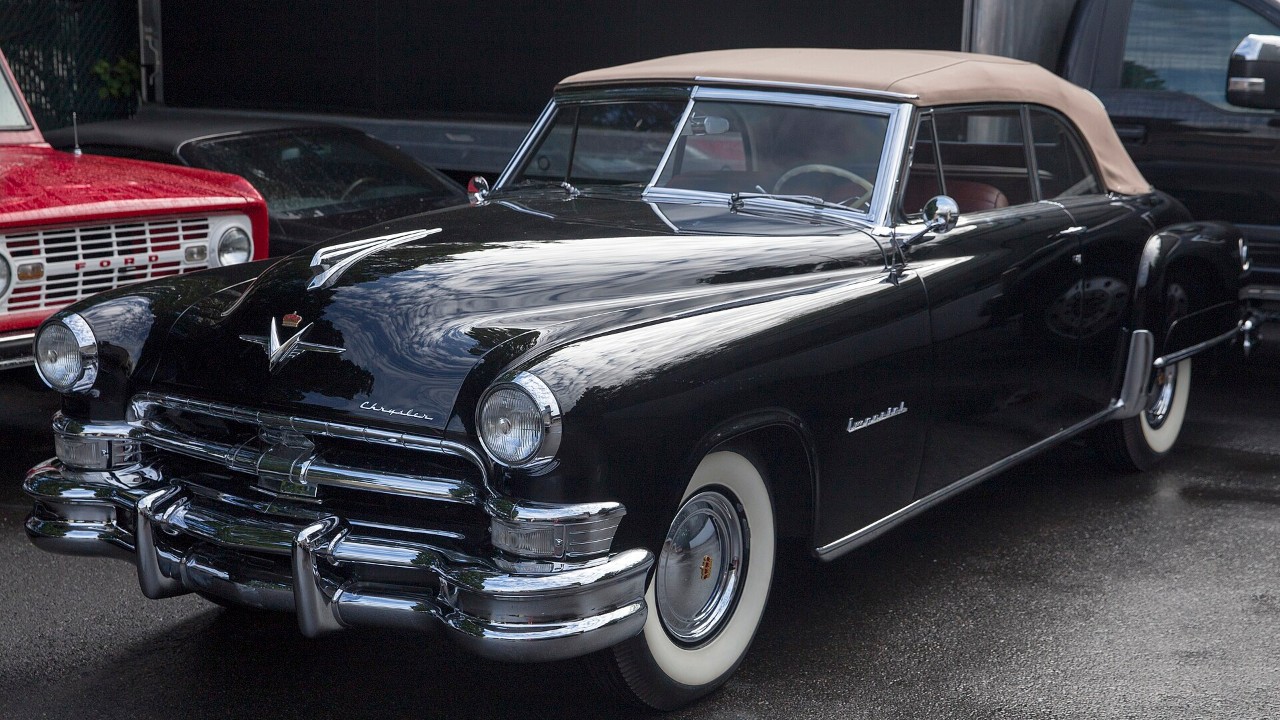
Chrysler’s FirePower Hemi arrived for the 1951 model year as a 331-cubic-inch V8 rated at 180 horsepower. Chrysler did not sell it as a “Hemi” at first. Instead, it called the engine the FirePower, and that name went on the cars.
The name came later, but the shape was there from day one. Its combustion chambers were rounded like half a sphere. That design gave the engine its eventual nickname and, in time, one of the best-known badges in American performance.
Here is where the first Hemi came from, what it put into a 1951 Chrysler and how quickly the design grew before Chrysler retired it.
A wartime idea behind the FirePower Hemi
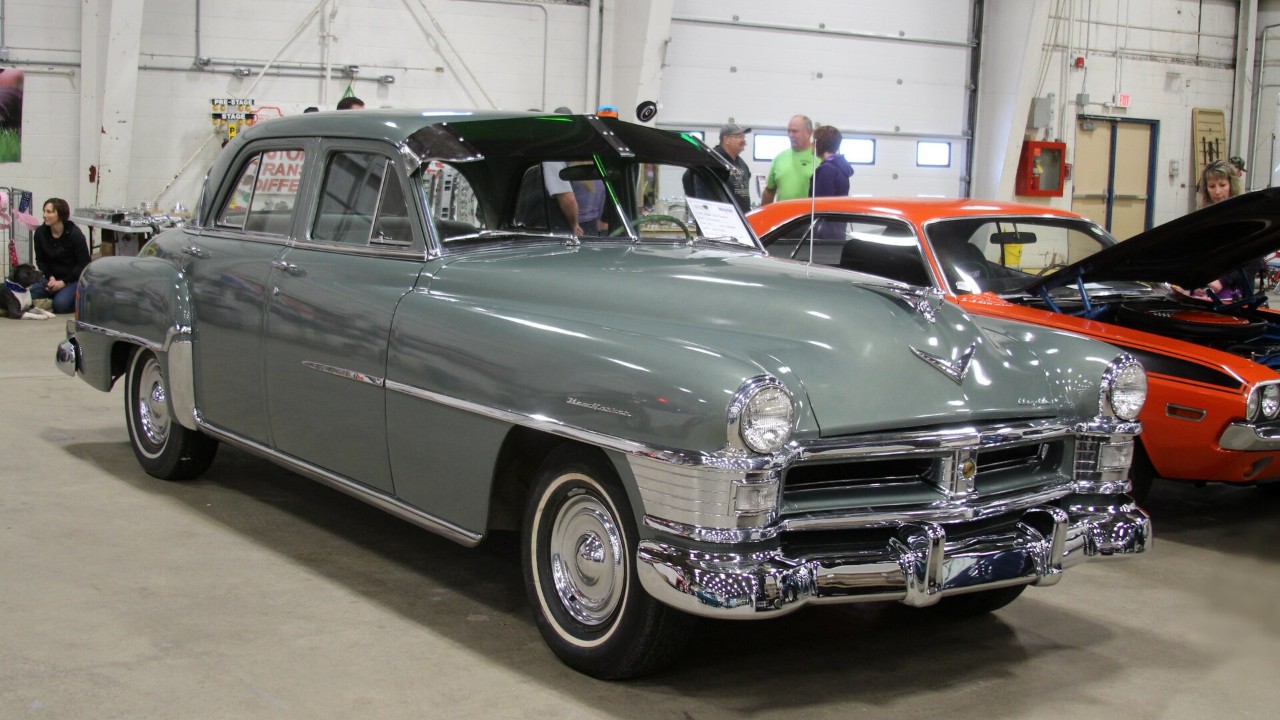
Chrysler had a head start from its war work. During World War II, it developed an experimental inverted V16 aircraft engine of about 2,500 horsepower, Jalopnik reports in its history of the FirePower. The same article says Chrysler tested it in a Republic P-47 Thunderbolt. However, the war ended before production, and jet engines made the project obsolete.
EngineLabs names that aircraft engine the XI-2220, a 2,220-cubic-inch design from 1940. Meanwhile, Street Machine says work on a car engine began right after the war. Chrysler had a prototype 330-cubic-inch Hemi built and tested by 1948, according to the magazine.
What made the hemispherical head different
After all, the head design was the point. A hemispherical chamber puts the spark plug at the top center, which makes combustion more efficient, Jalopnik explains. The intake and exhaust valves sit on either side of the plug, so air flows in and out more freely.
That layout needed two rocker shafts in each head. In fact, Chrysler’s own engineers called it the “Double Rocker” engine internally, Jalopnik says. Also, the FirePower used a smaller dome than a true half-sphere, so some purists argue it is not a real Hemi at all.
On the other hand, the engine was heavy. It weighed nearly 1,000 pounds and used a forged-steel crankshaft, according to EngineLabs. Its intake valves measured 1.81 inches and its exhaust valves 1.50 inches. Most versions breathed through a two-barrel carburetor.
The 1951 numbers: 331 cubic inches and 180 hp
EngineLabs and Street Machine both give the same rating. The 331 made 180 horsepower at 4,000 rpm. Street Machine adds that this was more than 40 percent above Chrysler’s straight-eight from the year before.
It also beat Cadillac. The FirePower outran the 1951 Cadillac V8 by 20 horsepower, Jalopnik notes. By comparison, a four-barrel Cadillac Series 62 rose to 190 horsepower for 1952. Both Curbside Classic and EngineLabs describe the FirePower as the first mass-produced hemi-head engine in America.
Chrysler put it in the New Yorker, Imperial and Saratoga, Jalopnik reports. Then the idea spread across the company. DeSoto got its own Hemi, the Firedome, in 1952, and Dodge followed with the Red Ram in 1953. If you want the DeSoto side of that story, we covered every DeSoto Hemi V8 from the 276 to the 345 last month.
A FirePower Hemi in a 1951 New Yorker
The Tennessee Museum of Transportation owns one of the rarer cars to get the engine. Its 1951 New Yorker four-door station wagon carries the 331-cubic-inch, 180-horsepower Firepower V8. Chrysler built only 251 of that model, the museum’s record says.
The record lists more details, too. For example, the wagon rode on a 131.5-inch wheelbase and ran to about 98 mph. It returned 10.9 mpg and cost $4,026 new. Its power steering was an industry first, the museum says.
Soon, the engine made a name on the road as well. In 1951, Tom McCahill drove a New Yorker at Daytona Beach and won the trophy for the fastest American stock car, according to Jalopnik.
Bigger engines, then a quick exit
Meanwhile, the design grew fast. The 331 became a 354 for 1956, and a raised-block 392 arrived for 1957, Street Machine reports. Before that, the 1955 Chrysler C-300 used two four-barrel carburetors and made 300 horsepower, according to EngineLabs.
Racing kept pace. Briggs Cunningham’s team ran Hemi power at Le Mans, and its C-5R finished third in 1953, Street Machine notes. On the oval side, Tim Flock won 18 races and the championship in 1955 for Chrysler’s 300 team, Jalopnik says. Cunningham’s earlier road cars used the engine too, as our story on the Vignale-bodied Cunningham C-3 explains.
In the end, cost ended the run. The FirePower was expensive to build, so Chrysler moved to lighter, cheaper wedge-head V8s, Jalopnik reports. DeSoto dropped its Hemi after 1957, according to Street Machine. Chrysler retired the production FirePower after 1958, and the 1958 300D was the last production model to carry one.
The name lived on anyway. EngineLabs notes that Chrysler later trademarked “Hemi,” the word it had avoided in 1951. Today the Tennessee Museum of Transportation keeps its 251-built FirePower wagon, which Celia Scudder donated in 1980.
More from Fast Lane Only