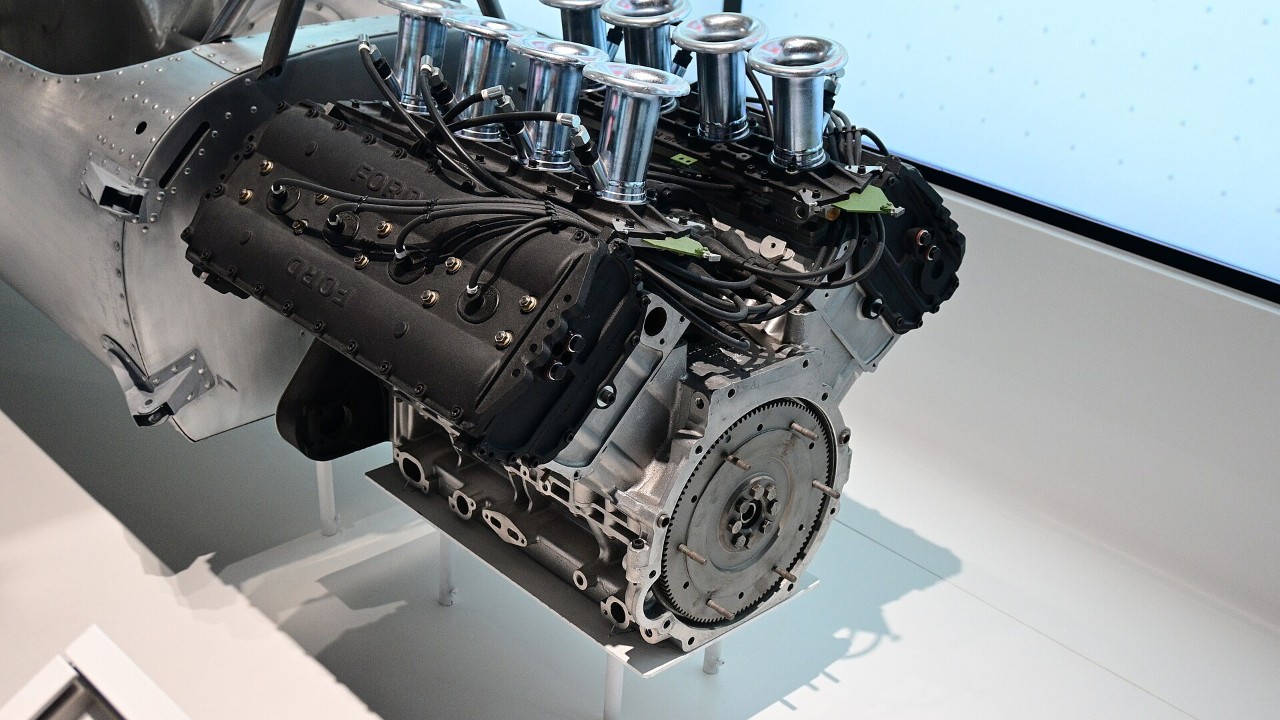
The Cosworth DFV was a 3.0-liter V8 that Ford paid for and Cosworth designed and built. Between 1967 and 1983 it won 155 Formula 1 Grands Prix. It won on its very first start, and then it kept winning for a long list of customer teams.
That’s the real story of the DFV. It wasn’t only fast. Instead, it was for sale, and it changed who could afford to go Grand Prix racing.
Here’s how a British engine company, a Ford budget and one clever chassis idea came together. As a result, the engine powered a whole era of the sport.
Who paid for the Cosworth DFV, and who built it

Initially, the project began inside Ford. According to Ford’s own history of the engine, Walter Hayes, Ford’s head of motorsport, commissioned Keith Duckworth and Mike Costin in 1965 to build a Formula 1 program.
Ford’s money made it possible. Autosport reports that Ford put up the £100,000 cost to develop the new V8 and supply it to Lotus for 1967. That’s why it’s fair to call the DFV Ford-funded or Ford-backed. However, Cosworth did the design and the building.
What “DFV” means and why four valves mattered
First, DFV stands for Double Four Valve. Ford explains that the design grew out of Cosworth’s four-cylinder FVA, short for Four Valve Series A. In effect, the DFV doubled that idea into a V8 with four valves per cylinder.
Later, Ford credited the engine with moving Formula 1 from the old two-valve engines to four-valve designs. That shift is the change the DFV’s name describes.
Moreover, the numbers backed it up. In a retrospective by Marcus Simmons, Autosport notes that no one believed a three-liter engine could make 420 bhp. Yet the DFV did, and by the end of its life it made 500 bhp. Autosport also describes it as a compact 90-degree V8.
The engine that held the car together
The DFV’s packaging was just as important as its power. Motor racing historian Doug Nye, writing for the Revs Institute, explains how Lotus used it in the Type 49. The engine acted as the car’s rearmost structural chassis member.
In other words, the Lotus 49 had no frame behind the driver. Instead, the DFV bolted to the back of the stressed-skin monocoque tub just behind the seat. Nye writes that only four bolts held it there.
That idea soon spread beyond Lotus. In fact, Autosport credits the engine’s compact nature with opening Formula 1 to smaller teams.
A win on its first start at Zandvoort
The DFV first raced at the Dutch Grand Prix at Zandvoort on June 4, 1967. Jim Clark drove a Lotus 49 to victory that day, so the engine won first time out. Goodwood’s account says Clark won by 23 seconds from Brabham.
Ford adds a striking detail. According to the company, it was the first time in 13 years that a new design had won a Formula 1 event. Then the wins kept coming. Goodwood records three more for Clark that season, at Silverstone, Watkins Glen and Mexico City.
Watkins Glen was special, too. Graham Hill finished second there behind Clark, giving the DFV its first one-two finish.
How 155 Formula 1 wins piled up
In time, the DFV went to customer teams, and that changed the grid. Autosport says it opened the door for team owners such as Frank Williams and Ken Tyrrell.
Indeed, the spread of winners proves the point. Goodwood lists the teams that won with DFV power: Lotus, McLaren, Matra, Brabham, March, Tyrrell, Hesketh, Penske, Wolf, Shadow, Ligier and Williams. By 1977, Autosport notes, 16 of the 21 constructors in Formula 1 used an engine first built 10 years earlier.
Overall, Ford sums up the record this way. Between 1967 and 1983, the DFV won 155 races, powered 12 world champion drivers and secured 10 constructors’ championships. Those title counts are Ford’s figures.
The last Cosworth DFV wins and the turbo era
Eventually, turbocharged engines caught up. Autosport reports that the DFV scored its 155th and final world championship win in June 1983 in Detroit. By then it ran in short-stroke DFY form. The engine kept racing in Formula 1 until 1985, when the turbos finally made it obsolete.
Meanwhile, the design found work elsewhere. Autosport lists DFV-based engines that won Le Mans in 1975 and 1980. It also notes a turbocharged DFX for Indycars, a DFW for the Tasman Series and a rev-limited version for Formula 3000 from 1985 to 1995.
Where Ford stands in Formula 1 today
Today, Ford is back in Formula 1 for 2026. According to Ford, Ford Racing is the official powertrains partner for Red Bull Ford Powertrains. The program supplies power units for Oracle Red Bull Racing and its customer team, Visa Cash App Racing Bulls.
Even so, the DFV’s own record stands apart: 155 Grand Prix wins between Jim Clark’s victory at Zandvoort on June 4, 1967, and the June 1983 win in Detroit.
More from Fast Lane Only
- Unboxing the WWII Jeep in a Crate
- 15 rare Chevys collectors are quietly buying
- 10 underrated V8s still worth hunting down
- Police notice this before you even roll window down
This article was created with the help of AI and was reviewed and edited by Fast Lane Only editors before publication.