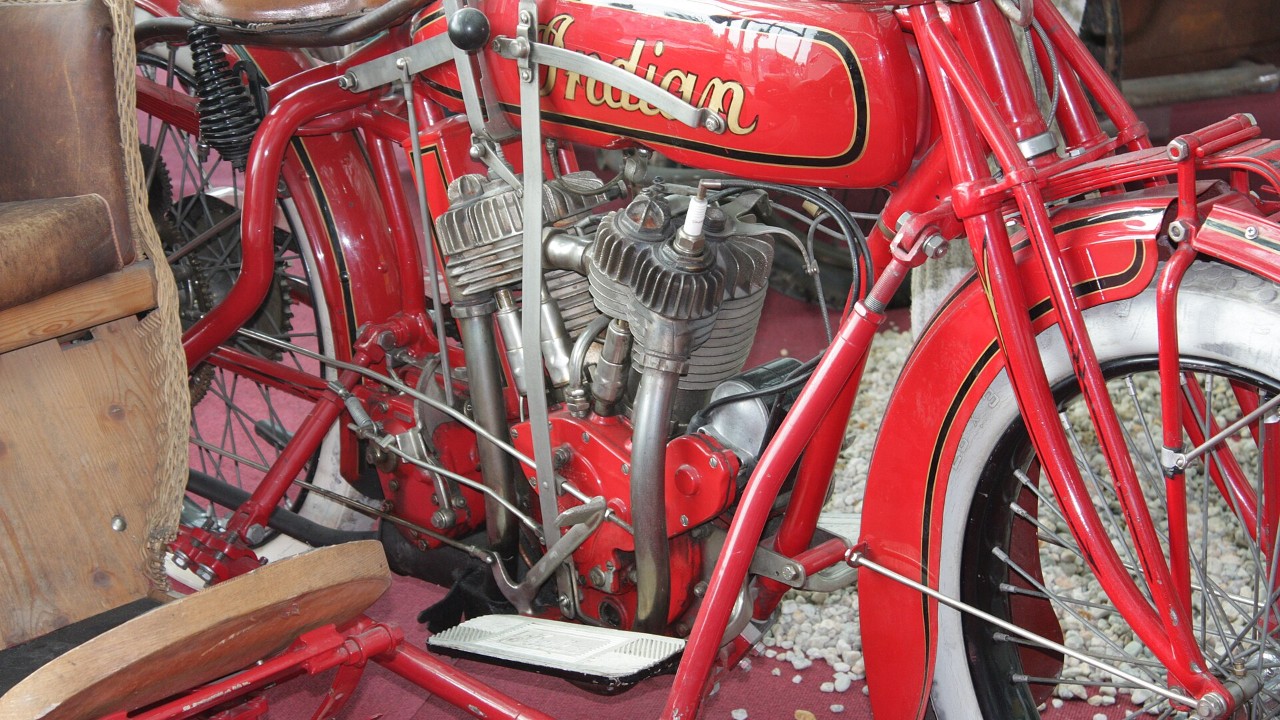
Indian stopped building motorcycles in 1953, when Chief production ended. Yet one 1920 Indian Scout, bought that year by a young New Zealander, went on to set a world record at Bonneville 47 years later. That kind of second life is common in Indian’s story.
The Springfield, Massachusetts, company is best known for its big V-twins. However, many of its most important machines earned their reputations slowly. They did it on race tracks, in army trials, on dealer floors and in backyard sheds rather than in advertising.
These are our picks for seven Indian motorcycles that grew into legends without much fanfare. The verdict is our opinion. The facts behind it come from company history, racing records and hall-of-fame entries we checked, and we left out any figure we couldn’t confirm.
1. 1920 Indian Powerplus
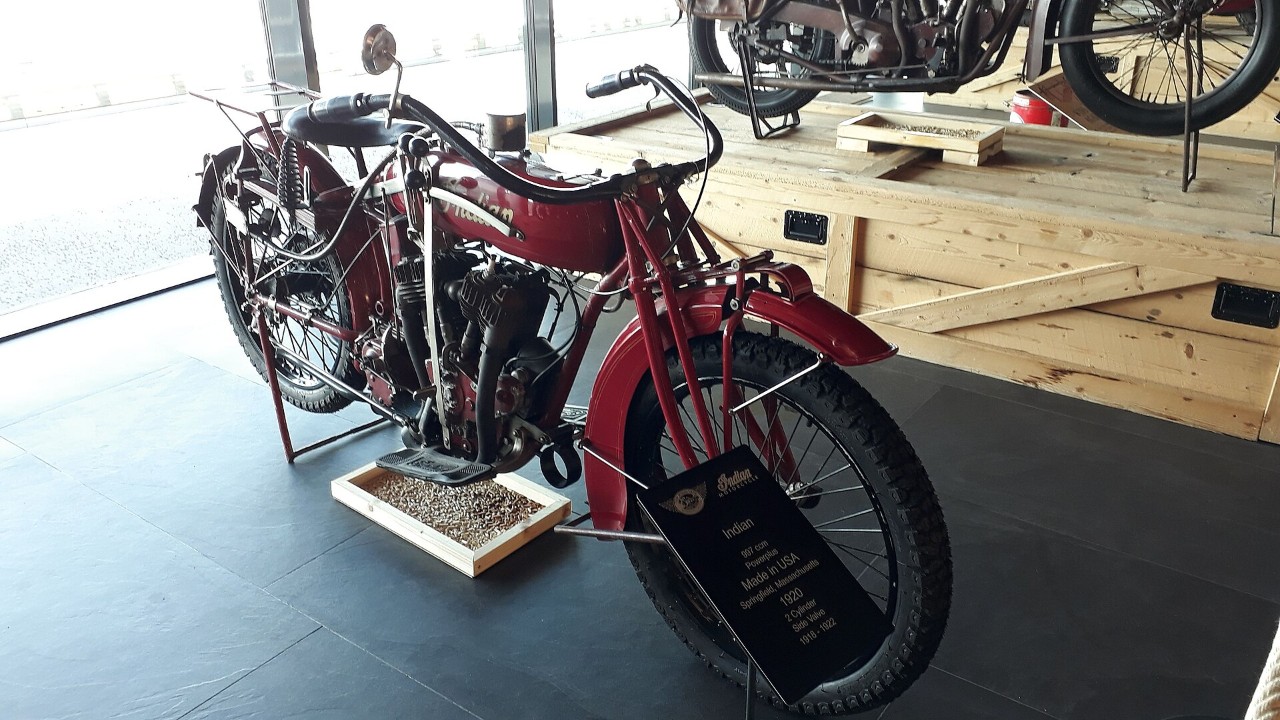
Built from 1916 to 1924 by the Hendee Manufacturing Company in Springfield, the Powerplus was Indian’s first flathead engine. Charles Gustafson, Indian’s chief engineer from 1913, designed it. The 61-cubic-inch, side-valve V-twin made roughly 16 horsepower. Indian named it Powerplus because it clearly out-pulled the engine it replaced. Ready to ride, it weighed about 430 pounds and carried just 2.5 gallons of fuel.
It proved itself early. In August 1915, Erwin “Cannonball” Baker rode an early Powerplus from Vancouver to Tijuana in 3 days, 9 hours and 15 minutes. That run set a new “Three Flags” record. Meanwhile, buyers could order an optional Cradle Spring Frame with a leaf-sprung swingarm. Indian wouldn’t offer rear suspension on a production bike again until 1940.
Our take: the Powerplus bridged the early pioneer machines and the Scout and Chief that followed. It doesn’t get the attention of those famous names. Even so, its flathead layout became the backbone of Indian’s engine thinking for decades. By 1920, a larger 72-cubic-inch version was also on offer. If you ever see one running, notice how civilized it sounds for a machine more than a century old.
2. 1928 Indian 101 Scout
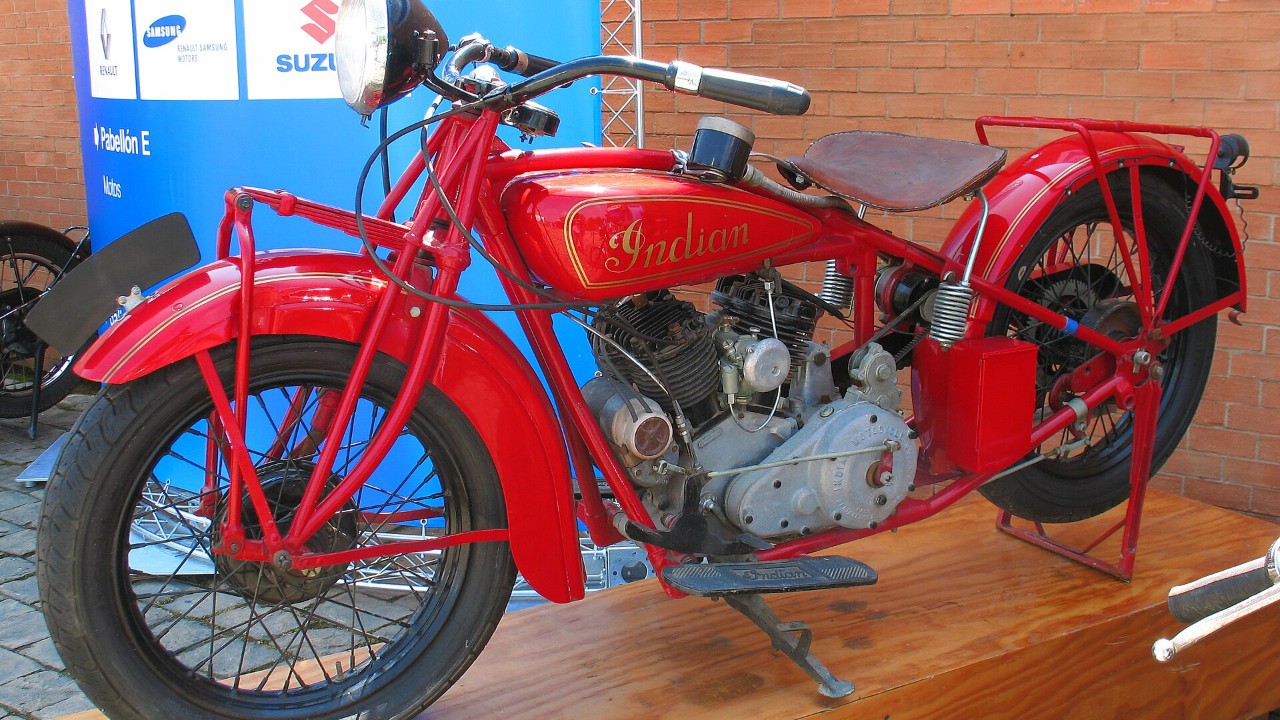
Charles B. Franklin designed the first Scout, and its geared primary drive made it the only American V-twin to use that maintenance-free setup. By 1927, the engine had grown to 45 cubic inches to fight the Excelsior Super X. Then, for 1928, Indian gave the Scout a new frame with more fork rake, a longer wheelbase and a lower seat. That became the 101 Scout.
The new chassis transformed it. Racers, hillclimbers and trick riders loved the way it handled. Many enthusiasts still call the 101 the best motorcycle Indian ever built. Ironically, that special frame was also its undoing. It cost too much to build and earned too little profit, so Indian dropped the 101 after 1931.
Our take: the 101 Scout is the rider’s Indian. It isn’t the biggest or the fastest, but its balance won over generations of stunt riders and racers. A front brake arrived early in 1928, too, which made the 101 a more complete machine. If you want to understand why Indian fans speak so fondly of the Scout, this is the model to study.
3. 1928 Indian Big Chief
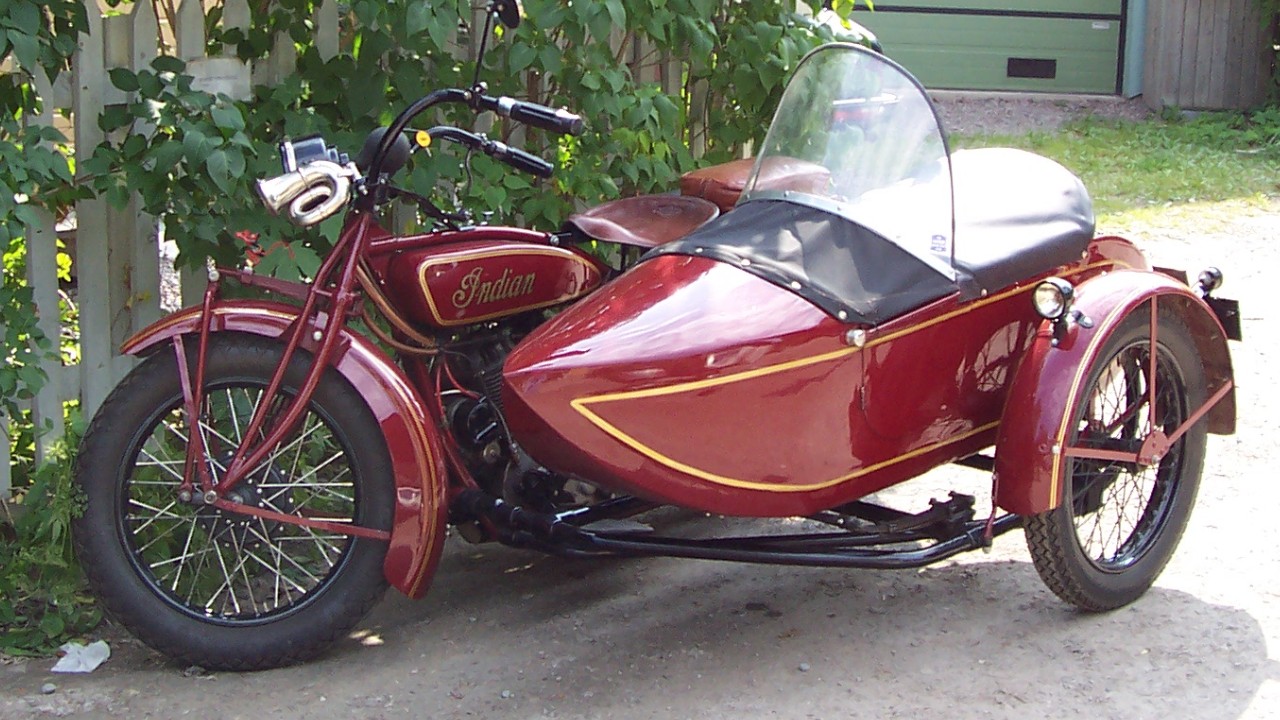
Indian introduced the Chief in 1922 with a 61-cubic-inch engine, also from Charles Franklin’s drawing board. A year later, the Big Chief arrived with a 74-cubic-inch V-twin of about 1,210cc. Indian aimed it mainly at sidecar buyers. Even so, solo riders liked its extra pull.
The year 1928 matters here. That year, Indian dropped the smaller 61-cubic-inch Chief, partly to free up factory capacity for the new 101 Scout. As a result, the 74-inch engine became the Chief from then on. The early Chiefs had no rear suspension at all.
Our take: the 1928 Big Chief is where the Chief name settled into the big-engine role it kept until 1953. It’s simple, torquey and built for distance with a load. In 1928, it was also the biggest V-twin in Indian’s range. Better yet, it shared a designer with the 101 Scout, so the two 1928 models make a natural pair. In our view, it laid the groundwork for every heavyweight Indian that followed. By 1950, the Chief had telescopic forks and an 80-cubic-inch engine. However, the 1928 Big Chief shows the model in its plain, purposeful early form.
4. 1940 Indian Four
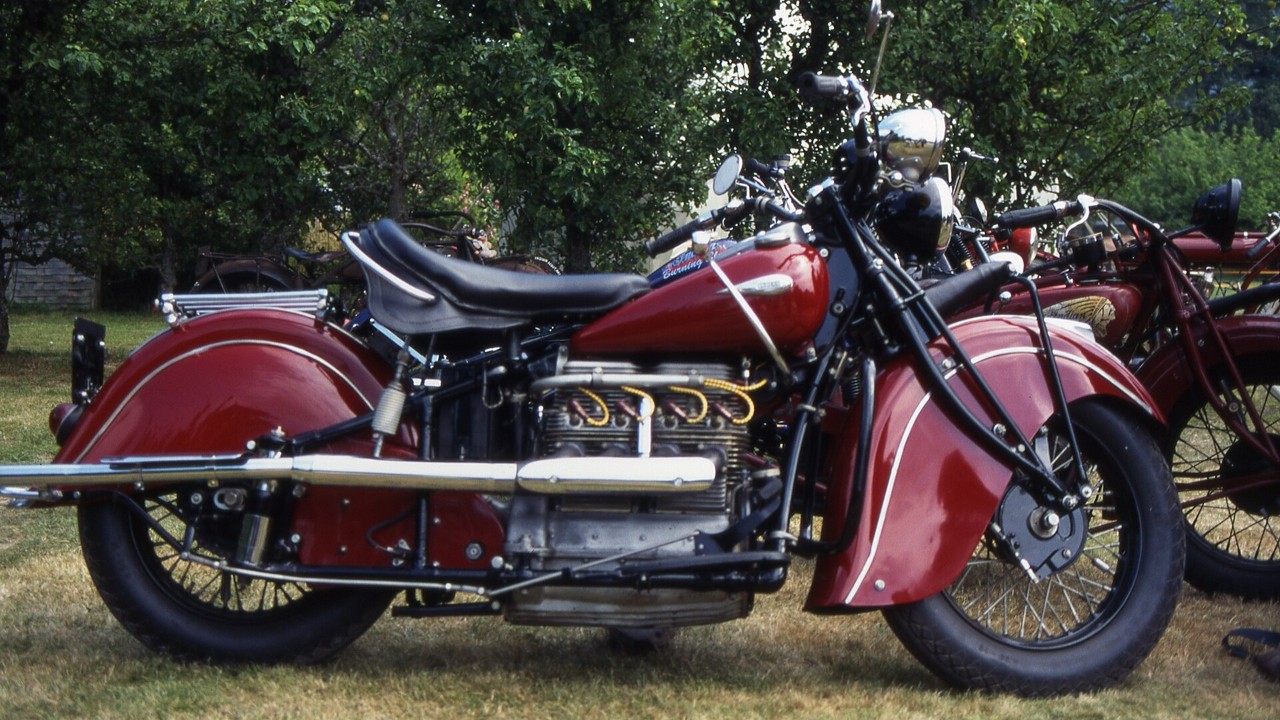
Indian bought the rights to the Ace four-cylinder in 1927 and turned it into the Indian Four, built from 1928 to 1942. Its inline-four displaced 77 cubic inches. The 1929 version added a five-bearing crankshaft in place of the Ace’s three-bearing design. Then, for 1936 and 1937, Indian tried an upside-down cylinder head. Sales dropped, and the original layout came back in 1938.
The 1940 model brought big changes. The Four’s frame gained plunger rear suspension, and every Indian got large decorative fenders that became the brand’s signature look. After civilian production stopped in 1942, the Four never returned. In 2006, the U.S. Postal Service put the 1940 Indian Four on a stamp.
Our take: the Four was Indian’s luxury flagship, and in our view it felt smoother than any of the company’s V-twins. Its flawed 1936 head nearly sank it, yet the 1940 version is now one of the most admired American motorcycles of its era. A 1941 model sits in the Smithsonian collection. If you see one at a show, look for the plunger rear suspension that marks the 1940 change.
5. 1940 Indian Junior Scout
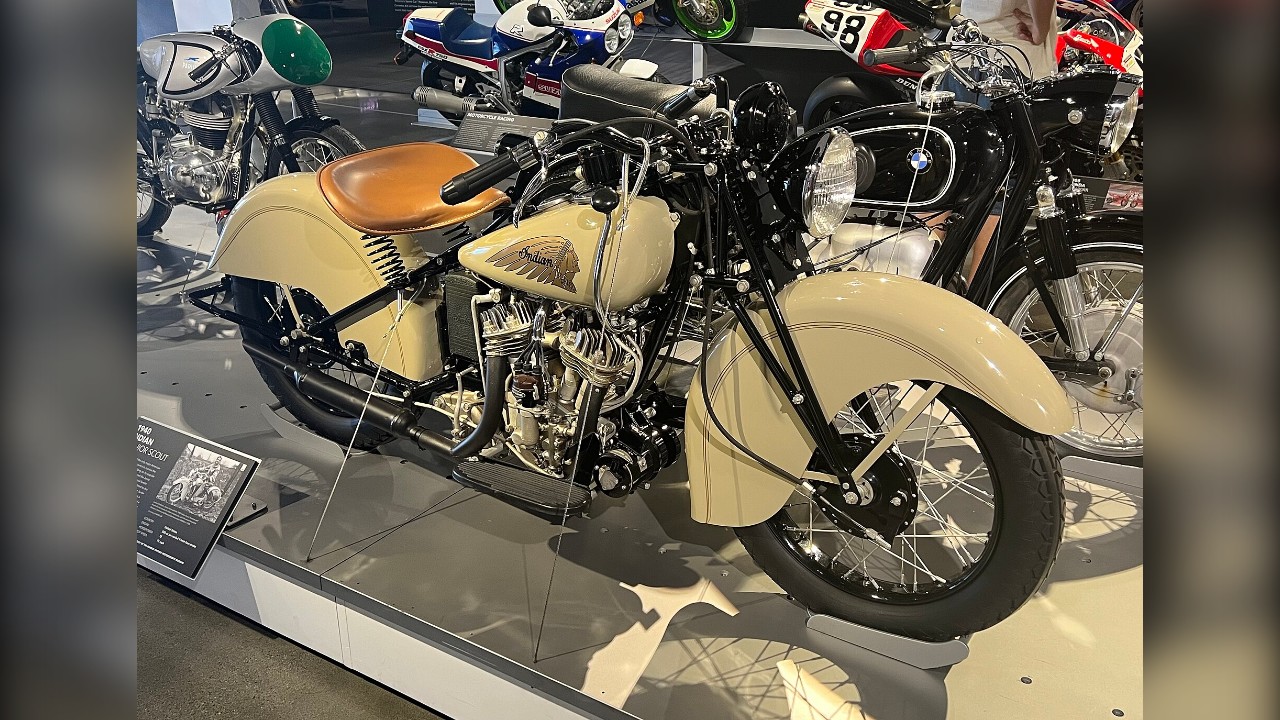
The Junior Scout began life in 1933 as the Pony Scout, a smaller V-twin of about 500cc, or 30.50 cubic inches. Indian later renamed it the Junior Scout. Its bigger sibling, the Sport Scout, won the first Daytona 200 in 1937. Together with the short-lived Motoplane, the small Scouts were known as the “Thirty-Fifty,” after their engine size.
The Junior Scout was the entry-level Indian. It was light, simple and affordable, and it gave a new rider a way into the brand. However, its most impressive chapter came in uniform. The 741B, a military version of the Thirty-Fifty, became the most common Indian military motorcycle of World War II. Over 30,000 were sold, mostly to Allied forces.
Our take: the Junior Scout rarely gets top billing at Indian gatherings, which is exactly why it belongs on this list. It carried the Scout name to riders who couldn’t afford a Chief, and then its military cousin carried soldiers across the war. By 1940, it also wore the brand’s new full fenders. If you want an approachable prewar Indian, it’s the one we’d start with.
6. Indian 841
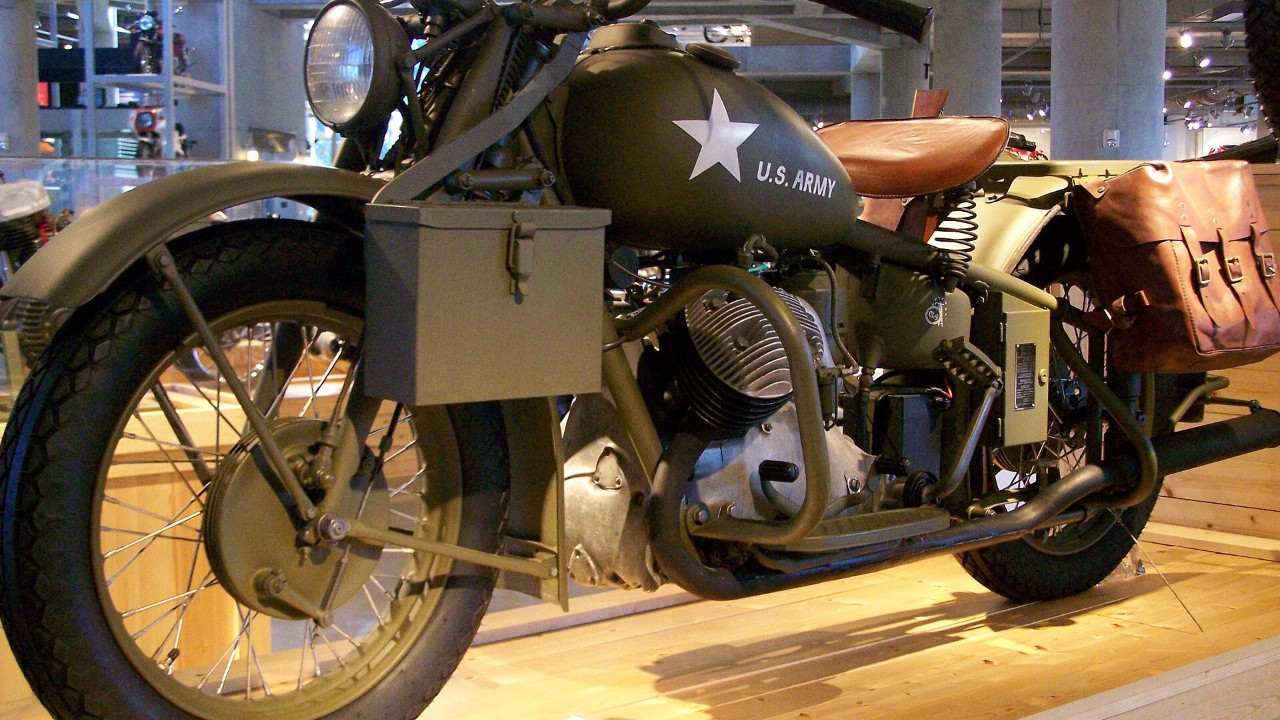
The U.S. Army wanted experimental motorcycles for desert fighting in World War II. It asked Indian for 1,000 test bikes and offered $350,000 for them. Indian built 1,056 examples of the 841 between 1941 and 1943. Inspired by BMW’s R71, it used a 737cc side-valve V-twin mounted with its crankshaft along the frame, driving the rear wheel by shaft.
The details set it apart from any earlier Indian. It had a foot-shifted four-speed gearbox, a hand clutch, a girder fork and plunger rear suspension. It made 25 horsepower, reached 70 mph and weighed 528 pounds wet. Harley-Davidson built its rival XA for the same trials. In the end, the Army chose neither. Instead, it judged the Jeep better suited to the job.
Our take: the 841 is a dead end that turned out to be a signpost. Its layout, a lengthwise V-twin with shaft drive, is the one Moto Guzzi later made famous. Few people outside the Indian world know that link. That’s why we’d count it among the brand’s most important machines, even though it never saw combat service.
7. Burt Munro Special Indian Scout
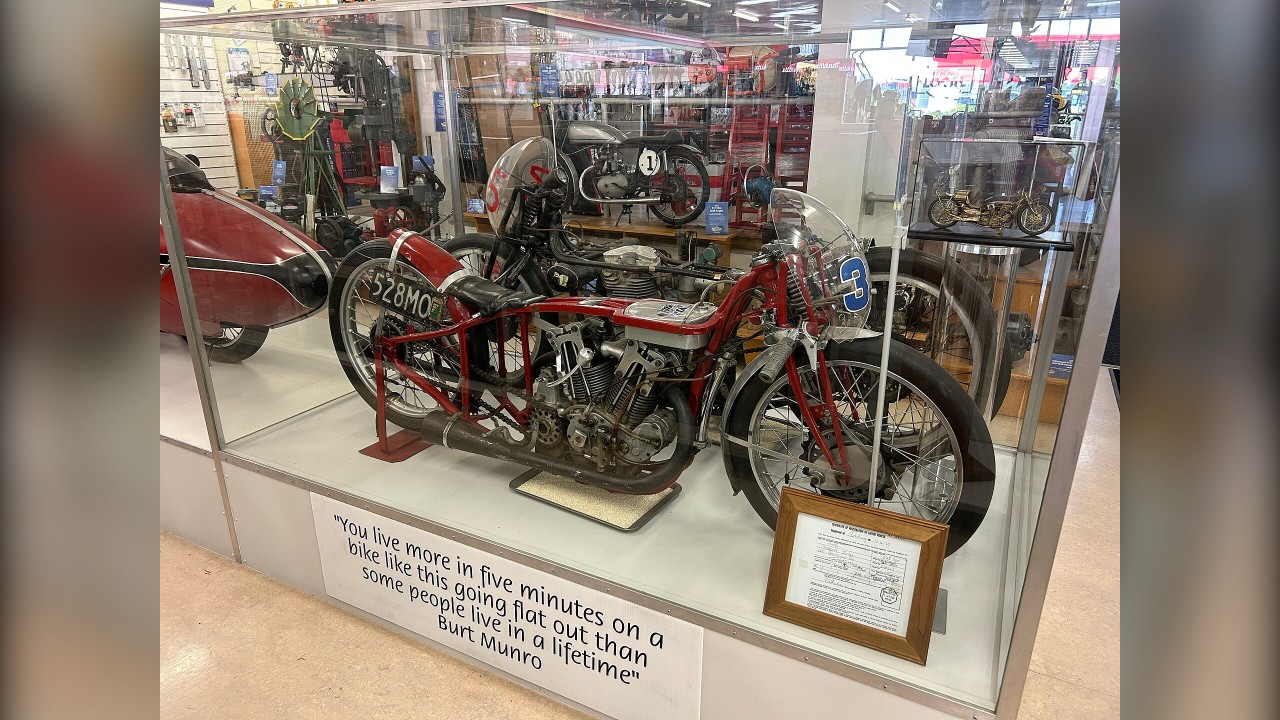
Burt Munro bought his 1920 Indian Scout new. It was the 627th Scout built, with a 600cc engine and a top speed of about 55 mph. According to Motorcycling New Zealand’s hall of fame entry, he began modifying it in 1926. Eventually, he cast many parts himself and made his own barrels, pistons and flywheels. He even used an old spoke as a micrometer.
The engine grew to 950cc. At Bonneville in August 1967, Munro set an under-1,000cc class record at age 68. His one-way qualifying run of 190.07 mph remains the fastest officially recorded speed on an Indian. Indian’s own tribute to Munro adds that the Special needed a rebuild after every 10 minutes of running by then. In 2014, a recalculation raised his 1967 record to 184.087 mph.
Our take: the Munro Special is the clearest proof of how much speed lived in a 1920 Scout. In 2005, Anthony Hopkins played him in The World’s Fastest Indian, which carried his story to a far wider audience. Munro was inducted into the AMA Motorcycle Hall of Fame in 2006. Today, the Munro Special is on display at E. Hayes and Sons in Invercargill, New Zealand.
More from Fast Lane Only