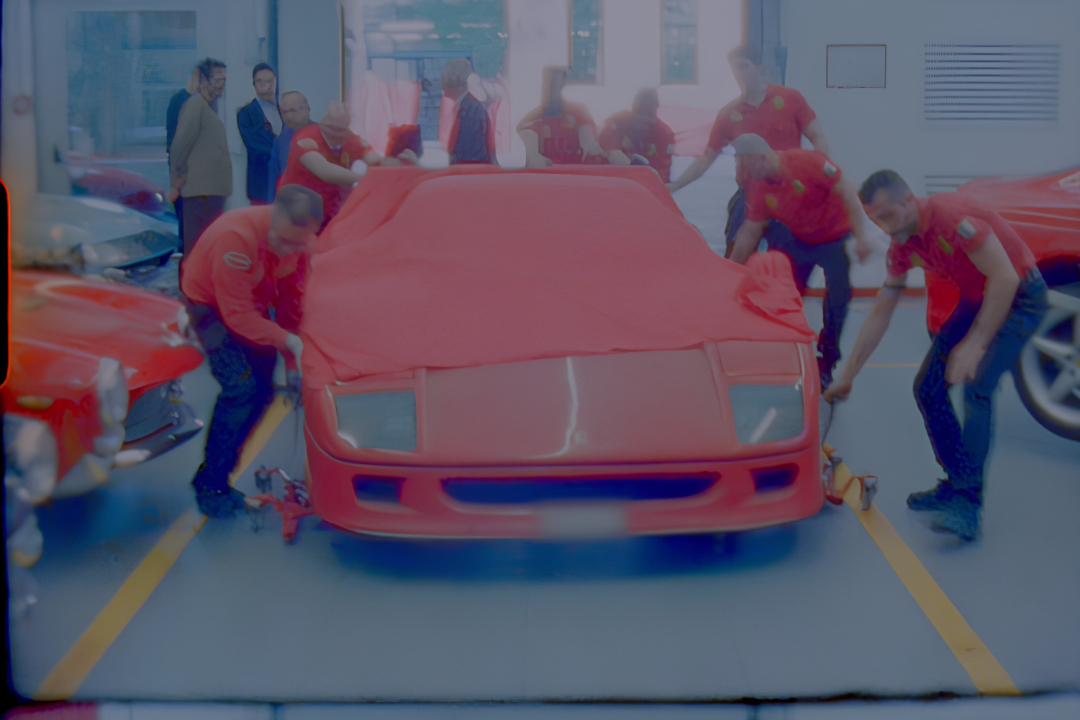
For Lewis Hamilton, the Ferrari F40 was never just a car on a poster. He describes Ferrari itself as more than a badge growing up, tied up in sound, history, and childhood daydreams, and the F40 sat at the center of all of it. So when the seven-time Formula 1 world champion finally got his hands on one, it wasn’t a straightforward purchase followed by a straightforward drive. It was a car that had been sitting untouched for over 30 years, dust on the paint, dirt packed into the grille, and needed a full restoration before it could become his in any real sense.
The timing carries its own weight. Hamilton says the F40 was with him on his first day at Maranello, when his childhood dream of driving for the team in red finally became real. A car that represented the dream arriving alongside the moment the dream came true isn’t a coincidence he treats lightly.
Thirty years frozen in place
What makes this particular F40 notable isn’t just the model, it’s the condition it arrived in. Hamilton describes it as untouched and original, having sat in a garage for more than three decades without being driven, cleaned, or altered. The dust on the paint, the dirt built up in the front air intake, even flies embedded in the grille, all of it remained exactly as it had been left. For a car this significant, that kind of preservation is rare. Most F40s that survive decades in storage get touched at some point, sold, serviced, occasionally modified. This one apparently wasn’t.
Hamilton frames that untouched state as part of the car’s value rather than a problem to fix quickly. In his words, it’s still exactly as it was when it left the factory floor, with every bit of it telling a story. That’s a deliberate way of looking at a car most collectors would be tempted to immediately clean up and put on display.
Taking it apart to bring it back
Getting the F40 roadworthy again meant sending it to Ferrari Classiche, the marque’s in-house restoration and authentication division based in Maranello, and letting technicians take it apart piece by piece. The car went up on a hydraulic lift with its wheels removed, and the twin-turbo 2.9-liter V8, the engine that defined the F40’s reputation as one of the last raw, analog supercars Ferrari built, came out entirely for inspection and rebuild. Rear suspension components were pulled as well.
Hamilton walked through the shop during this process, examining original parts pulled from storage shelves, including a leather tool pouch that had presumably sat with the car through its decades of dormancy. It’s a different kind of footage than most car reveals offer, less about the finished product and more about the unglamorous middle stage where a dream car exists in pieces on a workbench.
A car built to make you feel something
Before any of the restoration footage, Hamilton sits in the F40 as it exists now, dusty, original, not yet touched by the rebuild, and the reaction is immediate. He calls it a car that makes you feel something rather than one you simply admire, and says you can feel the era it came from just sitting in the seat. That’s a meaningful distinction coming from someone who spends his professional life in some of the most technically advanced race cars ever built. The F40 represents something almost opposite: raw, mechanical, built for one purpose, as he puts it, to make you feel alive.
That contrast is probably why this particular car matters so much to him. Modern F1 machinery is refined to the point of clinical precision. The F40 was engineered in an era before that kind of refinement was even possible, when feel and feedback mattered more than telemetry.
Watching it come back
Hamilton closes with something simple: some cars you just don’t forget, and this one’s his. That’s the entire emotional arc of the piece compressed into one line, a childhood dream, a decades-dormant car, and a restoration process happening in the same city where his own Ferrari story began. Whatever the finished F40 eventually looks like once Classiche completes the rebuild, the version worth paying attention to is this one: dusty, disassembled, and still somehow exactly what he’d been imagining since he was a kid looking at posters on a wall.
More from Fast Lane Only
- Unboxing the WWII Jeep in a Crate
- 15 rare Chevys collectors are quietly buying
- 10 underrated V8s still worth hunting down
- Police notice this before you even roll window down
*Research for this article included AI assistance, with all final content reviewed by human editors.