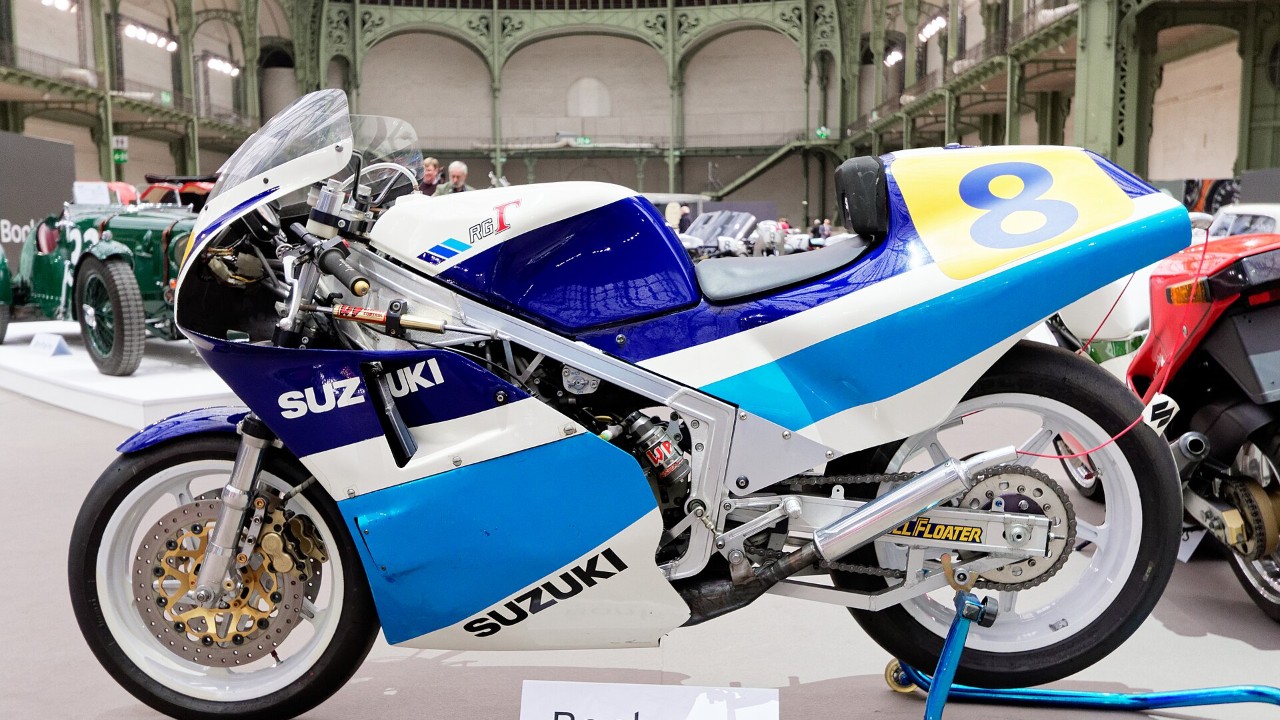
Suzuki built fewer than 10,000 road-going RG500 Gamma motorcycles in its first three years, and a race-prepared one is scarcer still. That’s the world of the collectible two-stroke: short production runs, hard use and very few survivors in original condition.
Two-strokes were light, loud and fast, which is exactly why riders used so many of them hard and used them up. Racers rebuilt them, modified them and moved on. As a result, the clean, documented examples that collectors want are thin on the ground today.
These are our picks for twelve two-stroke motorcycles we think you’ll rarely see cross an auction block. The verdict is our opinion, not a market survey. However, the facts behind each pick come from factory figures, racing records and period sources we checked.
1. 1986 Suzuki RG500 Gamma TT Formula 1
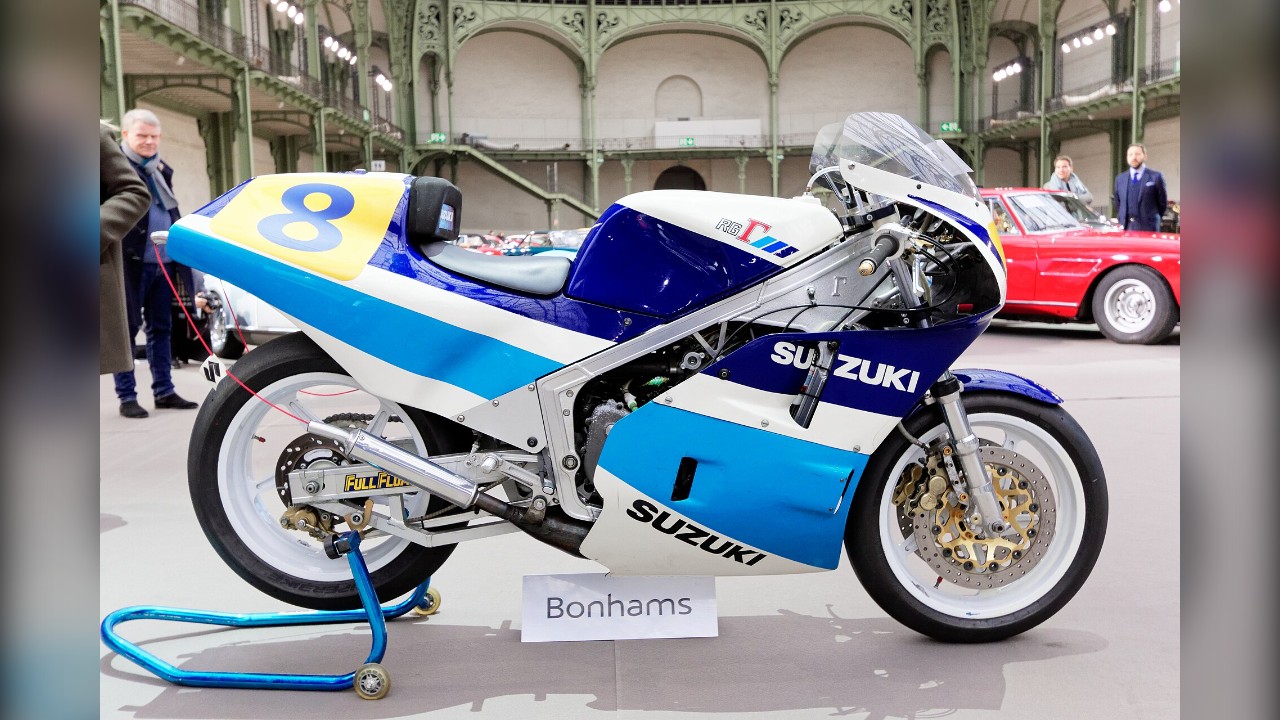
Suzuki’s RG Gamma 500 racer won the 500cc world championship in 1981 with Marco Lucchinelli and in 1982 with Franco Uncini. The road-going RG500 Gamma followed in 1985 and stayed on sale until 1989. Its 498.5cc square-four used two crankshafts and rotary-valve induction, much like the Grand Prix bike. It sat in a box-section aluminum frame.
Production fell fast. Suzuki built 7,340 RG500s in 1985, then 1,412 in 1986 and only 532 in 1987, for 9,284 across those three years. The example pictured is a 1986 Gamma prepared for TT Formula 1 racing. A photographer caught it at Bonhams’ Paris sale in 2017. Because it shares its engine design with the Grand Prix bike, this RG500 Gamma in race trim is about as close as a road rider could get to Uncini’s machine.
Our take: a road-going RG500 Gamma is already a prize. A race-prepared RG500 Gamma takes that further, because racing bikes rarely survive in one piece. If you’re looking at one, ask for its race history and the original road parts, because both affect what the bike is worth.
2. Yamaha RZV500R
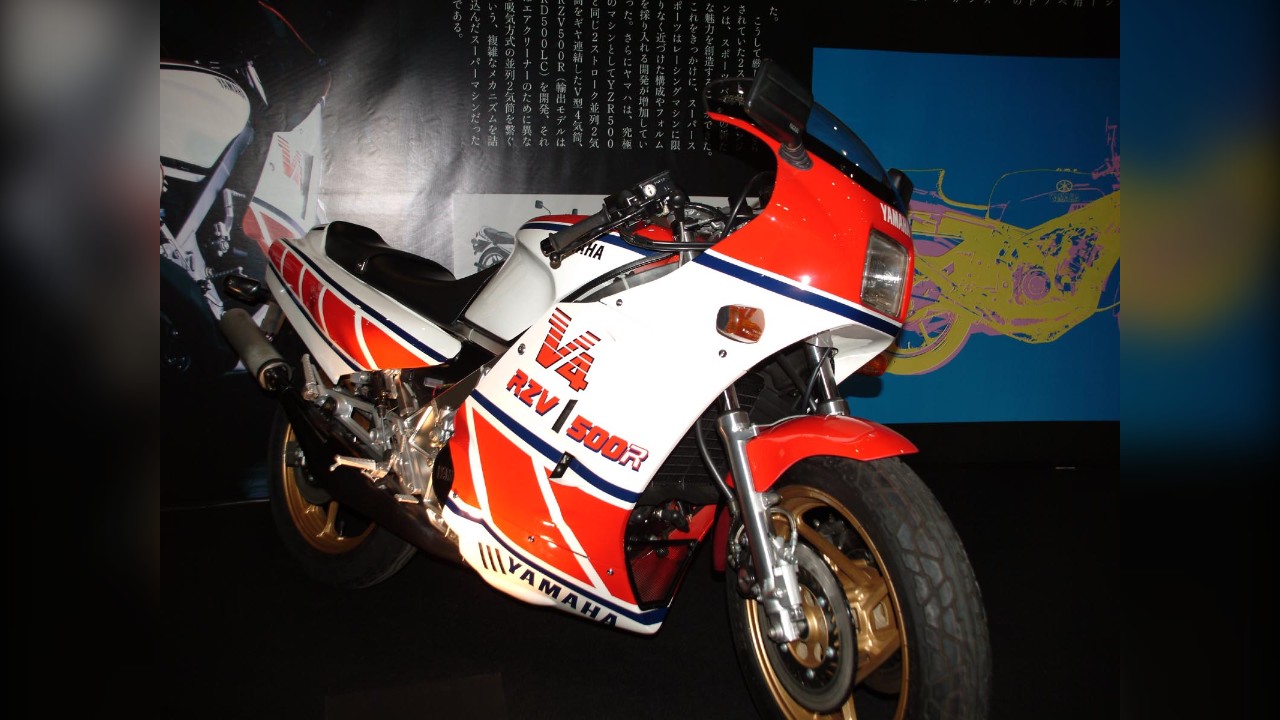
Yamaha built the RD500LC from 1984 to 1986 as a road replica of the YZR500 racer that Kenny Roberts made famous. Its 499cc V4 two-stroke used reed valves and Yamaha’s YPVS power valves. In standard form, it made 88 horsepower. Yamaha never sold it in the United States, because it couldn’t meet EPA rules.
The RZV500R was the Japanese-market version, and it’s the one we’d chase. Japanese rules forced Yamaha to detune it to 64 horsepower. In exchange, it got a hand-welded aluminum frame instead of the export bike’s steel one. That cut its dry weight to 432 pounds, compared with 452 for the standard model. Yamaha limited the RZV500R to 1,600 units. In addition, the RD500LC won the 1984 Castrol Six Hour race, proof the V4 could survive long stretches at full throttle.
Our take: the RZV500R is the purist’s version of a bike that was already exotic. It trades some power for a lighter, more race-like chassis. In our view, that makes it the most interesting V4 two-stroke Yamaha sold to the public. If you find one outside Japan, confirm the frame and the paperwork before anything else.
3. Honda NS400R
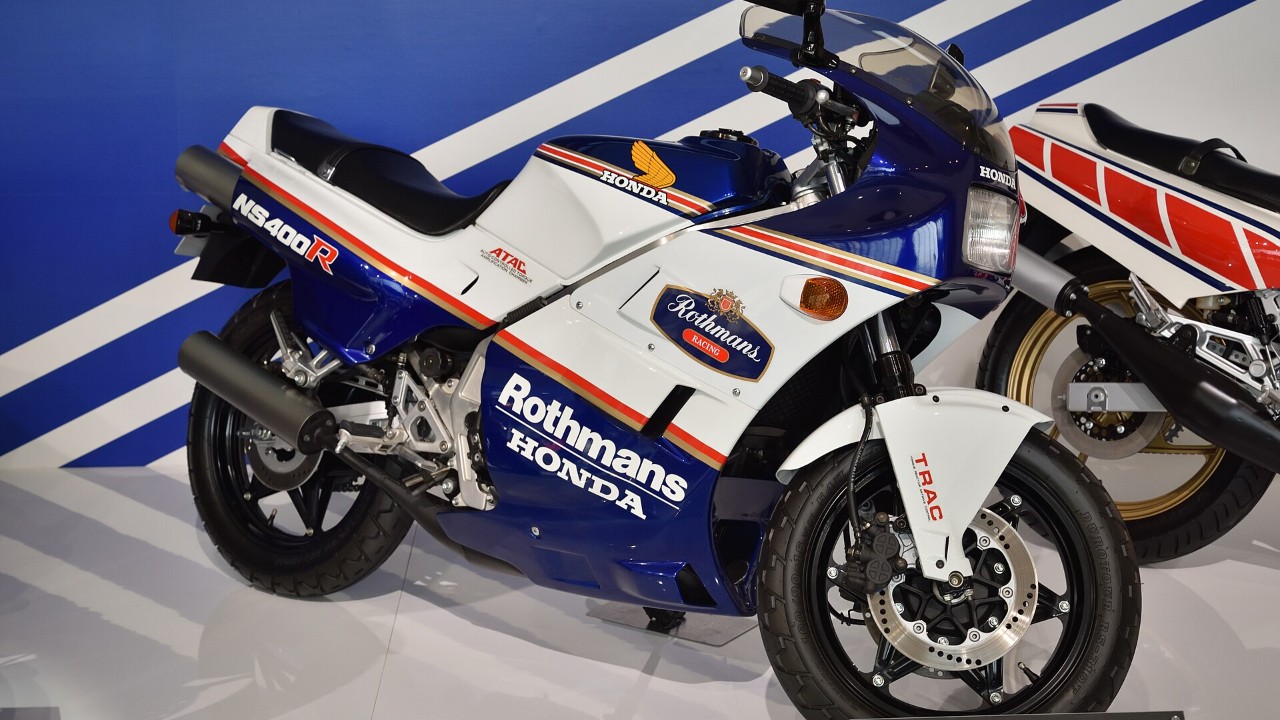
Freddie Spencer won the 1983 500cc world title on Honda’s NS500 V3 at 21, making him the youngest champion at the time. The NS400R was Honda’s street-legal replica of that bike. It used a liquid-cooled, oil-injected 387cc V3 two-stroke. Honda rated it at 72 horsepower at 9,500 rpm. By contrast, Japanese rules held the home-market version to 59.
It weighed 163 kilograms dry and rode on a box-section alloy frame. Next to the RD500LC’s 205 kilograms dry, that’s a featherweight. Meanwhile, Honda equipped the front fork with its TRAC anti-dive system, a feature of the period. Production ran from 1985 to about 1987, and Honda built 12,000 in total. That launch year matters, because the RG500 Gamma reached showrooms in 1985 too, so the two met head-on.
Our take: the NS400R is the odd one out among the 1980s two-stroke replicas. It’s smaller than the 500s from Suzuki and Yamaha, and its three-cylinder layout is unique among them. That’s why we’d argue it deserves the same respect. If you buy one, check that the oil-injection system works properly, because a lean two-stroke is an expensive lesson.
4. 1976 Kawasaki KR250
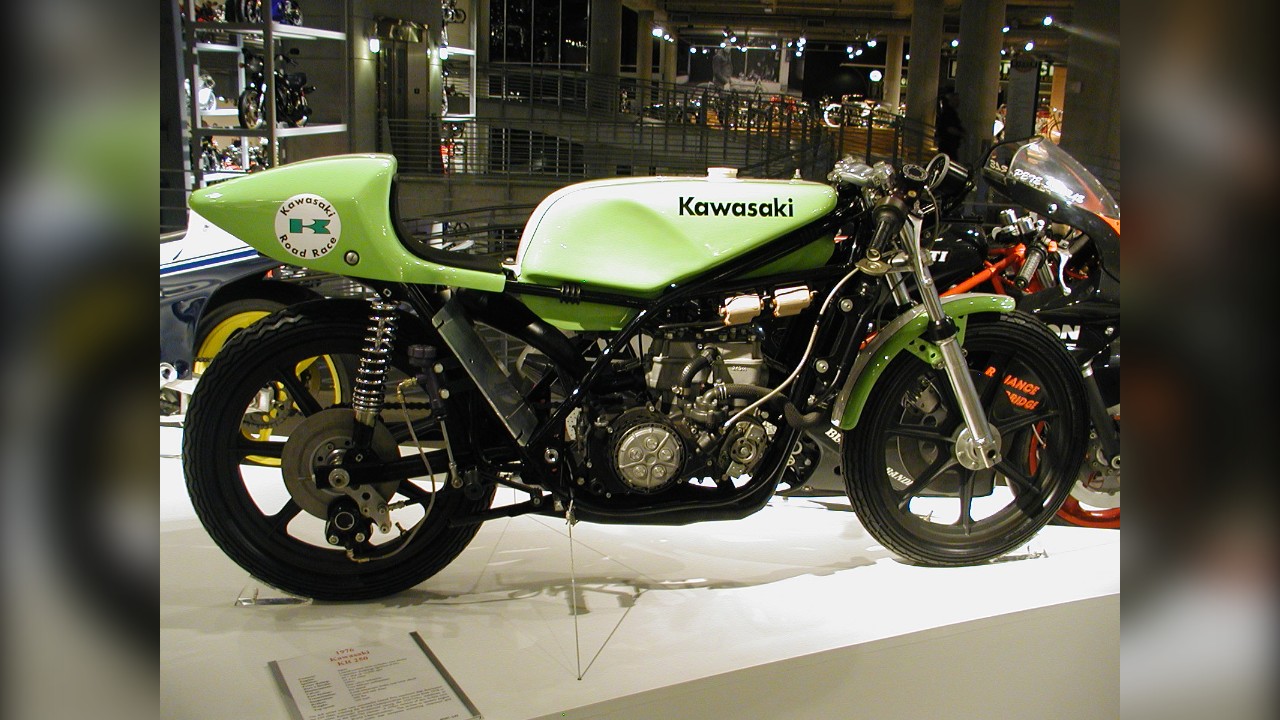
Kawasaki built the KR250 Grand Prix racer from 1975 to 1982. Work started in 1974 under Nagato Sato. The team chose a “tandem twin” layout, with one cylinder behind the other. That narrowed the bike’s frontal area and made room for a disc-valve engine.
Success took time. Mick Grant rode it in its early years with little result, and its first win came at the 1977 Dutch TT at Assen. Then the KR250 took off. It won four straight 250cc world titles, with Kork Ballington in 1978 and 1979, and Anton Mang in 1980 and 1981. A 1976 example sits in the Barber Vintage Motorsports Museum. Later, the racer also inspired a road-going KR250 with the same engine layout.
Our take: an early KR250 shows the racer before its glory years. Works racing bikes rarely come up for public sale, so most fans will only ever see one in a museum. That’s exactly why it belongs here. If you ever get the chance to hear one run at a vintage event, take it, because the sound alone explains the appeal.
5. 1967 Bultaco Pursang Mk2 250
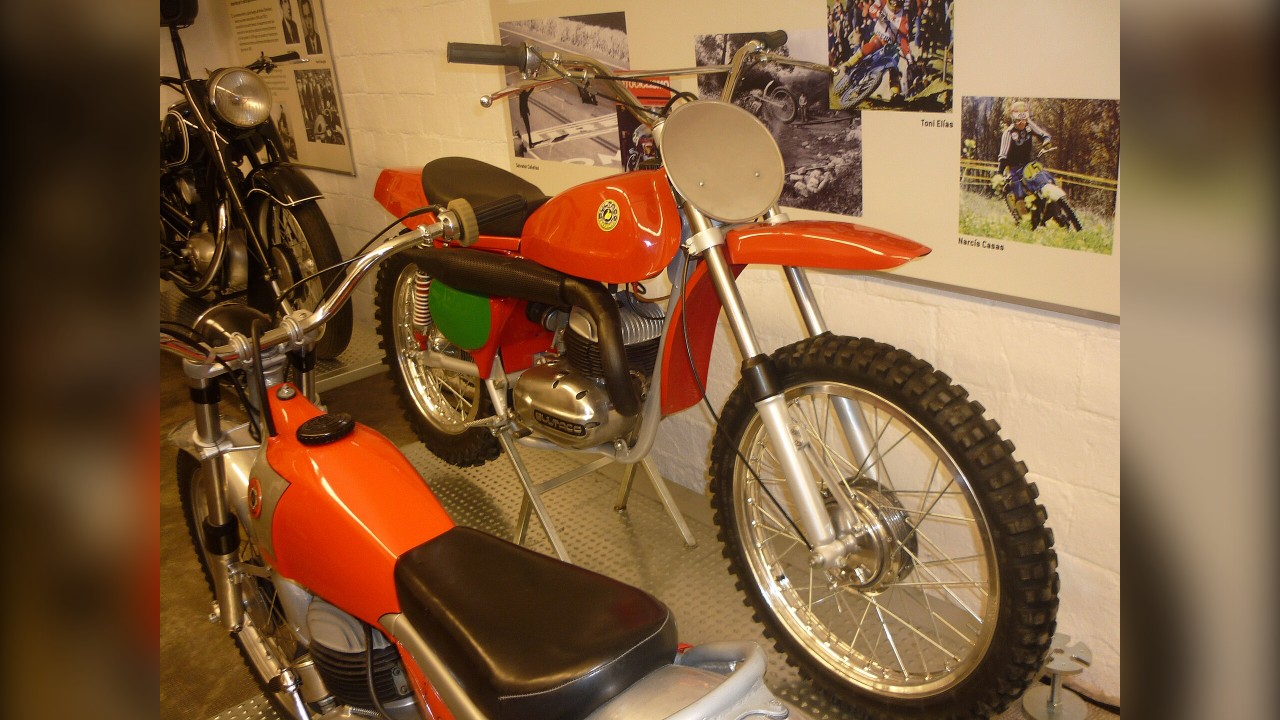
Bultaco’s Mk2 Pursang appeared in the spring of 1967. It used expanded engine cases with a new five-speed gearbox and a three-main-bearing crankshaft. The wheelbase also grew by more than 2 inches. According to Motocross Action’s look back at the bike, it made 34 horsepower out of the crate, about five more than many European rivals.
Riders nicknamed it the “Boat Tail,” because its square red bodywork looked like a Chris Craft runabout. Both a motocross version and a scrambles version came to the U.S. Its suggested retail price was $895 in 1967. However, the fiberglass bodywork broke easily in falls, and the high pipe overheated riders’ legs, so Bultaco moved to a low pipe the next year.
Our take: the Boat Tail captures Spanish dirt bikes at their most stylish. In our view, its fragile bodywork means few survived intact, and that’s the core of its appeal today. Motocross Action notes that a near-perfect example sold for $12,000. If you find one, look closely at the original fiberglass, because original panels are what make a Boat Tail special.
6. 1968 Montesa Cappra 250 GP
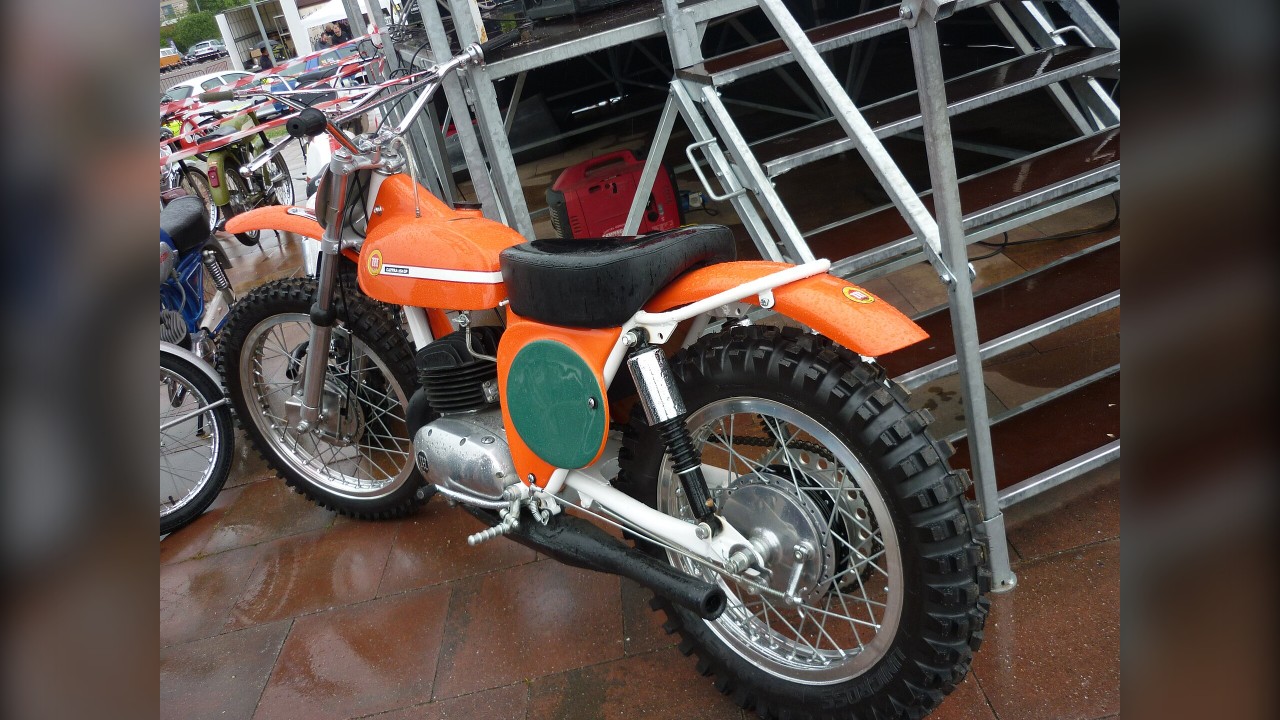
Montesa’s Cappra line was the Spanish company’s motocross range in the late 1960s. The production tables kept by Cybermotorcycle’s Montesa archive list 250 units of the 1968 Cappra 250 GP, model code M53. By comparison, the 1967 Cappra 250 shows 207 units. Later, the 1969 Cappra 250 “GP Five” jumped to 1,100. By 1973, the Cappra 250 “VR” reached 2,400, which shows just how small that 1968 batch was.
Its bigger brother tells you how serious the range was. Cycle World tested the 1968 Montesa 360 Cappra GP and reported a claimed 38 horsepower and a $1,140 price. That bike used an aluminum barrel, head and cases, along with a four-speed gearbox. It was also Montesa’s first 360cc motocross model, after three years of development.
Our take: the 1968 Cappra 250 GP comes from a batch that small Spanish factories built in the hundreds, not the thousands. That alone makes it hard to find today. Factories built bikes like this to race, too, so originality is rare. If you’re shopping, focus on documentation and correct parts, because a complete early Cappra is a real find.
7. 1970 Kawasaki H1R
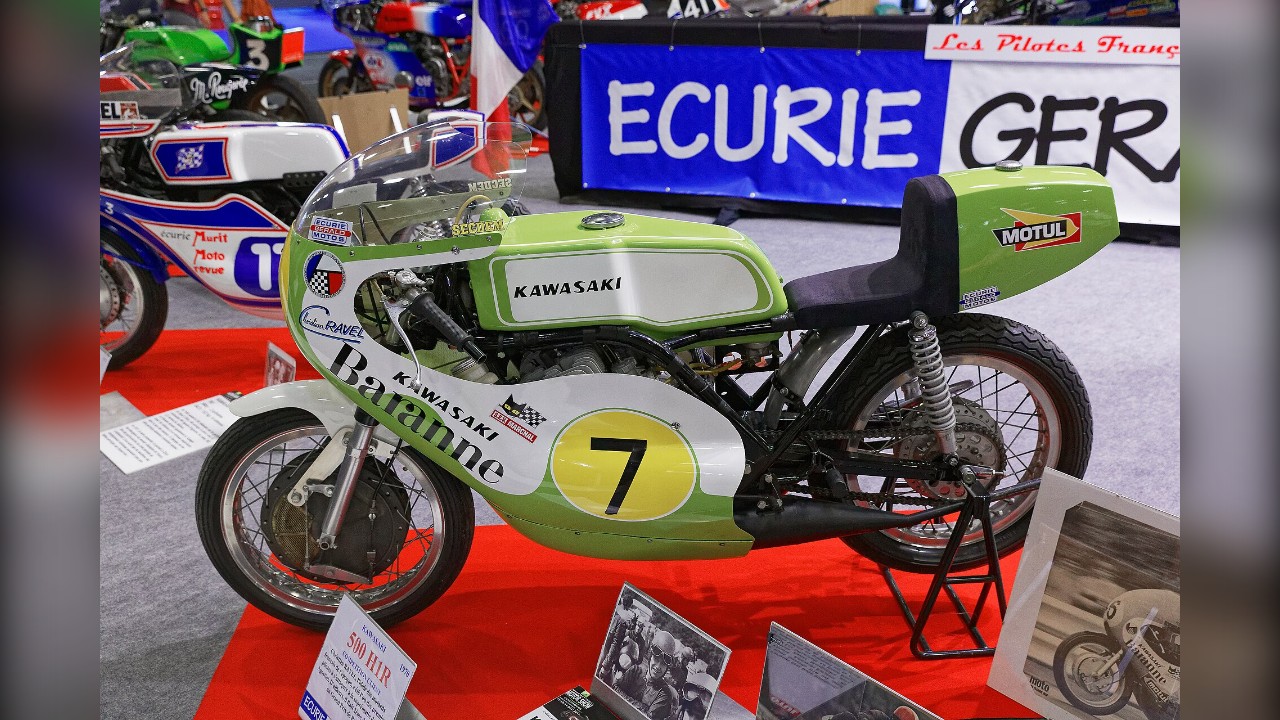
The H1R was Kawasaki’s 500cc Grand Prix racer, based on the H1 street triple. Kawasaki built it from 1969 to 1973. Its 498.76cc three-cylinder two-stroke made 82 horsepower at 9,000 rpm, in a bike that weighed just 295 pounds dry.
In 1970, Ginger Molloy finished second in the 500cc world championship on an H1R. Only Giacomo Agostini on the MV Agusta beat him. Molloy scored four second-place finishes that season, and Kawasaki finished second in the constructors’ standings. Then, in 1971, Dave Simmonds won the season-ending Spanish Grand Prix at Jarama. That was Kawasaki’s first win in the premier class, and Simmonds finished fourth in the standings. Kawasaki then placed third among constructors in 1971 and fourth in 1972.
Our take: the H1R is a production-based racer that punched far above its weight. It took on factory teams with a production-based triple and came close to the top. Teams rode racing bikes like this hard and rebuilt them often, so original ones are scarce. If you find one, ask about every rebuild, because history matters as much as hardware here.
8. 1981 Maico MC 490
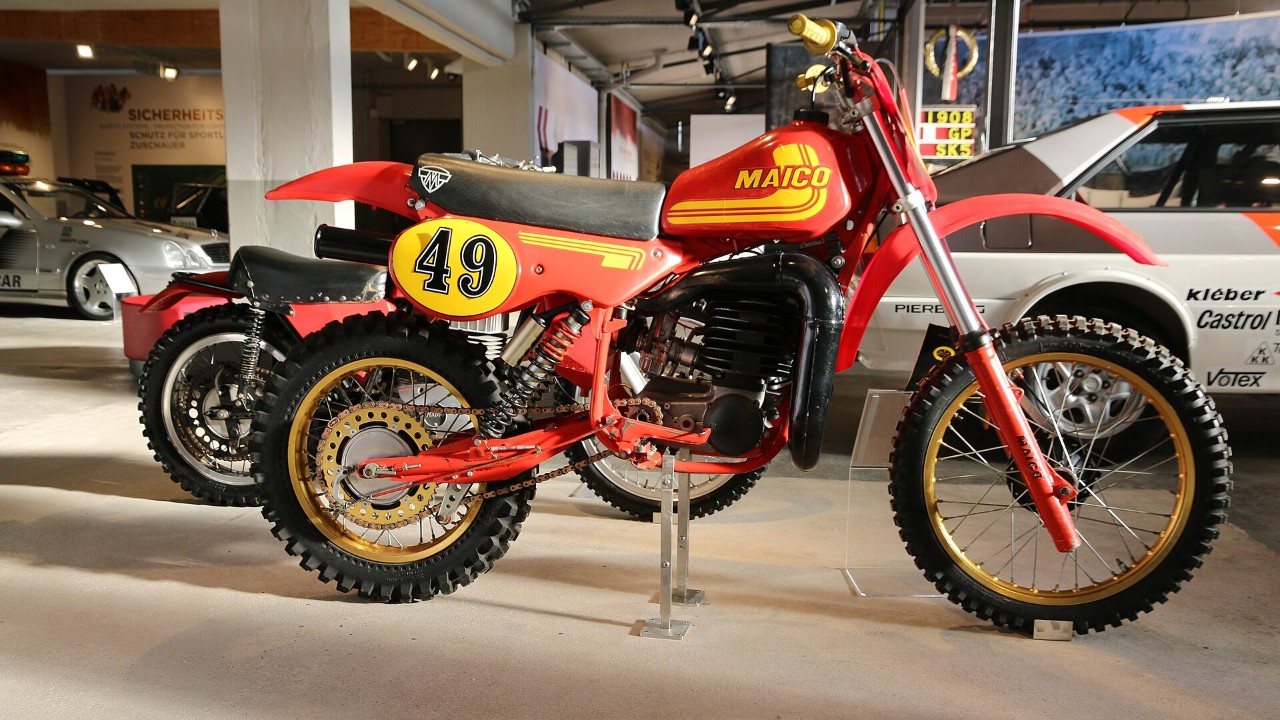
Maico built motorcycles in Pfäffingen, near Tübingen in Germany, after Ulrich Maisch founded the company there in 1926. Its 1981 open-class 490, sold as the Mega 2, earned a huge reputation. Motocross Action magazine later called it “the greatest open-class motocross bike of all time.” Earlier, in 1974, teams such as Wheelsmith had started forward-mounting Maico rear shocks for more travel, and other teams soon copied the idea.
The company’s riders, including Åke Jonsson, Adolf Weil and Willy Bauer, scored many top-three finishes in the Motocross World Championships. However, the business didn’t last. Maicowerk AG filed for bankruptcy in 1983, though it kept building small numbers of motocross and enduro bikes through 1986. Later, a company called Rodem built Maicos from 1995 until its own bankruptcy in 1997.
Our take: the 1981 Maico 490 is one of the great open-class motocross bikes of its time. Its reputation is huge, and riders raced many of them hard. That combination makes a clean one very hard to find. If you buy one, check the frame and engine numbers, because matching numbers are the first proof of an original bike.
9. Suzuki RGV250
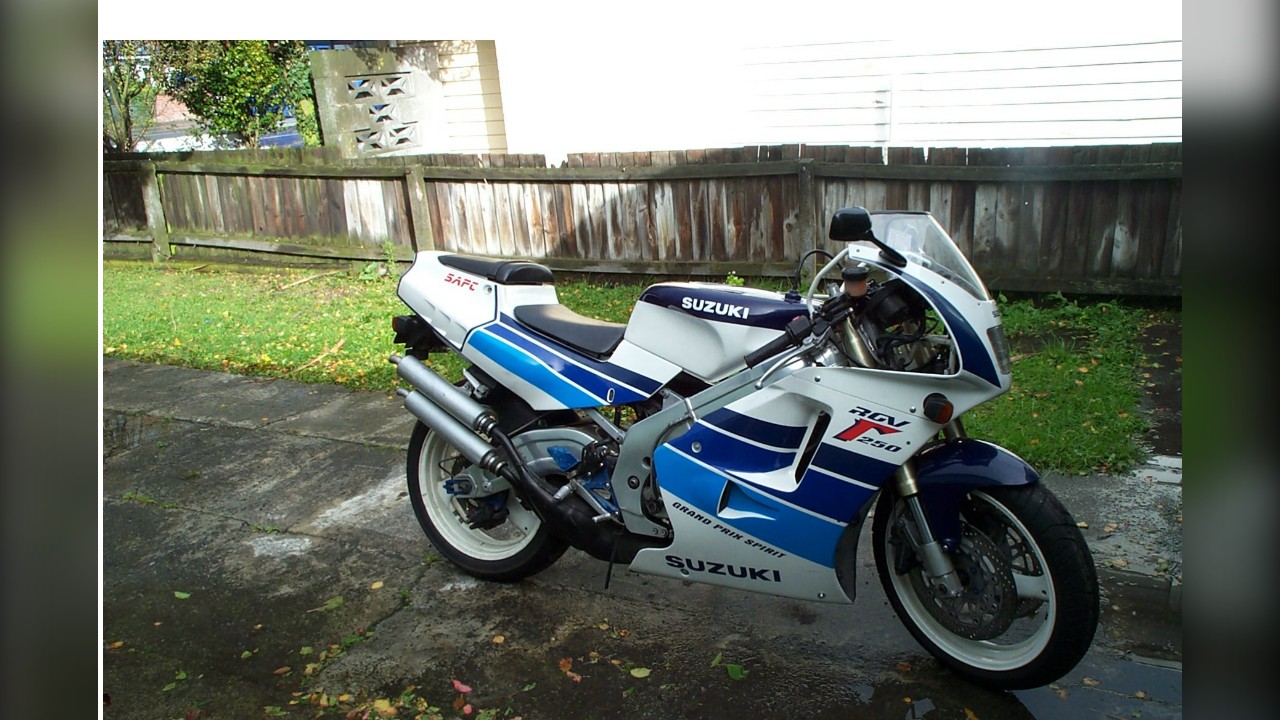
Suzuki built the RGV250 from 1988 to 1998. The first VJ21 version used a 249cc 90-degree V-twin two-stroke, quoted at 58 horsepower in 1988 and 59 in 1989. The VJ22 followed in 1991 with SAPC, Suzuki’s electronic control of the power valves and ignition timing. Suzuki also reshaped the swingarm so both expansion chambers could run out on the right side. Even the early VJ21 drew favorable reviews in the British motorcycle press.
For the final VJ23 version of 1997 and 1998, Suzuki redesigned the engine as a 70-degree V-twin. Suzuki quoted 70 horsepower for the SP model. Meanwhile, Japanese rules held home-market bikes to 45 horsepower, while bikes for other markets made more than 50.
Our take: the RGV250 is a sharp, light two-stroke sport bike from the very end of the era. In our view, owners rode many of them hard on track days, so clean ones are scarce. The VJ23 is the one we’d hunt, since it was the last and most refined version. If you buy one, check whether it’s a restricted Japanese bike, because that changes both its performance and its value.
10. 1970 Husqvarna 250 Cross
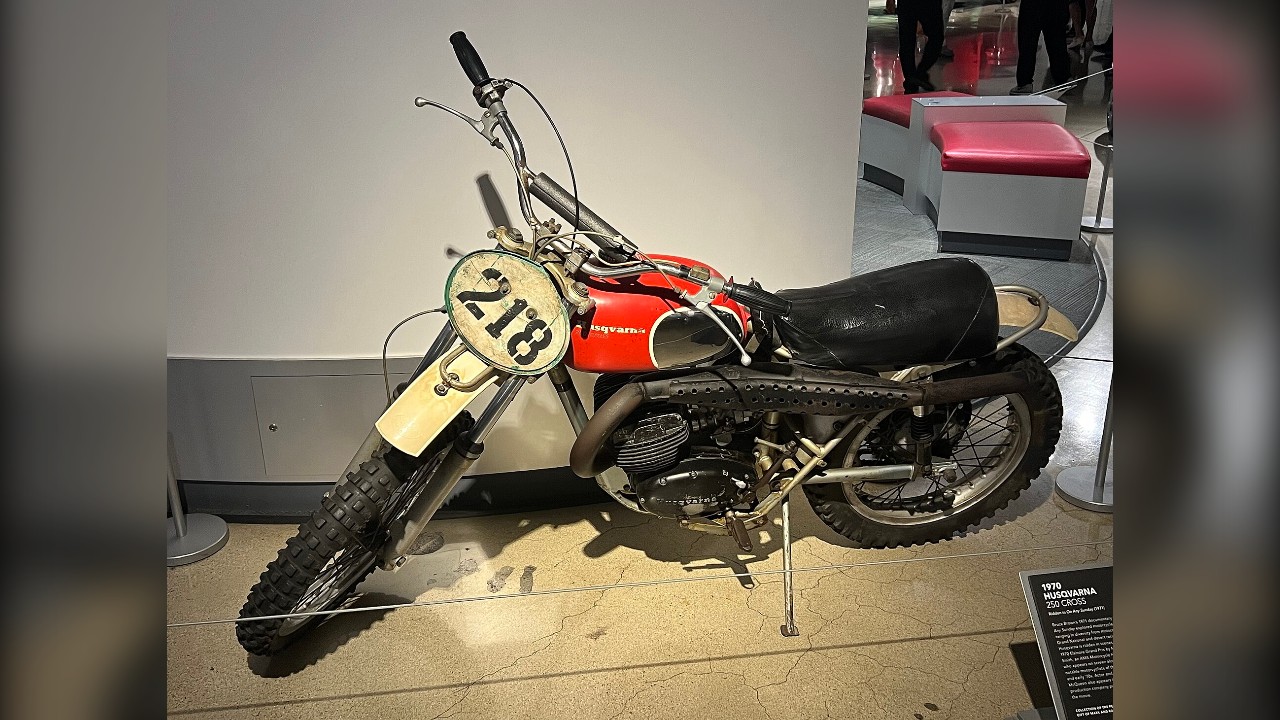
Husqvarna sent reigning 250cc motocross world champion Torsten Hallman to the U.S. in 1966. He won every heat he entered. Then Bruce Brown’s film On Any Sunday boosted Husqvarna’s sales even further. Steve McQueen helped finance the film and rode in it, alongside Mert Lawwill and Malcolm Smith.
The 250 Cross is the air-cooled, premix two-stroke at the center of that story. When one does surface, people notice. For example, a 250 Cross owned by Bruce Brown and displayed at the Petersen Automotive Museum sold through Iconic Motorbike Auctions in June 2025. It went for $7,276 with fees.
Our take: to us, the 250 Cross is the bike that sold motocross to America. It’s light, simple and beautiful in a way modern dirt bikes are not. Even so, these were racing bikes, and a documented example with a film or racing link is very rare. As a result, to our minds, a Husqvarna with a film connection ranks among the most desirable vintage dirt bikes. If you buy one, check the listing year carefully, because that Petersen bike’s listing called it both a 1970 and a 1971.
11. Yamaha TZ350
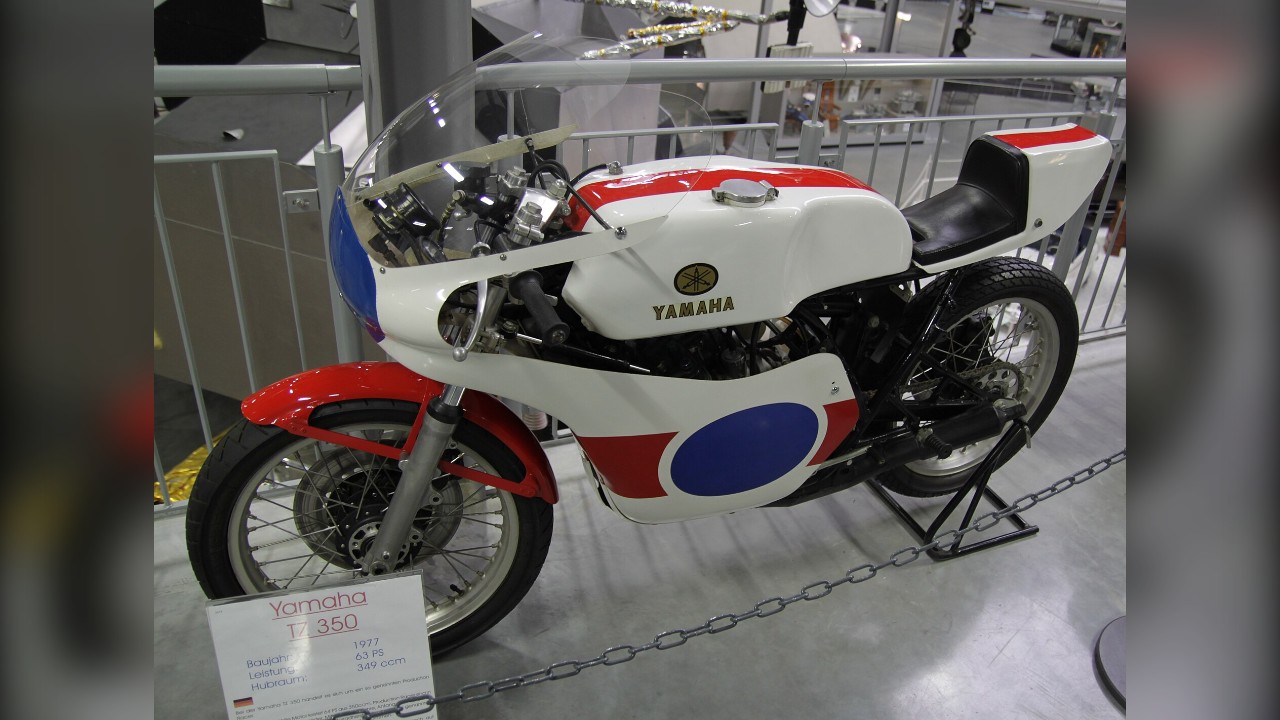
Yamaha built the TZ350 as a series-production road racer from 1973 until 1981, from Model A to Model H. Its 347cc parallel-twin two-stroke made 60 horsepower at 9,500 rpm in Model A form. By Model H, that figure had climbed to 72 horsepower at 11,000 rpm. It ran through a six-speed gearbox and weighed about 115 kilograms dry. Its wheelbase measured roughly 1,331 millimeters, which kept it short and nimble.
The bike changed a lot along the way. Models A and B used twin rear shocks and drum brakes up front. From Model C on, Yamaha switched to a single rear shock and added disc brakes at both ends. In addition, the TZ’s engineering shaped Yamaha’s road two-strokes, including the RD and RZ series.
Our take: the TZ350 was a series-built racer, not a one-off works bike. In our view, that’s exactly why so few survive untouched, since Yamaha built them to race. Two TZ350s sit in Germany’s Technikmuseum Speyer. If you find one, ask which model letter it is, because the twin-shock and monoshock bikes are very different machines.
12. 1962 Greeves 250DCX Sportsman
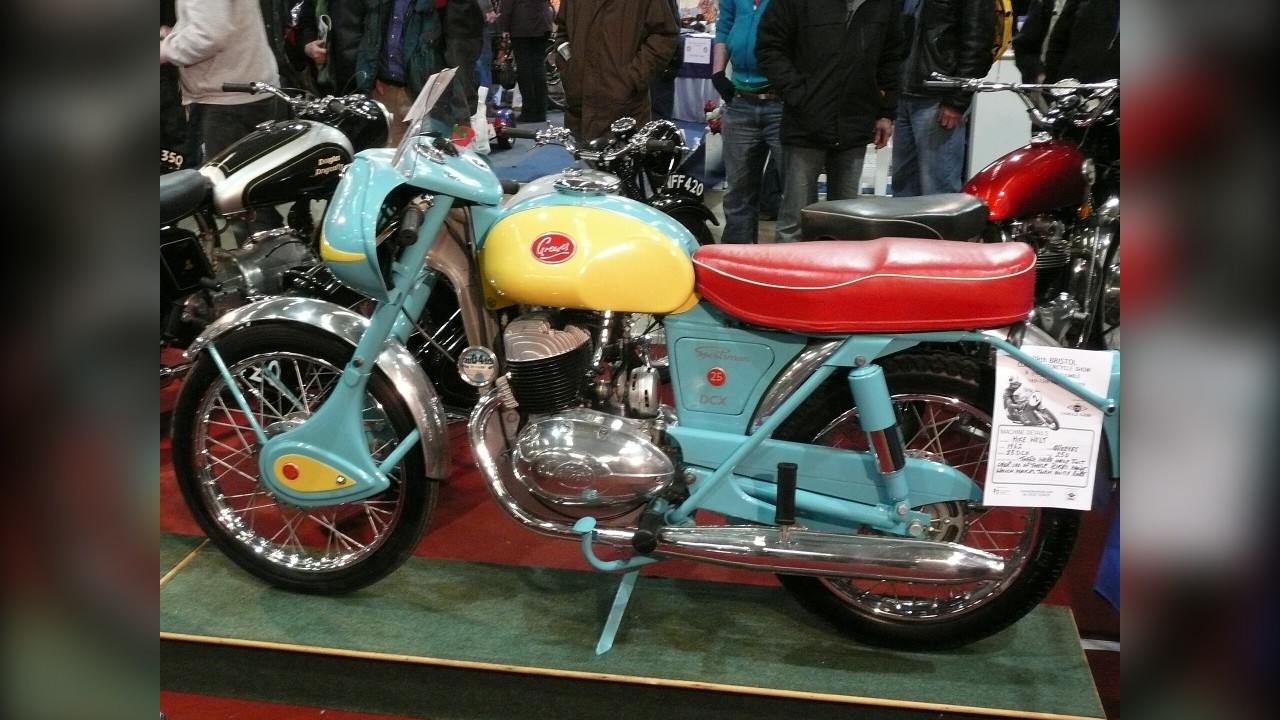
Bert Greeves came to motorcycles after developing the Invacar, a postwar invalid carriage. His company built motorcycles in Thundersley, Essex, from 1954 to 1978. Greeves machines used Villiers two-stroke engines and an unusual frame with a cast-alloy beam. Their leading-link front forks used rubber bushes in torsion instead of steel springs.
The 25DCX Sportsman, however, appears in Greeves’ model lists as a roadster, built only in 1962 and 1963. A sister model, the 32DCX, shared the Sportsman name and the same two-year run. Early Greeves used the Villiers 8E engine, later replaced by the 9E. Then came Villiers twins of 249cc and 324cc. Long after the factory closed, the name returned in 1999 with a replica trials bike.
Our take: the Sportsman is the Greeves most people have never heard of. In our view, its short two-year run means few turn up today. To us, that makes it one of the most interesting British two-strokes of its era. If you find one, check that the cast-alloy beam is free of cracks. Greeves closed in 1978, after Bert Greeves retired and a fire caused financial ruin.
More from Fast Lane Only