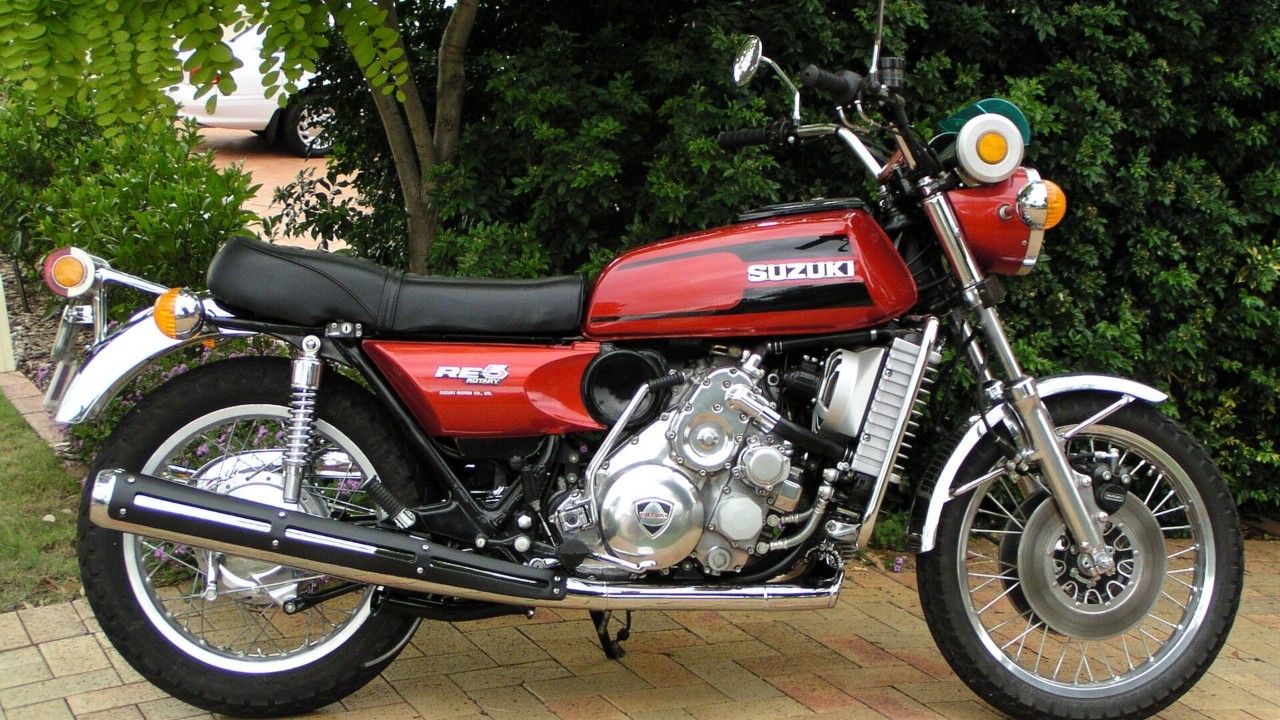
The Suzuki RE5 was Suzuki’s bet that the rotary engine would replace the piston on motorcycles. It packed a 497 cc single-rotor Wankel into a big touring bike, then wrapped it in styling linked to Giorgetto Giugiaro. The first bikes reached dealers in late 1974, and by the end of 1976 Suzuki had walked away from it.
Today the RE5 is one of the very few Wankel motorcycles ever built in real numbers. It is also one of the strangest. The engine, the gauges and even the tail light were designed around the rotary idea, and few bikes from the 1970s look anything like it.
Here is how Suzuki built it, what made it so different, and why such an ambitious machine sold so poorly.
Why Suzuki bet on a rotary
In the early 1970s, the Wankel rotary was touted as the future of motorcycling. Several makers wanted in, and Suzuki moved early. Suzuki signed a license with NSU, the German firm behind the design, in 1970. Model histories say Suzuki was the 20th company to take one, and NSU’s own rotary sedan, the 1967 NSU Ro 80, had already shown the idea on four wheels.
Suzuki then spent more than four years on research and development, according to Cycle News. The prototype was first called the RX-5. As Hagerty UK reports, Suzuki unveiled the bike at the Tokyo Show in late 1973. Suzuki also recruited astronaut Edgar Mitchell to help introduce and endorse it.
The launch did not go smoothly, though. Hagerty says Suzuki pushed US delivery back from October 1974 to the following January, and it lost many orders as a result. Then a carburetor problem led to a recall of every bike sold so far. Meanwhile, the Audrain Automobile Museum notes that the first RE5s appeared in dealerships in late 1974.
Inside the Suzuki RE5’s 497 cc rotor
The heart of the bike was a single rotor sweeping a 497 cc chamber. Suzuki used two cooling systems. Water cooled the outer housing, while oil cooled and lubricated the rotor’s internals. The Audrain museum describes separate oil and water radiators mounted behind the front suspension.
Lubrication was just as involved. The museum counts three separate oil pumps. Model histories describe one of them, an engine-driven metering pump, feeding oil from a tank under the seat into the carburetor at about 100:1. That made the RE5 partly a total-loss oil system, much like a two-stroke.
Fuel came through a two-stage Mikuni downdraft carburetor. Cycle News says it needed five cables and 14 jets. Hagerty UK quotes a claimed 62 bhp at 6,500 rpm. By comparison, Suzuki’s own GT750 made 67 bhp at the same revs from 739 cc. Model histories also list 55.6 lb-ft of torque at 3,500 rpm.
The exhaust ran extremely hot, at up to about 1,700°F. As a result, Suzuki fed it into a large finned manifold that split into two twin-shell pipes with air-cooling ducts. It also fitted heat shields to protect the rider and passenger.
The Giugiaro tin-can styling
Suzuki wanted the RE5 to look as new as its engine. The Audrain museum credits the design to the Italian stylist Giorgetto Giugiaro. Hagerty UK is more cautious and says Suzuki was rumored to have commissioned him. Either way, the result was unlike anything else in a 1975 showroom.
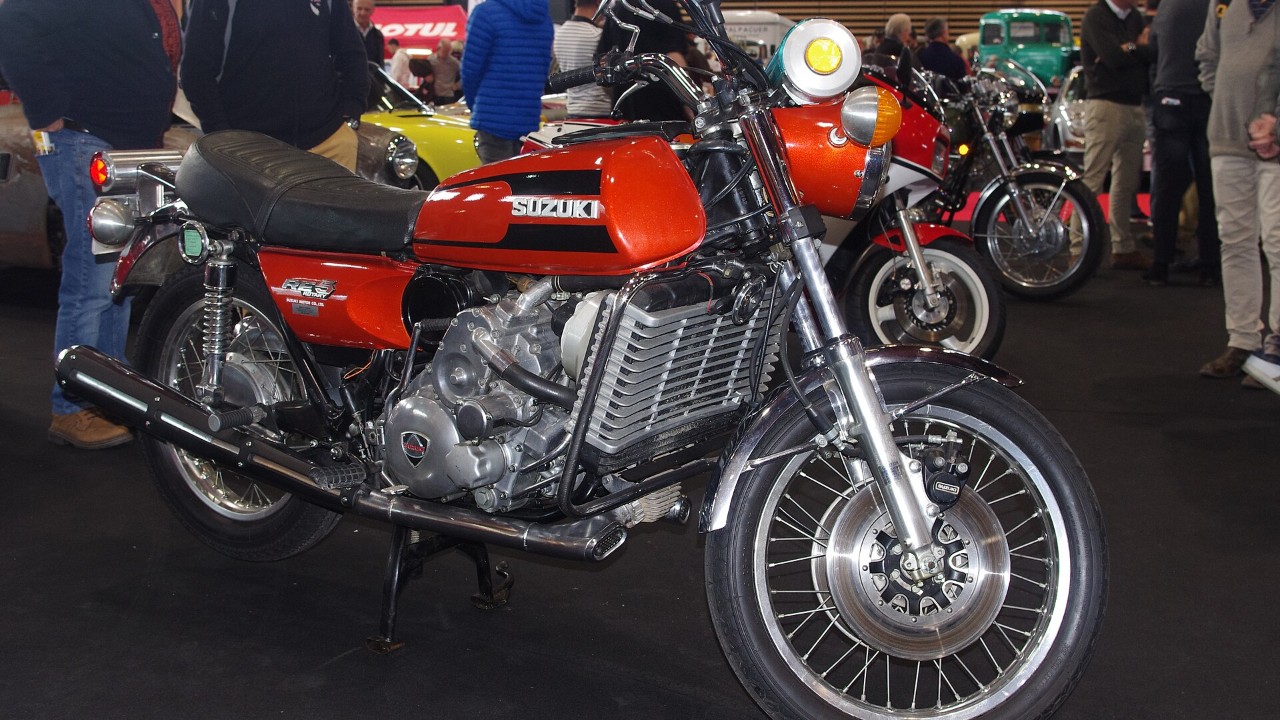
The instruments sat in a cylindrical pod on the handlebars. Its lid could be raised or lowered to protect the gauges, the museum notes. Inside, the “tin can” held warning lights for low fuel and the oil tank, plus a digital gear indicator. The tail light repeated the same tube shape, and round turn signals finished the rotary theme.
Buyers didn’t take to it, however. The museum says poor sales pushed Suzuki to tone the look down. For 1976, the restyled A model gained GT750-style instruments, a new headlight housing, new tail lights and new colors. Many earlier M models were later converted to the plainer look.
On the road and in the showroom
The RE5 was a heavy, expensive machine. Hagerty UK lists a dry weight of 230 kg, or about 507 pounds. In Britain, it cost £1,195, which was more than £300 above the GT750 and only about £50 below Kawasaki’s 903 cc Z1. In the US, Cycle News puts the 1975 list price at $2,475.
Performance was solid but not spectacular. Hagerty gives a top speed of about 110 mph and a standing quarter-mile of about 14.5 seconds. Fuel use was the bigger problem. At around 30 mpg, Hagerty says, the low-fuel light could come on after roughly 70 miles.
The press was split. Cycle World put the RE5 on its February 1975 cover and called it the “smoothest touring machine ever made,” Cycle News recalls. Later, though, the same magazine ranked it last in a comparison against the BMW R90/6 and Kawasaki Z-1 900. Reviewers did praise its steering and handling.
Dealers were another hurdle. Cycle News says many Suzuki shops wouldn’t take on the RE5, because carrying it required a trained mechanic. In addition, the museum notes that three oil pumps confused mechanics used to piston engines. Even the NGK spark plug cost $27 in 1975.
What happened to the Suzuki RE5
Suzuki tried hard to win buyers over. It offered a full engine replacement for any engine problem within 12 months or 12,000 miles. It also restyled the bike for 1976. Even so, sales didn’t recover, and Hagerty UK says Suzuki had abandoned production by the end of 1976.
Estimates of the total vary. Model histories put output at roughly 6,000 bikes, while Cycle News estimates sales at 6,300 to 6,500. Either way, that was a small run for a major Japanese maker. In 1985, Cycle World even named the RE5 among its ten worst motorcycles. The rotary engine itself lived on in cars, and we traced that story in why the rotary engine refused to die.
The unsold bikes lingered for years. By 1980, Cycle News reports, dealers were clearing leftover RE5s at low prices, and one buyer, Sam Costanzo, bought three new-old-stock bikes for $2,700 in total.
More from Fast Lane Only